
died c. 60·Feast April 26
St. Peter of Rates
First Bishop of Braga and Martyr
Overview
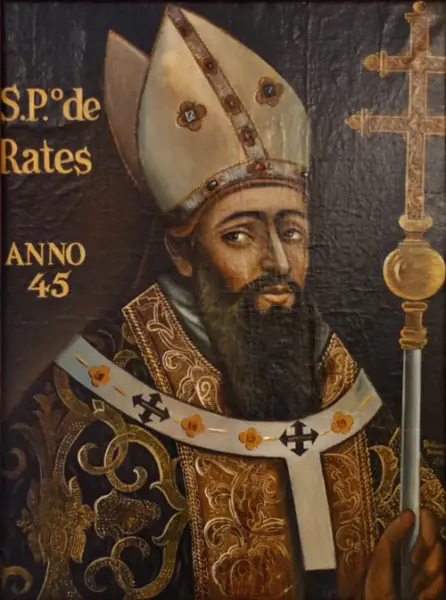
Peter of Rates, known in English also as Peter of Braga, is honored by tradition as the first bishop of Braga, serving between roughly AD 45 and 60. According to the ancient account, James the Great preached in the northwest of the Iberian Peninsula and, during a visit to the Serra de Rates in what is now the municipality of Póvoa de Varzim, ordained the local man Peter as bishop. The old Breviary of Braga and the Breviary of Evora both describe him as a disciple of James who preached in Braga, though the Bollandists regarded this pedigree as purely traditional rather than established history. Peter is said to have been beheaded while laboring to bring the Christian faith to the inhabitants of northern Portugal, winning the crown of martyrdom around the year 60. His cult endured for centuries in the region: in the ninth century a hermit named Felix was said to have discovered his body through a mysterious light, a Romanesque monastery rose over the find, and in 1552 the relics were translated to Braga Cathedral. Devotion persists at fountains in Balasar and Rates associated with his ministry, and his feast is kept on 26 April.
The Complete Life
Ordained by an Apostle
The ancient narrative of the Portuguese church tells that James the Great, one of the Twelve, carried the gospel to the far northwest of the Iberian Peninsula in AD 44, and that among the places he visited was the Serra de Rates in the present municipality of Póvoa de Varzim. There, the tradition holds, the apostle found a local man named Peter and consecrated him for the government of the young church, making him the first bishop of Braga, an office the tradition places between AD 45 and 60. The Breviarium Bracarense, the ancient Breviary of Braga, together with the Breviary of Evora, preserves this account and presents Peter as a disciple of James who preached in the Braga region. Modern scholarship has treated the story with reserve: the Bollandists judged the apostolic connection to be purely traditional, and the chronology strains against what is otherwise known of James's whereabouts. Whatever the verdict of history, the narrative rooted Peter's episcopate in the apostolic age and gave the church of Braga a founding bishop whose memory has been kept liturgically for well over a thousand years. He is venerated in both the Catholic Church and the Eastern Orthodox Church as bishop and martyr.
§ Life
Preacher and Martyr of Northern Portugal
Tradition presents Peter's episcopate as a mission of conversion in the lands between the Douro and the Minho. He is said to have labored to turn the inhabitants of northern Portugal from the worship of the Roman gods to the Christian faith, and it was this preaching that cost him his life. One strand of the account relates that he was beheaded while engaged in converting adherents of the Roman religion; a later local tradition, recorded in the eighteenth century, adds the poignant detail that he was seized and put to death as he drank from the fountain at Balasar, where two shallow indentations in the stone are still shown as the marks of his knees. The year of his death is placed around AD 60, at the close of the episcopate tradition assigns to him. No formal process of canonization exists for a saint of so early an age; he belongs to the company of martyrs honored by the Church from the first generations, and his feast of 26 April has long been kept in the region. At Rates itself a stone by his fountain was believed to cure sterility, and on his feast day pregnant women and female animals were given rest from labor in certain villages.
§ Miraculous fountains
The Hidden Body and the Shrine at Rates
Centuries after the martyrdom, when the memory of the site had faded into legend, the tradition recounts that the martyr's body was found. Felix the Hermit, a fisherman from Villa Mendo, an ancient Roman villa in the region, had withdrawn from the world to the largest hill of the neighborhood, known today as São Félix Hill. Night after night, according to the story, he watched a light shining in the darkness from a distance, and at last, driven by curiosity about its origin, he lighted upon the martyr's remains. Over that place there rose the Romanesque Monastery of Rates, and the relics remained there, guarded by the monastic community, until the year 1552. In that year the body was carried in translation to Braga Cathedral, the see of the diocese Peter was held to have governed, and there it has remained ever since. Modern scientific examination of the remains has suggested that they belong to a child of the ninth century, the era of the supposed discovery, a finding that underscores how the cult absorbed later devotional layers. Yet the shrine at Rates and the cathedral treasury at Braga alike bear witness to the durability of the saint's cult in northern Portugal.
§ The discovery of Peter's body
An Ancient Cult Venerated East and West
Peter of Rates belongs to the earliest stratum of Christian sainthood, honored without any formal canonization process. His cult rests on the devotion of the Portuguese church, preserved in medieval liturgical books such as the Breviary of Braga and the Breviary of Evora, which celebrated him as a disciple of the apostle James and the founding bishop of Braga. He is numbered among the bishop-martyrs of the first Christian generations, and his memory is kept not only by the Catholic Church but also by the Eastern Orthodox Church, a rare double recognition that testifies to the antiquity of his feast. The principal shrine is the Church of Saint Peter of Rates in the parish of Rates, Póvoa de Varzim, near the hill where the body was said to have been found, while his relics repose in Braga Cathedral following their translation in 1552. Popular devotion gathered around the fountains of Balasar and Rates, which the people believed he had used: the Balasar fountain bore the marks of his knees, and the stone at Rates was invoked against sterility. His feast of 26 April long marked a day of rest from labor for expectant mothers in the villages of the region.
§ Life
Timeline
- 44
James the Great is said to have visited the northwest of the Iberian Peninsula and ordained Peter at Serra de Rates.
§ Life
- 45
By tradition he became the first bishop of Braga.
§ Life
- 60
Tradition holds that he was beheaded while converting pagans in northern Portugal.
§ Life
- 1552
His relics were transferred from the Monastery of Rates to Braga Cathedral, where they remain.
§ The discovery of Peter's body
In Their Own Words
purely traditional
The Record
- Symbols
- Bishop's vestments·Palm of martyrdom
- Canonization
- Pre-congregation martyr; venerated since antiquity in the Catholic and Eastern Orthodox churches
Prayer
Bibliography
Show 4 sources
- "Orthodox Europe :: Portugal"
- "Saint Peter of Rates", The Portugal News, August 22, 2022
- López Bardón, Tirso. "Archdiocese of Braga." The Catholic Encyclopedia Vol. 2. New York: Robert Appleton Company, 1907.
- "Portugal", EuroVelo
Profile text adapted from the Wikipedia article, licensed CC BY-SA 4.0.
Pray with this saint every day
Save St. Peter of Rates to your favorites, read the full profile, and get feast-day reminders in the Saints app.
Get the Saints AppFree on the App Store for iPhone and iPad