
1626 – 1667·Feast April 25
St. Peter of Saint Joseph de Betancur
Missionary of Guatemala and Founder of the Bethlehemites
Overview
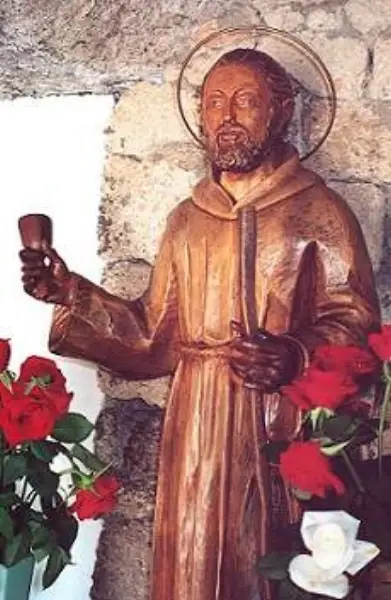
Peter of Saint Joseph de Betancur y Gonzáles, known affectionately as Hermano Pedro or Santo Hermano Pedro, was a Spanish missionary and religious founder whose charity transformed the city of Antigua Guatemala. Born at Vilaflor on Tenerife in 1626 to a family of humble shepherds with descent from both the conqueror Jean de Béthencourt and the aboriginal Guanche people, he spent his childhood tending sheep and praying in a coastal cave. In 1649, freed from indenture after his father's estate was seized for debt, he sailed for the New World. Destitute on arrival in Guatemala, he found his footing through the Franciscans, taught poor children, and eventually discovered that the religious life he sought would not come through priesthood or study. As a Franciscan tertiary he took the name Peter of Saint Joseph, turned a hut into a hospital for the convalescent poor, and gathered companions into the Order of Our Lady of Bethlehem, the Bethlehemites. He begged for prisoners, endowed early Masses for laborers, and rang a bell through the night streets for the souls in purgatory. Worn out by work and penance, he died at forty-one in 1667. Canonized in 2002, he is honored as the first saint of the Canary Islands, Guatemala, and Central America, and as a forerunner of human rights.
The Complete Life
A Shepherd of Tenerife
Peter was born at Vilaflor on the island of Tenerife on 21 March 1626. His parents, Amador Betancourt and Ana Gonzáles Betancurt, had five children, of whom he was one. His father descended from Jean de Béthencourt, the French knight who conquered the Canary Islands for Castile in the early fifteenth century, and in the twenty-first century research revealed that the family also carried the blood of the Guanches, the islands' aboriginal inhabitants. Poverty marked the household: the flock the family kept was its only source of income, and as a small child Peter worked as a shepherd, caring for it. In the south of the island he prayed in a small cave near the present town of El Médano, In it he wintered his cattle, poured out his prayers, and hid from the pirates who raided those coasts. The rhythms of transhumance from coast to summit, an inheritance of the Guanche way of life, entered him early and would later become part of his iconography in the Canarian shepherd's spear. In 1638 disaster struck: a moneylender seized his father's estate for unpaid debt, and Peter was bound in indenture to the creditor's service. During those hard years his eldest brother Mateo emigrated to Spain's colonies in the New World, perhaps settling in Ecuador, opening the door across the Atlantic that Peter would one day walk through.
§ Biography
Across the Atlantic in Search of a Calling
In 1649, at twenty-three, Peter was freed from his indenture and resolved to follow his brother to the Spanish colonies. He sailed from the port of Santa Cruz de Tenerife, pausing first, it is believed, to pray in the Church of San Francisco de Asís, the port church favored by emigrants departing for the New World. The voyage tested him before his mission began: by the time he reached Havana he was out of money, and he spent a year serving a priest who, like himself, came from Tenerife. He then worked passage on a ship that docked at Honduras and walked the rest of the way to La Antigua Guatemala, capital of the Kingdom of Guatemala. He arrived so destitute that he stood in the bread line the Franciscan friars ran to feed the poor. An uncle in the city found him work in a local textile factory, but the factory could not hold a heart set on God. In 1653 he enrolled in the Jesuit College of San Borgia to study for the priesthood, and after three years of struggling with the material he withdrew, accepting that academic life was not his road. He served as sacristan in a church of the Blessed Virgin, rented a house in a suburb of the city, and began teaching reading and catechism to poor children. Unable to receive holy orders, he became a Franciscan tertiary at the friary in Antigua, taking the religious name Peter of Saint Joseph.
§ To New Spain
Hospitals, Schools, and the Bethlehemites
Peter's apostolate took shape among the abandoned. He made his rounds of hospitals and prisons, sought out men without work, and gave his time to the young. In 1658 the turning point arrived: a hut came into his hands, and he turned it into a house of recovery for the poor who, sent away from the city hospital still unhealed, had nowhere to mend. His zeal opened the purses of benefactors, and bishop and governor alike furnished all that he needed. Within three years, patrons had bought the houses surrounding his dwelling and erected a larger hospital on the site, with Peter himself laboring alongside the masons. The house for convalescents came under the patronage of Our Lady of Bethlehem. Beside it there arose in time a refuge for those without homes, a school for needy children, an oratory, and lodging for priests. Other tertiaries joined him; although he trained his first assistants personally and had no ambition to found a community, the work demanded structure. He wrote an adaptation of the Rule of St. Augustine for his followers, even though he remained a Franciscan, and the women teaching the children adopted the same rule. From this emerged the Order of Our Lady of Bethlehem, the Bethlemitas, who tend the sick, serving in the city's other hospitals while Peter continued to befriend the poor. He also extended his compassion to prisoners, begging for them through the city every Thursday and visiting them in their cells.
§ The Bethlehemites
The Man Who Was Charity
Peter's spiritual life joined Franciscan poverty with an intuition for the needs of the marginalized that has led writers to call him a precursor of human rights. He devoted himself to lepers, prisoners, slaves, and indigenous people, and his labor for the most abandoned invites comparison with what Mother Teresa would undertake centuries afterward in Kolkata. He begged alms to endow Masses celebrated by poor priests, and endowed early-morning Masses so that working people would not miss the Eucharist on account of their labor. At night he walked the streets of Antigua ringing a bell, urging passersby to pray for the souls in purgatory. Two centuries before the dogma was defined, he was known as a defender of the Immaculate Conception, and his penances were severe enough that his death at forty-one was attributed to exhaustion from labor and penance alike. Some remember him, too, as the one who carried to the Americas the Christmas Eve posadas, the procession in which Mary and Joseph go from door to door seeking a place to stay, a custom that took root in Mexico and Central America. The historian David Vela, his biographer, called him 'doctor in humility' and 'wise in mercy'; tradition remembers him simply as 'the man who was charity'.
§ Later years
Exhausted by Labor and Penance
The last years of Peter's life were spent in unbroken service at Antigua Guatemala, where his Bethlehemite community now carried forward the hospitals and schools he had raised. The pace he kept was punishing: nightly processions for the souls of the dead, weekly begging for prisoners, daily care of the sick poor, all sustained on little food and heavy penance. On 25 April 1667 he died at the age of forty-one, and his contemporaries said plainly that work and penance had worn him out. The Capuchin Friars asked that he be laid to rest in their church, the San Francisco Church in Antigua, and for a long while the faithful kept a devoted vigil at his remains there, praying at the tomb of one they already reckoned a saint. He had spent barely eighteen years in Guatemala, yet in that span he had founded an order, transformed the city's care of the sick and the imprisoned, and earned the title by which history knows him: the Apostle of Guatemala. His feast of 25 April is often transferred to 24 April, since the 25th belongs to Mark the Evangelist, and in Tenerife he is also celebrated on 29 June, the feast of Peter the Apostle.
§ Later years
From Servant of God to First Canarian Saint
Devotion to Peter moved through the ordinary channels of the Church with unusual patience. The inquiry into his life began on 6 August 1729, when he received the title of Servant of God; the declaration of heroic virtue on 15 July 1771 made him Venerable; and the beatification followed on 22 June 1980, conferred by Pope John Paul II at St. Peter's Basilica. For canonization the Church accepted as the required miracle the healing of a child suffering from intestinal lymphoma, a child who, in a fitting providence, was a native of Peter's own birthplace, Vilaflor. On 30 July 2002 Pope John Paul II canonized him in Guatemala City, the land of his apostolate, proclaiming him the first Tenerifean and Guatemalan saint and, with him, the first native saint of the Canary Islands and of Central America. In his homily the Pope praised Peter's humble spirit and austere life, holding up before the faithful a heritage that must never be lost and a life worth imitating anew. His major shrines are the Cave of Santo Hermano Pedro near El Médano in southern Tenerife, a popular pilgrimage site where votive offerings are presented, the Sanctuary of the Santo Hermano Pedro built on his birthplace in Vilaflor, and the San Francisco Church in Antigua Guatemala, where his tomb lies.
§ Veneration
Symbol of Two Homelands
Peter of Saint Joseph de Betancur has become an emblem of identity for two worlds. In the Canary Islands he fills the oral tradition, above all in the tales bound up with his shepherd's labors and his hidden mysticism at the cave in the Chasna district of southern Tenerife, and his figure stands, alongside the Virgin of Candelaria, as a symbol of Canarian religious culture; among canonized saints he is the one most often chosen to represent the entire archipelago, and civic and religious authorities have proposed him as a co-patron of the islands. His Guanche ancestry and his connection to aboriginal lifeways such as seasonal transhumance tie him to the islands' deepest past. In Guatemala he remains the Apostle of the nation, the founding figure of a tradition of care for the poor that his Bethlehemite successors continue. A pilgrimage route in Tenerife, the Hermano Pedro's Way, retraces the path he walked in his youth between Vilaflor and the southern coast. In June 2026, during an apostolic journey to Spain that coincided with the four hundredth anniversary of Peter's birth, Pope Leo XIV reminded migrants at the Las Raíces center in Tenerife of Peter and José de Anchieta as migrants who set out on unknown roads to proclaim the Gospel in the Americas, and the relics of the two saints stood upon the altar during the farewell Mass the Pope offered in Santa Cruz de Tenerife.
§ Santo Hermano Pedro and the Canarian identity
Timeline
- 21 Mar 1626
Born at Vilaflor on the island of Tenerife, one of five children.
§ Biography
- 1638
His father's estate was seized by a moneylender, and Peter was indentured to the man's service.
§ Biography
- 1649
Freed from indenture at age twenty-three, he sailed from Santa Cruz de Tenerife for the New World.
§ To New Spain
- 1653
Enrolled in the Jesuit College of San Borgia in Guatemala to study for the priesthood.
§ To New Spain
- 1656
Withdrew from the Jesuit college after three years, unable to master the material.
§ To New Spain
- 1658
Received a hut that he converted into a hospital for poor convalescents.
§ Biography
- 1661
A larger hospital was erected on land purchased around his dwelling, under the patronage of Our Lady of Bethlehem.
§ Biography
- 25 Apr 1667
Died at Antigua Guatemala, aged forty-one, reportedly exhausted by labor and penance.
§ Later years
- 6 Aug 1729
His cause was formally opened, granting him the title of Servant of God.
§ Veneration
- 15 Jul 1771
Declared Venerable.
§ Veneration
- 22 Jun 1980
Beatified by Pope John Paul II at St. Peter's Basilica in Vatican City.
§ Veneration
- 30 Jul 2002
Canonized by Pope John Paul II in Guatemala City.
§ Veneration
In Their Own Words
a heritage which must not be lost; we should always be thankful for it and we should renew our resolve to imitate it
doctor in humility
the man who was charity
The Record
- Major works
- Order of Our Lady of Bethlehem (Bethlehemites)·Hospital for convalescent poor, Antigua Guatemala·Shelter for the homeless and school for the poor·Adaptation of the Rule of St. Augustine for his community
- Patron of
- Canary Islands·Guatemala·Central America·catechists of Guatemala·the homeless·those who serve the sick
- Symbols
- Walking stick·Bell·Canarian shepherd's spear
- Canonization
- Canonized by Pope John Paul II on 30 July 2002 in Guatemala City
Prayer
Bibliography
Show 6 sources
- Besse, Jean. "Bethlehemites." The Catholic Encyclopedia, Vol. 2. New York: Robert Appleton Company, 1907.
- "St Peter de Betancurt", Vatican
- Foley OFM, Leonard. "St. Pedro de San José Betancur", Saint of the Day: Lives, Lessons and Feast, revised by Pat McCloskey OFM, Franciscan Media
- Pope John Paul II, Homily on the Occasion of the Canonization of Brother Pedro de San Jose de Betancurt, Guatemala City, July 30, 2002
- Index ac status causarum beatificationis servorum dei et canonizationis beatorum (in Latin). Typis polyglottis vaticanis. January 1953. p. 187.
- "Words of greeting of his holiness Pope Leo XIV. "Las Raíces" Center (Tenerife)", vatican.va, 12 June 2026
Profile text adapted from the Wikipedia article, licensed CC BY-SA 4.0.
Pray with this saint every day
Save St. Peter of Saint Joseph de Betancur to your favorites, read the full profile, and get feast-day reminders in the Saints app.
Get the Saints AppFree on the App Store for iPhone and iPad