
1205 – 1252·Feast April 6 (Dominicans keep June 4)
St. Peter of Verona
Dominican Preacher, Inquisitor, and Martyr
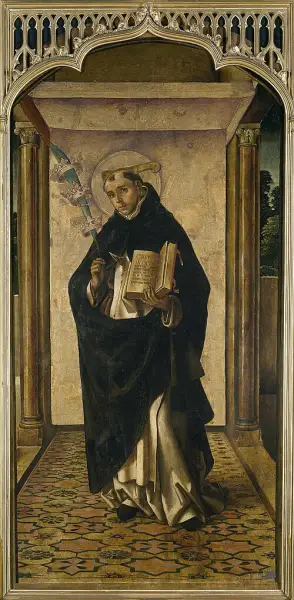
Overview
Peter of Verona, universally known as Saint Peter Martyr, was a Dominican friar whose preaching against heresy made him one of the most celebrated churchmen of thirteenth-century Italy, and whose assassination in 1252 made him the swiftest canonized saint in papal history. Born at Verona on 29 October 1205 into a household in which sympathy for the Cathar cause may have lingered, he kept his Catholic faith through a Catholic schooling and studies at Bologna, met Dominic of Osma at the age of fifteen, and joined the Order of Preachers. From the 1230s he preached against Catharism across northern and central Italy, evangelizing nearly the whole peninsula from Rome to Como. Pope Gregory IX made him General Inquisitor for northern Italy in 1234; in 1251 Innocent IV conferred on him the inquisitorial office in Lombardy, praising the austerity of his life and teaching, his power in the pulpit, and his burning devotion to right belief. The single act of his tenure that the record preserves was an act of mercy, a grant of clemency to those who owned to heresy. On 6 April 1252, returning from Como to Milan, he was murdered near Barlassina by the assassin Carino of Balsamo, hired by Milanese Cathars. Dying, he recited the Creed and, according to legend, wrote its first words in his own blood. Canonized at Perugia on 9 March 1253 by Pope Innocent IV, he rests in the Church of Sant'Eustorgio in Milan.
The Complete Life
A Catholic Son in a Divided House
Peter was born in Verona on 29 October 1205, into a family that was perhaps sympathetic to the Cathar heresy, the dualist movement that commanded widespread allegiance in thirteenth-century northern Italy. Whatever the sympathies of his household, Peter was sent to a Catholic school, and the faith he received there proved decisive. He went on to the University of Bologna, the great law school of the age, where it was said he maintained his orthodoxy amid an environment in which many students were drawn to heterodox currents. At the age of fifteen he met Dominic of Osma, the founder whose new Order of Friars Preachers had been created precisely to preach the Catholic faith to audiences contested by the Cathars. The encounter shaped his life: Peter joined the Order of the Friars Preachers and devoted himself to preaching. His earliest biographer, Thomas Agni da Lentini — a Dominican who governed Cosenza as archbishop before ascending to the patriarchate of Jerusalem — had shared long years of common life with Peter and ruled over him as superior, so the account of his formation rests on close personal knowledge. From Verona's divided city, where heresy and orthodoxy lived side by side, rose the man who would become the most famous anti-heretical preacher of his century.
§ Biography
The Friar Preacher
In the Dominican habit Peter's preaching won him fame through the north and center of the peninsula. From the 1230s onward he preached against heresy, and especially against Catharism, which had many adherents in the region. His gifts did not go unnoticed at the papal court: in 1234 Pope Gregory IX appointed him General Inquisitor for northern Italy, an office he exercised in tandem with an evangelizing circuit that brought him through nearly every part of the peninsula, his voice heard at Rome, then at Florence, at Bologna, at Genoa, and at Como. Crowds came out to meet him and followed him from place to place, and his conversions were numerous, including many Cathars who returned to the Catholic Church. In his sermons he denounced not only open heresy but also the complacency of baptized Catholics who professed the faith in words and contradicted it in their deeds. His influence extended to the governance of religious life itself: in 1243 he urged the pope to approve the newly founded Servites, adding his weight to one of the emerging orders of penitential reform, and around 1240 he is credited with founding the Venerabile Arciconfraternita della Misericordia di Firenze, the Florentine confraternity of mercy whose lay descendants still serve the city. In 1245 he led two battles against the Cathars in Florence, in both of which he was victorious.
§ Biography
Inquisitor in Lombardy
In 1251 Pope Innocent IV set his seal upon Peter's reputation, enumerating before the Church the virtues of the man — the austerity of his life and teaching, his gift for the pulpit, his fervor for the Catholic faith as handed down — and conferred on him the inquisitorial office in Lombardy, the heartland of Cathar strength in Italy. He bore the office for roughly half a year; whether any cause ever came to trial under him cannot now be determined. The one act of his tenure the record preserves was merciful: he granted clemency to those who owned to heresy or inclined toward it, a fact that complicates any simple picture of the fiery inquisitor and suggests a pastor seeking reconciliation over condemnation. Yet his success in winning converts had earned him deadly enemies. Cathars of Milan formed a plot upon his life and found their instrument in a hired killer, Carino of Balsamo, whose accomplice was Manfredo Clitoro of Giussano. On 6 April 1252, Peter journeying back from Como toward Milan, the pair trailed him to a solitary place by Barlassina. Carino's axe came down upon Peter's skull; he then turned on Domenico, a friar of Peter's own brotherhood, leaving him mortally wounded. That brother was borne to Meda and died five days on. The city that had hired his killers could not silence the faith they died defending; within eleven months the martyred inquisitor was a canonized saint.
§ Biography
The Dying Confession of Faith
The account of Peter's death became the anchor of his cult. Peter raised himself to his knees beneath the blow that had split his skull and began the Creed's first article, surrendering his blood to God as a sacrifice. According to legend, with fingers dipped in that blood he traced upon the earth the confession's opening words, Credo in unum Deum: I believe in one God. The axe had sheared away the crown of his head; yet the sworn depositions gathered at the inquest into his killing attest that the Creed was already upon his lips from the first moment of the assault, anchoring the legend in evidence given under oath. Dominican tradition preserves other marks of his interior life: it relates that Peter kept converse with the saints themselves, the virgin martyrs Catherine, Agnes, and Cecilia among them — companions befitting a preacher who devoted himself to virginity and doctrinal combat. A beloved story relates that once, preaching to a vast crowd under a burning sun, he was challenged by heretics to procure shade for his listeners; as he prayed, a cloud came over the listening throng. Wonders were ascribed to him while he lived, and more still once he had shed his blood. In art he carries the instruments of his death — the hatchet, cleaver, or sword in his head — together with the words of the creed he died professing.
§ Legends
The Fastest Saint in History
Milan received his body and enshrined it in the church of Sant'Eustorgio; there Balduccio Pisano wrought the rich mausoleum that honors him, housed since the eighteenth century within the Portinari Chapel. On 9 March 1253, eleven months after the murder at Barlassina, Pope Innocent IV canonized Peter at Perugia — the fastest canonization in papal history, a measure of how decisively the Church judged his life and death. His feast was assigned to 6 April, the day of his martyrdom, though the Dominicans celebrate it on 4 June. From 1586, when the feast was inserted into the General Roman Calendar, until 1969, when it was struck from the calendar, its worldwide observance judged of modest international significance; throughout those centuries the universal celebration fell on 29 April, chosen because the April date would too often conflict with the Easter Triduum. In Milan his cult centered on the shrine at Sant'Eustorgio, while in Verona the Church of Santa Maria Antiqua is co-entitled to him, and the sculptures on the great door of Sant'Anastasia, the Dominican church of his native city, represent scenes from his life. Even his assassin belongs to the story: Carino repented, confessed, joined the Dominican convent of Forlì as a lay brother, and is honored locally as Blessed Carino of Balsamo.
§ Veneration
The Martyred Inquisitor in Art and Memory
Few medieval saints have commanded so sustained an artistic afterlife. Lorenzo Lotto painted the Madonna and Child with St Peter Martyr; Giovanni Bellini depicted The Assassination of Saint Peter Martyr; Antonio Vivarini portrayed the fire miracle of the saint; and portraits such as Friar Angelo Ferretti as Saint Peter Martyr show how his distinctive iconography — the Dominican habit, the cleaver in the head, the creed written in blood — entered the visual imagination of Europe. His cult shaped the order he served, becoming for the Friars Preachers the very type of the preaching friar's vocation carried to its ultimate price, and his patronage extends to the Order of Preachers, to inquisitors, and to midwives, as well as to Lombardy, Como, Cremona, the Duchy of Modena and Reggio, and Guaynabo in Puerto Rico. Historians have continued to study him closely: his first biography came from his friend and superior Thomas Agni da Lentini, modern scholarship owes foundational studies to Antoine Dondaine, and Donald Prudlo's The Martyred Inquisitor has renewed attention to his life and cult, including the remarkable conversion of his own murderer. As the patron of a controversial office, he remains a figure whose memory invites both veneration and rigorous historical inquiry.
§ Veneration
Timeline
- 29 Oct 1205
Born at Verona to a household that may have harbored sympathy for Catharism.
§ Biography
- 1220
At the age of fifteen, while studying at the University of Bologna, he met Dominic of Osma.
§ Biography
- 1234
Appointed General Inquisitor for northern Italy by Pope Gregory IX.
§ Biography
- 1240
Credited with founding the Venerabile Arciconfraternita della Misericordia di Firenze around this year.
§ Biography
- 1243
Urged upon the pope his approval of the newly founded Servites.
§ Biography
- 1245
Led two victorious battles against the Cathars in Florence.
§ Biography
- 1251
Appointed Inquisitor in Lombardy by Pope Innocent IV, who praised his virtues.
§ Biography
- 6 Apr 1252
Assassinated near Barlassina by Carino of Balsamo while returning from Como to Milan.
§ Biography
- 9 Mar 1253
Canonized by Pope Innocent IV at Perugia, the fastest canonization in history.
§ Veneration
- 1586
His feast, assigned to 29 April, was inserted into the General Roman Calendar.
§ Veneration
- 1969
The feast was removed from the General Roman Calendar on grounds of the saint's limited international importance.
§ Veneration
In Their Own Words
Credo in unum Deum
The Record
- Major works
- Venerabile Arciconfraternita della Misericordia di Firenze (co-founder credit, c. 1240)·Rubricae super quartum et quintum decretalium (manuscript work attributed to him)
- Patron of
- Order of Preachers·inquisitors·midwives·Lombardy·Como·Cremona·Duchy of Modena and Reggio·Guaynabo, Puerto Rico
- Symbols
- Dominican habit·hatchet, cleaver, or sword in his head·severe head wound·the words Credo or Credo in unum Deum
- Canonization
- Canonized by Pope Innocent IV on 9 March 1253 at Perugia, eleven months after his death — the fastest canonization in history
Prayer
Bibliography
Show 7 sources
- "Saint Peter of Verona", Dominican Shrine of St. Jude
- Allaria, Anthony. "St. Peter of Verona." The Catholic Encyclopedia. Vol. 11. New York: Robert Appleton Company, 1911
- Henry Charles Lea, A History of the Inquisition of the Middle Ages (Macmillan, 1887)
- "St. Peter of Verona", Dominican Sisters of St. Cecilia
- Prudlo, Donald (2008). The Martyred Inquisitor: The Life and Cult of Peter of Verona (martyred 1252). Ashgate Publishing, Ltd. ISBN 978-0-7546-6256-3
- Martyrologium Romanum (Libreria Editrice Vaticana 2001, ISBN 88-209-7210-7)
- Dondaine, Fr. Antoine, O.P. "Saint Pierre Martyr" Archivum Fratrum Praedicatorum 23 (1953): 66-162
Profile text adapted from the Wikipedia article, licensed CC BY-SA 4.0.
Pray with this saint every day
Save St. Peter of Verona to your favorites, read the full profile, and get feast-day reminders in the Saints app.
Get the Saints AppFree on the App Store for iPhone and iPad