
1680-1747·Feast July 9 (with the Martyr Saints of China)
St. Peter Sanz
Dominican Bishop and Martyr
Overview
Pere Sans i Jordá was born on 22 September 1680 at Asco in Catalonia, professed as a Dominican at Lerida in 1697, and ordained a priest on his twenty-fourth birthday in 1704. Volunteering for the missions, he spent 1713 to 1715 in the Philippines learning Chinese before entering China itself, where he would labour for more than thirty years. In January 1728 Rome's missionary congregation named him Coadjutor Vicar Apostolic of Fujian; he was consecrated on 22 February 1730, titular bishop of Maurocastrum, and succeeded as Vicar Apostolic in January 1732 upon the death of Magino Ventallol. In 1741 the imperial authorities arrested him together with four Dominican companions; torture and long imprisonment at Fuzhou followed. He was beheaded there on 26 May 1747, and when word arrived in October 1748 that Rome had named one of his companions his coadjutor bishop, the remaining friars were put to death at once. Leo XIII beatified the group in 1893, and John Paul II counted them among the Martyr Saints of China, canonized on 1 October 2000, whose shared feast falls on 9 July.
The Complete Life
Early Life
Pere Sans i Jordá was born on 22 September 1680 at Ascó, in the Ribera d'Ebre district of Catalonia, into the Spain of the late Habsburg years and the even later Habsburg ones. At seventeen, in 1697, he professed vows as a Dominican at Lerida, and, theology finished, he was ordained priest on his twenty-fourth birthday, 22 September 1704. The Catalan Dominican province in that generation sent a steady stream of its men to the Far East, and Sanz belonged to the last cohort of that great missionary era, joining an enterprise already two centuries old when he entered it and already watered with the blood of his predecessors in China and Japan. Nothing more is recorded of his family or his boyhood beyond the fact of his Catalan birth; the man who emerges later in the records is fully formed, a friar of finished studies and a fixed intention toward the missions.
Conversion and Vocation
Sanz volunteered for the missions and was accepted for China. In 1713 he was sent first to the Philippines to prepare, and there he studied Chinese for two years before entering the empire with a small band of fellow friars. The ministry he then began in Fujian lasted well over thirty years, without any recorded return to Europe. In January 1728 the Roman congregation charged with the missions named him Coadjutor Vicar Apostolic of Fujian, and he was consecrated bishop on 22 February 1730 with the titular see of Maurocastrum, the consecration performed by the Bishop of Nanking with the bishops of Macau and of Beijing as co-consecrators. In January 1732, on the death of Magino Ventallol — who had governed the vicariate for thirteen years without ever managing to be consecrated — Sanz succeeded as Vicar Apostolic, and bore the full weight of the Chinese church's most difficult decades.
Mission and Ministry
Sanz's long ministry in Fujian was exercised under the shadow of the imperial prohibitions that followed the Chinese Rites controversy and the Yongzheng emperor's expulsion edicts. Vicars apostolic in that era were missionaries first and administrators second: they moved constantly, ordained native clergy, kept the sacraments alive in villages that might see a priest once a year at best, and corresponded with Rome through slow and dangerous channels. Sanz governed the Fujian vicariate through the persecutions of the 1730s and 1740s, years in which the Christian communities of the province were periodically harried, their chapels ruined, and their pastors hunted from district to district. That he survived in office for fifteen years as bishop of a forbidden church, and died at last by sentence rather than by chance, testifies to a rare combination of prudence and nerve, and the record of his long survival is itself the best evidence of how the Fujian mission was carried on.
Trial and Final Years
In 1741 the imperial authorities arrested Sanz together with four other Dominican friars. The five suffered torture and long imprisonment at Fuzhou, the provincial capital, where they were held together and visibly. Sanz, the senior and most visible of the group, was finally beheaded there on 26 May 1747, after six years of confinement. The story did not quite end with him: in October 1748 word reached the prison that the Holy See had named one of his surviving companions as coadjutor bishop, and on that news the remaining friars were executed at once. The imperial logic was plain — a church that could still appoint bishops behind prison walls was not yet broken — and the answer to it, on the imperial side, was the scaffold. Sanz had thus seen the persecution of his church from both sides of the prison wall — first as pastor in hiding, then as its most distinguished captive.
Canonization
Sanz and his four Dominican companions were beatified by Leo XIII on 14 May 1893, in the series of nineteenth-century beatifications of the Chinese martyrs. On 1 October 2000 Pope John Paul II canonised them among the one hundred and twenty saints collectively called China's martyr saints, to whom the common feast of 9 July was assigned for the whole church of China's martyrs. Previously their own proper feast had been kept on 3 June, a date of Dominican significance, and Dominicans keeping the General Roman Calendar of 1960, with its older rite, still keep that earlier date under the permissions clarified in Summorum Pontificum. The double dating is a small monument in itself: it marks the moment when the cause of the Chinese martyrs, long a Dominican and Franciscan affair, passed into the general calendar of the whole Church. In Catalan Spain his memory has also been kept, as a son of the Ebre district who carried its faith to the far side of the world.
Legacy
Peter Sanz is remembered as the foremost of the Dominican bishops martyred in China, and his death in 1747 closes the heroic age of the Fujian mission. For the Dominican order he is one of the great links in a chain running from the first missionaries of the 1630s to the martyrs of 1900, and for the Chinese church he belongs to the long pre-history of its native hierarchy. His life also documents, more clearly than most, the mechanics of persecution under the Qing: arrest by imperial authority, torture and imprisonment at the provincial capital, execution of the bishop first and of his clergy when Rome's response made further custody pointless. For the historian of missions his file is unusually complete — profession, preparation in the Philippines, thirty years of ministry, episcopal succession, arrest and death can all be dated — which makes him a fixed point in the chronology of the eighteenth-century Chinese church.
Timeline
- 22 Sep 1680
Born at Asco on the Ebro in Catalonia, Spain.
§ Early life
- 1697
Professed religious vows as a Dominican at Lerida.
§ Early life
- 22 Sep 1704
Ordained a priest after finishing his theological studies.
§ Early life
- 1713
Sent to the Philippines to prepare for the China mission, studying the Chinese language there for two years.
§ Mission in China
- Jan 1728
Appointed Coadjutor Vicar Apostolic of Fujian by the Roman congregation that oversees the missions.
§ Mission in China
- 22 Feb 1730
Consecrated a bishop for the titular see of Maurocastrum by the Bishop of Nanking.
§ Mission in China
- Jan 1732
Succeeded to the office of Vicar Apostolic of Fujian upon the death of Magino Ventallol.
§ Mission in China
- 1741
Arrested by imperial authorities along with four other friars, beginning torture and a long imprisonment at Fuzhou.
§ Martyrdom
- 26 May 1747
Beheaded at Fuzhou after years of captivity, dying as a martyr.
§ Martyrdom
- Oct 1748
News arrived that a companion had been named his coadjutor bishop, and the remaining friars were executed at once.
§ Martyrdom
- 14 May 1893
Beatified with his companion martyrs by Pope Leo XIII.
§ Beatification and canonization
- 1 Oct 2000
Canonized by Pope John Paul II among the 120 Martyr Saints of China.
§ Beatification and canonization
The Record
- Symbols
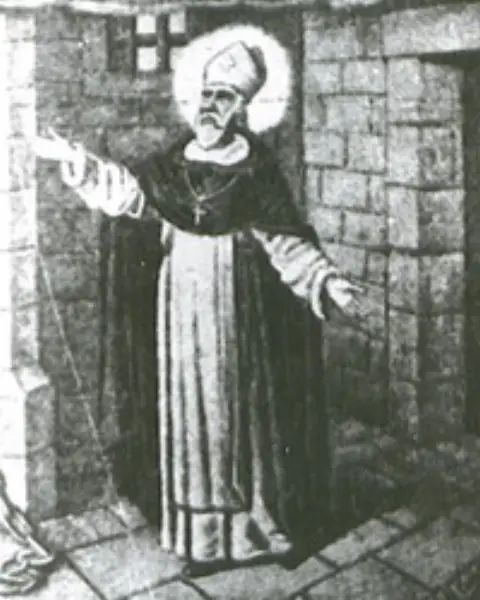
- Dominican habit with a mitre and pectoral cross
- Canonization
- Beatified 14 May 1893 by Pope Leo XIII; canonized 1 October 2000 by Pope John Paul II among the 120 Martyr Saints of China
Prayer
Bibliography
Show 5 sources
- 1 2 3 Cheney, David M. "Bishop St. Pedro Sanz y Jordá, O.P. †" . Catholic-Hierarchy.org . Retrieved October 22, 2022 . [ self-published ]
- ↑ Companions Martyrs of China Third Order of Penance of St. Dominic "The Martyrs of China"
- ↑ Third Order
- ↑ Vatican News Service (in Italian)
- ↑ 1959 Saint Dominic Missal
Profile text adapted from the Wikipedia article, licensed CC BY-SA 4.0.
Pray with this saint every day
Save St. Peter Sanz to your favorites, read the full profile, and get feast-day reminders in the Saints app.
Get the Saints AppFree on the App Store for iPhone and iPad