
died 1815·Feast September 24 (also December 12)
St. Peter the Aleut
Martyr of San Francisco and Witness of Kodiak
Overview
Peter the Aleut, baptized name of a man born Cungagnaq, is venerated as a martyr and saint of the Eastern Orthodox Church, honored as the 'Martyr of San Francisco'. A native of Kodiak Island of Alutiiq, or Sugpiaq, descent, he received the Christian name Peter at baptism from the monks of the mission of St. Herman of Alaska, who were operating in the north. According to the tradition preserved in four early sources derived from a single eyewitness, he was part of a company of Russian-American Company employees and Aleut seal and otter hunters captured by Spanish soldiers in 1815 while hunting seals illicitly near San Pedro on the California coast, Spanish territory then anxious about Russian advances southward from Alaska. Taken for interrogation, Peter was tortured and killed, it is said, for refusing to abandon his Orthodox faith. The story reached Kodiak, where St. Herman hailed him as a new martyr, and it circulated through the accounts of Semyon Yanovsky, chief manager of the Russian colonies, whose 1865 letter became the most widely circulated telling. Historians have debated details of the story, notably its attribution to Jesuits, whom the evidence excludes in favor of the Franciscans present in California. Peter was glorified in 1980 by the Orthodox Church in America's Diocese of Alaska, with endorsement by the Russian Orthodox Church Outside of Russia.
The Complete Life
Cungagnaq of Kodiak
The martyr known to the Church as Peter the Aleut was born on Kodiak Island, a native of the Alutiiq, or Sugpiaq, people whose homeland lies along the Gulf of Alaska coast. His given name has come down in several spellings: Cungagnaq, the form most commonly printed, is said to reference the color blue; the ethnographer Alisha Drabek regards Cukagnak as the proper form, likely connoting youthful speed and quickness on land or sea; the spelling Chukagnak appears in a 2016 study printed in the Journal of California and Great Basin Anthropology, while scholarship from 2007 gives the form Chunagnak. Peter, the name by which he is everywhere honored, is his baptismal name. It was given him at baptism into the Orthodox faith, administered by the monks of the Alaskan mission among whom St. Herman of Alaska shone as the greatest, the humble ascetic of Kodiak under whose spiritual care the Aleut converts of the late eighteenth and early nineteenth centuries lived their new faith. Peter thus belonged to the first generation of native Alaskan Orthodox Christians, seal and otter hunters who worked the coasts for the Russian-American Company while keeping the baptismal faith taught by the Kodiak missionaries. It was as one of these company hunters that he sailed south in the year of his death.
§ Name
Capture and Martyrdom on the California Coast
In 1815 California belonged to Spain, and Spanish authorities watched warily as Russian parties pressed south from Alaska. In its fullest telling, the account runs thus: a party of Russian company employees together with their Aleut hunters of seal and otter — Peter among them — was seized by Spanish soldiers while hunting seals illicitly near San Pedro, a place name interpreted either as San Pedro in modern Los Angeles or as the San Pedro y San Pablo Asistencia in Pacifica, north of San Francisco. The original account says the soldiers took the prisoners to 'the mission in Saint-Pedro' for interrogation; one Russian source states that captives taken near modern Los Angeles were conveyed to Mission Dolores, modern San Francisco. There, according to the tradition, Peter was tortured and killed for his refusal to convert to the Catholic faith. The most widely circulated telling, Yanovsky's 1865 letter, describes the torture as carried out on the orders of 'Jesuits' — a detail historians reject, since the Jesuit order had been expelled from Spanish territories in 1767 and none were present in California in 1815; some, including the Orthodox Church in America, conclude the killers must have been Franciscans, who staffed the California missions. The earliest account, the 1819 deposition of eyewitness Ivan Kiglay, makes no mention of Jesuits at all. A contemporaneous letter of 1816 by the Franciscan José Señan independently describes the capture and transfer of 'Russian Indians' along the coast, confirming an incident of the kind the tradition remembers.
§ Life
From New Martyr to Canonized Saint
Veneration of Peter long preceded his formal glorification. According to Yanovsky, when the report of Peter's death reached Kodiak, St. Herman, hearing it, hailed the dead man aloud as a new martyr and begged his intercession before God — the earliest liturgical echo of the killing. A century and a half later the memory revived: in 1965 The inaugural issue of The Orthodox Word commended Peter to its readers as a martyr worthy of invocation, and that journal further disclosed that by 1967 Peter's image, painted as a martyr's, could be found in certain Greek monasteries. In 1980 the Diocese of Alaska of the Orthodox Church in America locally glorified Peter as a saint. On 13 November of that year the Russian Orthodox Church Outside of Russia endorsed the glorification, issuing a synodal decree observing that Peter's name already stood in the canonization service composed for St. Herman of Alaska, so that no separate rite was needed for him to be reckoned among the canonized. His feast is kept on 24 September, with 12 December also observed in his memory. He is honored under the title 'Martyr of San Francisco', and a number of North American churches bear his name, including congregations at Lake Havasu City, Arizona; Minot, North Dakota; Calgary, Alberta; and Abita Springs, Louisiana.
§ Canonization
Martyr Between Empires, Saint Between Churches
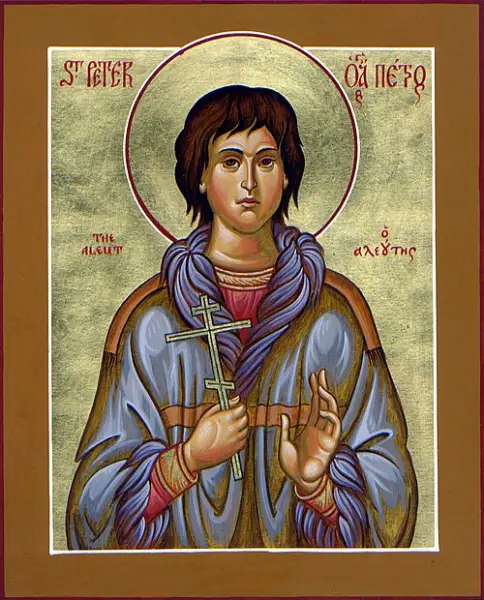
Peter the Aleut stands at the crossing point of empires and confessions, and his story has been examined with corresponding care. All accounts of his martyrdom derive from a single eyewitness tradition, the 1819 deposition of Ivan Kiglay, first published in English in 2011, which fed the reports of 1820 and, decades later, the celebrated letter of 1865. Historians have debated his historicity and the details of the killing: Hubert Howe Bancroft's History of California records only that some Russian source faulted the Spaniards for harsh treatment of the party they had detained near San Pedro, and scholars note that in nineteenth-century Russian literature the figure of the Jesuit carried strongly negative, often conspiratorial connotations, which may explain the attribution in Yanovsky's letter. The varying descriptions of the martyrdom's site — San Francisco, near Los Angeles, or somewhere in Southern California — reflect varying readings of the 'San Pedro' of the documents and of the captives' route by way of Santa Barbara and Monterey to Fort Ross. For Orthodox Christians the debate has not dimmed his witness: he is celebrated as the first native Alaskan and among the first American martyrs, shown in icons as an Aleut boy clad in the traditional parka of sewn gut, a martyr's cross in his hand, a sign that the faith planted on Kodiak's shores had produced fruit of its own, sealed in blood on a distant coast.
§ Historicity
Timeline
- 1815
Captured by Spanish soldiers near San Pedro while seal hunting with a Russian party, and tortured and killed, according to the tradition.
§ Life
- 1819
Ivan Kiglay, an eyewitness of the killing, gave a deposition describing the death — the earliest and fountainhead account.
§ Sources
- 15 Feb 1820
Semyon Yanovsky reported the martyrdom to his superiors in St. Petersburg.
§ Sources
- 1820
News of the affair reached Tsar Alexander I in a report from the Russian-American Company's chief administrator.
§ Sources
- 22 Nov 1865
Yanovsky wrote his famous letter to Damascene, abbot of the Valaam Monastery, recounting the martyrdom fifty years on.
§ Sources
- 1965
The inaugural issue of The Orthodox Word commended Peter to its readers as a martyr worthy of invocation.
§ Pre-canonization
- 1967
Icons depicting Peter as a martyr were reported present in some Greek monasteries.
§ Pre-canonization
- 1980
Locally glorified as a saint by the Diocese of Alaska of the Orthodox Church in America.
§ Canonization
- 13 Nov 1980
The Russian Orthodox Church Outside of Russia endorsed his glorification by synodal decree.
§ Canonization
In Their Own Words
Holy new-martyr Peter, pray to God for us!
The Record
- Symbols
- Aleut youth in a traditional gut parka·martyr's cross
- Canonization
- Glorified in 1980 by the Diocese of Alaska of the Orthodox Church in America; endorsed by the Russian Orthodox Church Outside of Russia on 13 November 1980
Prayer
Bibliography
Show 8 sources
- Bancroft, Hubert Howe (1882), "XIV. Russians in California - Foundation and Progress of Fort Ross", California, Vol. II, 1801-1824, History of the Pacific States of North America, vol. 14, San Francisco: A. L. Bancroft & Company
- Farris, Glenn, "The Strange Tale of Saint Peter, the Aleut: A Russian Orthodox Martyr on the California Frontier", paper presented at The Spanish Missions and California Indians Symposium, D-Q University, 3 March 1990
- Ogden, Adele, The California Sea Otter Trade 1784-1848. University of California Press, Berkeley, 1941
- The Russian Orthodox Religious Mission in America, 1794-1837, with Materials Concerning the Life and Works of the Monk German. Translated by Colin Bearne; ed. by Richard A. Pierce. Limestone Press, Kingston, Ont., 1978
- Tarakanoff, Vassili Petrovitch, Statement of My Captivity Among the Californians. Glen Dawson Press, Los Angeles, 1953
- Tikhmenev, P. A, A History of the Russian-American Company. Translated and edited by Richard Pierce and Alton Donnelly. University of Washington Press, Seattle, 1978
- Morris, Susan L.; Farris, Glenn J.; Schwartz, Steven J.; Wender, Irina Vladi L.; Dralyuk, Boris (2014). "Murder, Massacre, and Mayhem on the California Coast, 1814-1815". Journal of California and Great Basin Anthropology. 34 (1)
- Bucko, Raymond A. (2007). "St. Peter the Aleut: Sacred Icon and the Iconography of Violence". Journal of Religion & Society. Supplement 2
Profile text adapted from the Wikipedia article, licensed CC BY-SA 4.0.
Pray with this saint every day
Save St. Peter the Aleut to your favorites, read the full profile, and get feast-day reminders in the Saints app.
Get the Saints AppFree on the App Store for iPhone and iPad