
died 9th century·Feast June 12
St. Peter the Athonite
First Hermit of the Holy Mountain
Overview
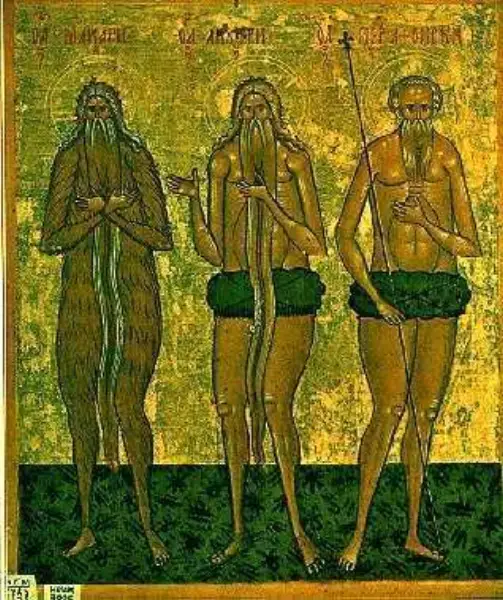
Peter the Athonite, sometimes called Peter of Mount Athos, is honored as the first hermit to settle upon the Holy Mountain, the peninsula that would become the greatest center of Orthodox monasticism. Known almost entirely through hagiographical tradition, he is said to have been a man of arms who fell into enemy hands in a war against the Syrians and was shut up in Samara's stronghold on the Euphrates. Freed from his Muslim captors, as the accounts relate, through the miraculous intervention of Saint Nicholas and Saint Simeon the Righteous, he traveled to Constantinople to fulfill a vow to become a monk, receiving the monastic habit from the Pope of Rome himself, who instructed him in ascetic discipline. A vision of the Blessed Virgin and Theotokos set Peter walking toward Athos, where for close on fifty years he kept a hermit's life within a cave. A hunter who chanced upon him told of a man without clothing, his body shaggy with hair, his beard hanging long; charged to keep silence and to pray, the hunter came back a year later, his demon-tormented brother in tow, to find that the saint had died — and at the touch of that body the tormented man was healed. His feast is kept on 12 June, and he is the patron of Mount Athos.
The Complete Life
From Prisoner of War to Monk
The hagiographical traditions that preserve the memory of Peter the Athonite begin with him as a soldier of the Byzantine world. In the course of a war with the Syrians he was taken in the fighting and held prisoner in the citadel of Samara, which looks upon the Euphrates — a Muslim bastion far from the Christian lands he had served. There, according to the accounts, his deliverance came not by arms but by miracle: Saint Nicholas and Saint Simeon the Righteous appeared to assist in his escape from the prison. The deliverance changed the direction of his whole life. In gratitude Peter made a vow to become a monk, and he traveled to Constantinople — New Rome — to fulfill it. In a striking detail of the tradition, he is said to have taken the monastic habit from the Pope's own hands, receiving from him also his training in the ascetic discipline. The story knits together the Christian East and West at their most united, and it presents Peter's monastic profession not as flight from the world in ordinary times but as the repayment of a debt owed to God for a life snatched from captivity. From Constantinople the former soldier would set out toward the desert silence in which the rest of his life was spent.
§ Biography
Fifty Years in the Cave
A vision of the Blessed Virgin and Theotokos set Peter walking toward the Holy Mountain, that rugged peninsula in the Aegean that tradition regards as the garden of the Mother of God. He is honored as the first of all solitaries to make his home on the mountain, the forerunner of the ascetic movement that would in time fill the Holy Mountain with monasteries. Close on fifty years he kept his hermit's life within a cave, unknown to the world, engaged in the unceasing prayer and bodily austerity that the discipline taught him in Constantinople had prepared. The tradition preserves one encounter that lifted the veil on his hidden life: a hunter, pursuing his game through the mountain's wilds, lighted upon a man whose bare skin was overgrown with hair and whose beard trailed long, so altered by decades of asceticism that he seemed scarcely human. Peter instructed the astonished hunter to pray for a year and to say nothing of their meeting. The command was kept, and when the year had run its course the hunter returned — bringing with him his brother, who was afflicted by a demon, and other companions. They found that the hermit had died in the interval, a solitary to the end, discovered only because heaven had chosen to reveal him.
§ Biography
Death and the Healing at the Tomb
Peter died as he had lived, alone in his cave on Athos, without companion or chronicler, so that even the year of his repose is uncertain — some traditions place his earthly life in the seventh and eighth centuries, others in the ninth. The story of his death is thus inseparable from the story of his first miracle after it. When the hunter who had met him a year before returned with his demon-afflicted brother and their companions, they came upon the saint's body, already at rest. At the touch of the saint's body the tormented man, so the story goes, rose from that touch made whole, delivered on the spot from the power that had plagued him. The cure told those who had found him that the hidden solitary had been a saint of God, and it opened to the mountain's first hermit a public cult. After his repose, his relics were discovered and taken to the Monastery of Clement, one of the early monastic foundations of the Holy Mountain, which once stood where the celebrated Monastery of Iviron stands today. There the remains of the man who had hidden himself from men for half a century were kept with honor, the first-fruits of Athos offered to the veneration of the Church.
§ Biography
Ancient Veneration East and West
Peter the Athonite has never needed a formal act of canonization: his cult belongs to the ancient common memory of the undivided Church. The Church numbers him among her saints, keeping his solemn remembrance each 12 June in the Eastern Orthodox communion, the Eastern Catholic Churches, and the Roman Catholic Church alike, one of the few Athonite saints honored across all three communions. His image stands among the saints of the Byzantine tradition in the Menologion of Basil II, the great early eleventh-century illuminated manuscript, where he appears in company with Onuphrius and Macarius of Egypt, the classic desert fathers whose heir he was. In iconography he is shown in monastic garb, his cave beside him — the two attributes by which the tradition summarizes his life. He is honored as the patron of Mount Athos itself, the mountain whose first hermit he was and whose monastic destiny his fifty years of hidden prayer foreshadowed. The Greek Synaxaristes commemorates him on 12 June as the ascetic of the Holy Mountain, and the Orthodox Church in America keeps his memory under the title Venerable Peter of Mount Athos, bearing witness that the first solitary of Athos belongs to the whole Church and not to one jurisdiction alone.
§ Legacy
The Father of Athonite Monasticism
Whatever the uncertainties of his dates, Peter's place in the memory of Orthodoxy is secure: he stands at the head of the spiritual genealogy of Mount Athos, the forerunner of the countless ascetics who followed him to the peninsula and made it the Holy Mountain. His life was written down early and often. A vita of Peter, catalogued as BHG 1505, came from the pen of a monk of Athos called Nicholas, written near the close of the tenth century or the dawn of the eleventh, a sign that within a few generations of his repose the brotherhood of the mountain had formally enshrined his memory; this text was translated into Italian in 1999, making the first hermit's story accessible to modern readers. A hagiography devoted to him was also written at the Serbian monastery of Hilandar by Genadius the Athonite, evidence that his cult flourished across the monastic commonwealth of Athos, not in a single house alone. Modern scholarship has continued to study him: Graham Speake's history of Athos recounts his precedence among the mountain's ascetics, and the Dumbarton Oaks collection Holy Men of Mount Athos takes account of his early vita. As patron of Mount Athos, Peter remains the archetype of every Athonite vocation — the soul that gives everything away and keeps only Christ.
§ Legacy
The Record
- Patron of
- Mount Athos
- Symbols
- Monastic garb·cave
- Canonization
- Pre-congregation; venerated from antiquity by the Eastern Orthodox, Eastern Catholic, and Roman Catholic churches
Prayer
Bibliography
Show 7 sources
- "Venerable Peter of Mount Athos", Orthodox Church in America (www.oca.org)
- Great Synaxaristes: Ὁ Ὅσιος Πέτρος ὁ ἐν τῷ Ἁγίῳ Ὄρει ἀσκήσας. 12 Ιουνίου. ΜΕΓΑΣ ΣΥΝΑΞΑΡΙΣΤΗΣ (in Greek)
- "Peter the Athonite", Greek Orthodox Archdiocese of America
- Speake, Graham (2014). Mount Athos: renewal in paradise. Limni, Evia, Greece: Denise Harvey. pp. 41-42. ISBN 978-960-7120-34-2
- Greenfield, Richard P. H.; Talbot, Alice-Mary Maffry (2016). Holy Men of Mount Athos. Dumbarton Oaks Medieval Library, Vol. 40. Cambridge, Massachusetts: Harvard University Press. ISBN 978-0-674-08876-4
- Rigo, Antonio (1999). Alle origini deli Athos: La Vita di Pietro l'Athonita. Magnano
- Spadijer, Irena. "Old Serbian Literature and Its Mediaeval Manuscript Heritage", in The World of Serbian Manuscripts (12th-17th centuries), edd. D. Otašević, Z. Rakić, I. Špadijer, Belgrade 2016, 153-173
Profile text adapted from the Wikipedia article, licensed CC BY-SA 4.0.
Pray with this saint every day
Save St. Peter the Athonite to your favorites, read the full profile, and get feast-day reminders in the Saints app.
Get the Saints AppFree on the App Store for iPhone and iPad