
c. 417 – 491·Feast November 27
St. Peter the Iberian
Georgian prince turned bishop, ascetic, and wonderworker of Gaza
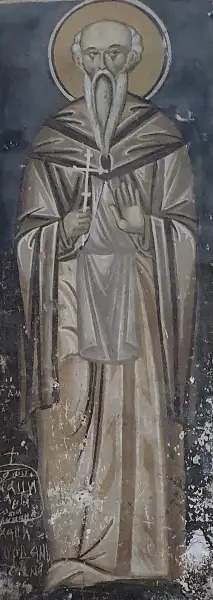
Overview
Peter the Iberian was born to the royal house of Iberia and became, in the Palestine of the fifth century, one of the age's most revered ascetics and churchmen. Baptized Murvan as a prince of the Chosroid dynasty, he was carried to Constantinople in childhood as a pledge of politics and schooled at the imperial court under the patronage of the empress Aelia Eudocia. As a young man he forsook the palace for Palestine, where Melania the Younger clothed him as a monk and where he helped plant a Georgian monastic presence in the Holy Land. Under the guidance of Zeno the Prophet in the desert country of Gaza and Maiuma he rose to renown; ordained despite his reluctance, he was raised to the see of Maiuma in 452, driven from it within months, and passed decades in exile and wandering across Egypt and the Palestinian coast. His holiness drew disciples, healings, and honorific titles of extravagant kind. He died in 491 at Yavne-Yam and rests near Gaza; his disciple John Rufus preserved his memory, and some scholars have proposed him as the true author behind the name Pseudo-Dionysius the Areopagite.
The Complete Life
A Prince as Hostage in Constantinople
The child first named Murvan — alternatively Nabarnugios — was born around 417 into the royal Chosroid dynasty that ruled Iberia, the eastern Georgian kingdom caught between the Byzantine and Persian empires. His early years were marked by danger: for a time he was kept hidden so he would not be delivered to the Persians as a hostage. The danger could not be averted forever. In 423, aged about five, the boy was dispatched to the imperial capital as a hostage of state — a living pledge of his father Bosmarios's fidelity to Byzantium against Persian overtures. In the imperial capital the captive prince received a brilliant education under the personal patronage of the empress Aelia Eudocia, wife of Theodosius II. His father also engaged the philosopher Mithridates of Lazica — also called John the Eunuch, or John the Laz — to take part in the boy's education. The captivity that was meant to secure a kingdom quietly formed a future monk, joining the heir of a mountain dynasty to the culture and faith of the Christian empire.
§ Early life in Iberia, Constantinople and Jerusalem
From Palace to Mount of Olives
Around the age of twenty, the young prince acted on a decision that separated him from his royal identity forever. Together with his mentor Mithridates, he left the imperial palace and made a pilgrimage to Palestine. Whether the pair ever planned to return to Constantinople remained uncertain — some spoke of an escape — but their presence in Jerusalem was well known and no one forced them home. In the holy city the pair were welcomed by Melania the Younger — the renowned ascetic whose example Peter had already encountered in Constantinople and that may well have drawn him thence. Melania clothed them in the monastic garb in a ceremony at the Anastasis, and the two received new names: Peter and John. He had carried with him relics of the Persian martyrs, and Melania enshrined them in a martyrion she raised on the Mount of Olives, the rite performed by Patriarch Cyril of Alexandria. He had likewise brought funds, and these paid for a house of their own — remembered afterwards as the monastery of the Iberians — which the two before long turned into a hostel serving pilgrims.
§ Early life in Iberia, Constantinople and Jerusalem
Bishop of Maiuma, Exile in Egypt
The road from Jerusalem to the desert frontier of Gaza was opened by the monk Zeno — known as the Prophet — who summoned the two back to the rigours of the common life. At his prompting they withdrew to a house lying between Gaza and Maiuma, where Zeno took charge of Peter's formation and the young monk entered the region's celebrated ascetic circles. So severe was his resolve that, his biographer John Rufus reports that he would neither send nor accept letters from his homeland, judging such contact with his royal kin a danger to his ascetic resolve. Around 445 the bishop of Maiuma ordained him, though Peter tried to avoid priestly service in favour of the quiet of monastic life. The year 452 brought his consecration to the see of Maiuma at the hands of Patriarch Theodosius. His tenure lasted only six months: when a local ruler banished Christians by decree, Peter escaped to Egypt and found refuge at the Enaton, the great monastic settlement near Alexandria. The exile did not silence him; it confirmed his standing among those who suffered for their confession.
§ In Gaza and Maiuma
The Renown of a Holy Father
In the early 470s Peter settled at Peleia near Ascalon, resuming a life of ascetic teaching while visiting towns and villages throughout Palestine. His fame grew to extraordinary heights for a man who had fled every honor: the titles heaped upon him included "Great Peter" and "pillar of Orthodoxy," likeness to Paul and to Moses as their second exemplars, and the phrase "an exceedingly wonderful person." Disciples gathered around him in numbers, drawn by a reputation for holiness that made him one of the defining figures of Palestinian monasticism. Medieval sources credited him with several famous religious works, though nothing survives written explicitly under his name. His spiritual outlook belonged to the Desert Fathers tradition and was shaped by his bond with Zeno and by the Gaza school's insistence that ascetic practice and doctrinal fidelity were inseparable. Later generations would also emphasize his philosophical depth: Peter counted among the founders of Christian Neoplatonism, a theological vision in which the Platonic inheritance of his education was transfigured into the service of Christian contemplation.
§ Escape to Egypt; return to Palestine
Hermits' Shelters and a Port Estate
Peter's last decades were spent in a series of increasingly humble dwellings along the Palestinian coast. He passed three years at Hilarion's hermitage, the cell sanctified by Palestine's first desert father. From there he moved for a time to a shack on the seashore near Azotus, a shelter as stark as any in the desert. His last home was a property at Yavneh-Yam — once the harbour of ancient Iamnia, once Eudocia's possession — tended on his behalf by a disciple. There, far from any throne or cathedral, the former prince of Iberia died in 491. His body was carried back to the monastery near Gaza where he had laboured for so many years, and he was buried among the monks he had led. The endings of his life mirrored its beginnings in their pattern of dispossession: the child taken hostage, the bishop driven from his see, the old man lodged in borrowed quarters — and through it all a reputation for sanctity only deepened.
§ Escape to Egypt; return to Palestine
Contested Memory of a Saint
Peter was never subject to formal canonization; his veneration arose among his own disciples and spread through the biographies written of him. Yet his memory became entangled in the Christological controversies of the age. From approximately the thirteenth century, after the translation of his biography from Syriac, the Georgian Orthodox Church honoured him as a Chalcedonian saint, keeping his feast on 2 December; in modern times his name has dropped from the Georgian Church calendar altogether. Among Georgian theologians opinions still divide: some uphold his Chalcedonian identity, while others judge him a Miaphysite. The Armenian and Coptic Churches reckon him Miaphysite and anti-Chalcedonian, and scholars relying on Armenian sources have supported that reading; David Marshall Lang considered it possible he was a Miaphysite, while Shalva Nutsubidze and Ernest Honigmann read him chiefly as a Neoplatonic philosopher and decline to fix him in any Christological camp. His feast is nevertheless kept across Eastern Christianity on 27 November and 1 December in the Syriac tradition, and as 1 Koiak among Oriental Orthodox.
§ Position vs. Chalcedonian creed
Monasteries, Inscriptions, and a Pseudonym
Peter's legacy endured on several fronts. His founding of the first Georgian monastery in Bethlehem planted Georgian monasticism in the Holy Land, and the oldest Georgian Bir el Qutt inscriptions mention Peter together with his father, preserving his name in stone. His disciples carried his influence into the next generation: John Rufus, his biographer and successor as bishop of Maiuma, and Severus of Antioch, the great theological voice of the Miaphysite cause, both stood in his debt. Two ancient biographies preserved his life — the Syriac version of John Rufus's Greek original, dating back to the eighth century, and a Georgian version derived from the account of his contemporary Zacharias Rhetor, bishop of Mytilene, surviving in a manuscript of about the thirteenth century. Most tantalizing is the scholarly hypothesis, argued by Shalva Nutsubidze in 1942 and Ernest Honigmann in 1952, that Peter the Iberian was the anonymous author known conventionally as Pseudo-Dionysius the Areopagite — a claim that, if ever proven, would place the Georgian prince among the most consequential writers in the history of Christian thought.
§ Peter the Iberian
Timeline
- 417
Born a prince of the Chosroid royal line of Iberia and given the name Murvan.
§ Early life in Iberia, Constantinople and Jerusalem
- 423
Sent as a political hostage to Constantinople at about the age of five to secure Iberia's loyalty to Byzantium.
§ Early life in Iberia, Constantinople and Jerusalem
- 445
Ordained around this year by the bishop of Maiuma, though he resisted priestly ministry in favour of monastic life.
§ In Gaza and Maiuma
- 452
Consecrated bishop of Maiuma by Patriarch Theodosius; left the see after six months when local Christians were banished.
§ In Gaza and Maiuma
- 452
Fled to Egypt after his banishment and found refuge at the Enaton monastic settlement.
§ Escape to Egypt; return to Palestine
- 470
In the early 470s moved to Peleia near Ascalon and resumed ascetic work across the towns and villages of Palestine.
§ Escape to Egypt; return to Palestine
- 491
Died at the estate of Yavne-Yam; his body was carried back and laid to rest at his monastery by Gaza.
§ Escape to Egypt; return to Palestine
In Their Own Words
pillar of Orthodoxy
the second Apostle Paul
the second Moses
The Record
- Major works
- First Georgian monastery in Bethlehem·Monastery of the Iberians near the Mount of Olives (founded with his own funds)
- Patron of
- patron of Georgia and of Georgian monasticism
- Symbols
- bishop's omophorion·fresco at the Monastery of the Cross in Jerusalem
- Canonization
- Pre-congregation canonization, venerated across Eastern Christianity from antiquity
Prayer
Bibliography
Show 5 sources
- Horn, Cornelia B. (2006), Asceticism And Christological Controversy in Fifth-century Palestine: The Career of Peter The Iberian, Oxford University Press, ISBN 0-19-927753-2
- Lang, David Marshall, "Peter the Iberian and His Biographers", Journal of Ecclesiastical History, vol. 2 (1951), pp. 156-168
- Steppa, Jan-Eric, John Rufus and the World Vision of Anti-Chalcedonian Culture, Gorgias Press, 2002, ISBN 1-931956-09-X
- Honigmann, Ernest, Pierre l'iberian et les ecrits du Pseudo-Denys l'Aréopagite, Bruxelles, 1952
- Bitton-Ashkelony, Brouria; Kofsky, Aryeh (February 2006), The Monastic School of Gaza, Brill, pp. 36-42, ISBN 9789047408444
Profile text adapted from the Wikipedia article, licensed CC BY-SA 4.0.
Pray with this saint every day
Save St. Peter the Iberian to your favorites, read the full profile, and get feast-day reminders in the Saints app.
Get the Saints AppFree on the App Store for iPhone and iPad