
9th–10th century·Feast May 3
St. Peter the Wonderworker
Bishop of Argos who fed the hungry and healed the sick
Overview
Peter the Wonderworker, also called Peter of Argos, was a Byzantine bishop and ascetic who became the patron saint of the Greek city of Argos. Born in Constantinople to a prosperous family known for piety and philanthropy, he grew up among five brothers who shared a deep attachment to the Christian faith and together with their parents aided the poor. Drawn to the monastic life, Peter first declined episcopal office when Patriarch Nicholas Mystikos wished to make him Bishop of Corinth, deferring instead to his brother Paul. Later, after the death of the local bishop, he accepted the see of Argos and Nauplion, where his holiness found its field. He organized famine relief in years of crop failure, ransomed captives, and healed the sick; the food supplies he dedicated to the hungry reportedly never ran out, and this abundance won him the title of thaumaturge. In 920 he took part in the Constantinopolitan synod convened over the emperor Constantine Porphyrogenitus. A noted scholar whose writings appear in the Patrologia Graeca, he died at Argos, where miracles at his tomb confirmed his fame, and where a cathedral honours him to this day.
The Complete Life
A Household of Five Brothers
Peter was born in Constantinople, the capital of the Byzantine Empire, into a well-to-do family distinguished not merely by wealth but by piety and philanthropy. He was one of five brothers, and the sources describe all of them as holding a great affinity for Christianity. Together with their parents the brothers made charity a family practice, helping the poor of the capital as a matter of course. It was in this household, saturated with almsgiving and devotion, that Peter first heard the call to the monastic life — a vocation that grew naturally out of the generosity he had watched at home. The formation of his character belonged to the city's great churches and to a family culture in which the faith was practised rather than merely professed. That all five brothers were marked by the same commitment suggests parents who saw their fortune as an instrument of mercy. From such beginnings came a bishop whose later fame would rest on precisely the virtues first rehearsed around his family's table: provision for the hungry and compassion for the suffering.
§ Life
The Mitre Declined and Accepted
Peter's path to the episcopate was marked by reluctance. Patriarch Nicholas Mystikos, recognizing his ability and sanctity, wished to raise him to the bishopric of Corinth, a major see of the Peloponnese. Peter declined the honour, deferring to his brother Paul, whom he proposed in his own place, because he wished to remain in the monastic state he had embraced. Providence disposed otherwise. When the bishop of Argos and Nauplion died, Peter consented at last to take up the burden of that see, in which he would exercise his ministry for the rest of his life. The sequence of refusal followed by acceptance is a familiar mark of the Byzantine ideal of the bishop: office sought is suspect, office accepted under obedience is honoured. At Argos Peter combined the ascetic's discipline with the bishop's charge, governing his church while preserving the monastic spirit. In 920 he also took his seat at a synod in Constantinople summoned by Nicholas Mystikos to deliberate the question of the emperor Constantine Porphyrogenitus, sharing in the church's response to one of the era's dynastic controversies.
§ Life
Bread That Never Ran Out
As Bishop of Argos and Nauplion, Peter's care for his flock took shape in works that earned him the title of wonderworker. In times of crop failure he organized famine relief for his suffering people, and the supplies of food he dedicated to the hungry were said never to run out — a provision so striking that contemporaries read in it the direct hand of God. He laboured for the ransom of captives, redeeming those seized in the raids and wars that tormented the Peloponnese, and he healed the sick by his prayer. These three works — feeding the starving, freeing the enslaved, curing the afflicted — became the substance of his holiness, and the abundance of the stores fixed his reputation as a thaumaturge. Peter was also a noted scholar: his writings were judged worthy of preservation and appear in the Patrologia Graeca, the great printed collection of the Greek Christian authors. He stands thus as a bishop in whom learning, asceticism, and practical charity were one life, with the miracle hidden inside the mercy.
§ Life
The Return of the Relics
Argos was where Peter ended his days, and there he was laid to rest in the Church of the Dormition. Wonderworking did not end at his grave: at his funeral his face was held to appear transfigured with heavenly light, and his body afterwards exuded the fragrant substance known as the Oil of Saints, which the faithful sought for healing. His remains were later moved to Nafplio and then carried abroad by the occupying Venetians under the Latin bishop Segundo Nani, and for centuries they remained far from the city that venerated him. In Peter's honour a cathedral was built at Argos, founded in 1859 by Bishop Gerasimos Pagonis and inaugurated on 18 April 1865. After a lengthy search his relics were at last located at a monastery near Rome and were solemnly returned to Argos on 19 January 2008; they now rest in the church of Saint Peter. The Orthodox Church keeps his feast on 3 May, and he remains the patron saint of Argos, whose cathedral bears his name.
§ Life
Timeline
- 920
Sat in the Constantinopolitan synod summoned by Nicholas Mystikos to settle the case of the emperor Constantine Porphyrogenitus.
§ Life
- 1859
Bishop Gerasimos Pagonis founded a cathedral in Argos in Saint Peter's honour.
§ Life
- 18 Apr 1865
The cathedral of Saint Peter in Argos was inaugurated.
§ Life
- 19 Jan 2008
After a lengthy search, his relics were found at a monastery near Rome and returned to Argos.
§ Life
The Record
- Major works
- Theological writings preserved in the Patrologia Graeca
- Patron of
- patron saint of Argos
- Symbols
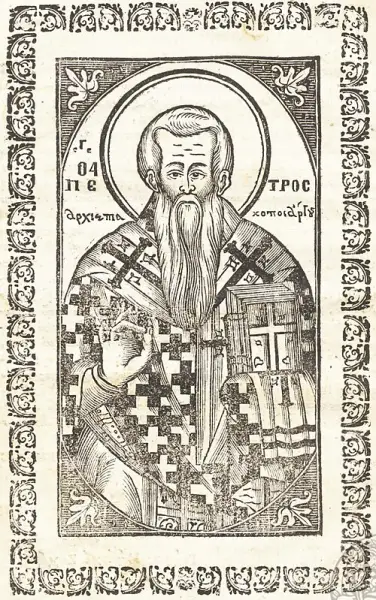
- vested as a bishop·holding a Gospel Book·right hand raised in blessing·making the Christogram IC XC
- Canonization
- Pre-congregation canonization, venerated in Eastern Orthodoxy from shortly after his death
Prayer
Bibliography
Show 4 sources
- "St Peter the Wonderworker and Bishop of Argos", OCA – Lives of the Saints
- Great Synaxaristes: Ὁ Ἅγιος Πέτρος Ἐπίσκοπος Ἄργους, 3 Μαΐου, ΜΕΓΑΣ ΣΥΝΑΞΑΡΙΣΤΗΣ
- Ott, M. (1911), "Oil of Saints", The Catholic Encyclopedia, New York: Robert Appleton Company, after Acta Sanctorum, May, I, 432
- Father George Sellis, «Άγιος Πέτρος Επίσκοπος Άργους Σημειοφόρος και Θαυματουργός», Publication of the Cathedral of St. Peter, Argos, 2008
Profile text adapted from the Wikipedia article, licensed CC BY-SA 4.0.
Pray with this saint every day
Save St. Peter the Wonderworker to your favorites, read the full profile, and get feast-day reminders in the Saints app.
Get the Saints AppFree on the App Store for iPhone and iPad