
c. 468 – c. 564·Feast June 4
St. Petroc
Cornish Abbot of Padstow and Bodmin
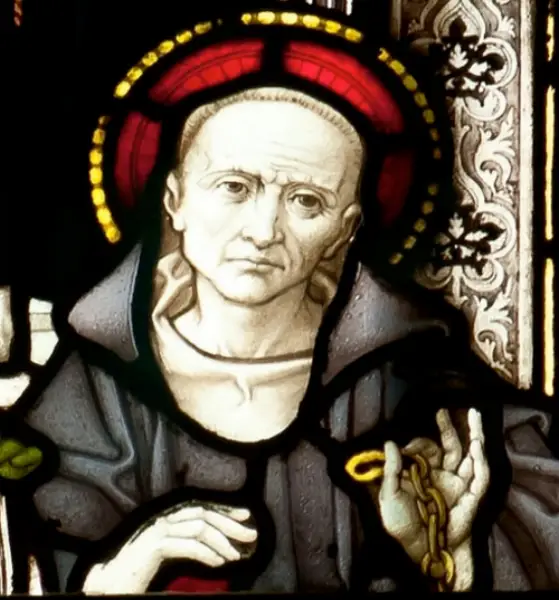
Overview
Petroc was a Welsh prince who became the best-loved of Cornish saints. Probably born in South Wales around 468, the younger son of a chieftain — later tradition names Glywys of Glywysing and makes him uncle to Saint Cadoc — he studied in Ireland, where he is said to have taught Kevin of Glendalough, and made a pilgrimage to Rome. Landing in Cornwall by wind and tide at Trebetherick, he founded a monastery and school at the mouth of the river Camel, at a place called Lanwethinoc that came to bear his own name: Petrocs-Stow, today's Padstow. From there he ministered across the kingdom of Dumnonia — Devon, Cornwall, Somerset, and Dorset — and served also in Brittany, founding churches and winning Constantine of Cornwall to the faith by rescuing a deer from the prince's hunt. Late in life he withdrew to Bodmin, where the hermit Guron yielded his cell. He died around 564 at Treravel near Little Petherick. His relics, translated to Bodmin in the later ninth century, made that monastery one of the wealthiest of Cornish houses; a Breton theft in 1177 ended with Henry II restoring them. With Piran and Michael he is a patron saint of Cornwall.
The Complete Life
A Prince Who Chose the Cloister
The oldest surviving Life makes him simply a junior son of a Welsh chieftain whose name it does not record. A twelfth-century redaction from Bodmin, the Gotha Life, supplies the genealogy later centuries preferred: his father was Glywys, king of Glywysing in south Wales, his brother Gwynllyw, and his nephew the great Saint Cadoc. Royal birth on both sides of the Bristol Channel would help explain the reach of his later cult. Born around 468, he turned from the prospects of princely rank toward the ascetic life, and crossed to Ireland for his formation — the standard route for British seekers of his generation. There he studied, and there tradition later placed him as the teacher of Kevin of Glendalough, the hermit of the Wicklow hills. From Ireland came the pilgrim habit that marked the rest of his days: he journeyed to Rome, and on his return to Cornwall the wind and tide, in the hagiographers' telling, brought his ship to Trebetherick on the north coast. The landing was providence by sea; the Christianity he carried inland from it would reshape the whole kingdom of Dumnonia and bind Wales, Ireland, Rome, and Brittany into a single story of prayer.
§ Life
Padstow: Petrock's Place
Where the river Camel meets the sea on Cornwall's northern shore stood the church of Lanwethinoc, named for an earlier holy man. Here Petroc founded the monastery and school that became his first great work. The settlement grew into Petrocs-Stow — Petroc's Place — the town the world now knows as Padstow. From this headland monastery his ministry radiated across the whole of Dumnonia, the Brittonic kingdom that took in Dewnans, the Devon of today, and Kernow, Cornwall, and reached into Somerset and Dorset; he served also in Brittany, where Saint-Perreux still carries his name. Ancient dedications to him number a probable seventeen in Devon alone, mostly coastal, among them a church inside Exeter's ancient Roman walls, along with the villages of Petrockstowe and Newton St Petroc; in Wales his name survives at St Petrox near Pembroke, at Ferwig near Cardigan, and at Llanbedrog on the Llŷn Peninsula. In Cornwall he founded the church at Little Petherick, known as Saint Petroc Minor. Among the converts credited to him stands Constantine of Cornwall, won to the faith when the saint saved a deer from the prince's hunt; Constantine afterwards made his hermitage at the bay that bears his name.
§ Life
The Humility of the Saint
Humility is the virtue tradition fixes upon Petroc. The story told most often concerns his return from pilgrimage to Rome and Jerusalem: setting foot in Britain under heavy rain, he assured his companions the weather would clear by morning. Instead the rain continued day after day, and Petroc, abashed at his own presumption, set out at once on another journey — this one undertaken as penance. That journey, legend claims, reached India itself, and there the wolf he subdued became his companion; hence the unlikely beast that attends him in his iconography, a beast of prey lying at the saint's feet. Like several other British saints he is also shown with a stag, recalling the hunted deer whose life he saved for Constantine. Thomas Fuller called him the captain of Cornish saints, and with Piran and Michael he is numbered among Cornwall's patron saints. The title honors a founder rather than a bishop: Petroc never held high office in any see, and his authority lay in the monastery, the school, the pilgrimage road, and the wild creatures that obeyed him — an apostolate of humility exercised in an age of warrior kings, remembered now by a whole peninsula.
§ Veneration
Bodmin and the Death at Treravel
Guron, a hermit, had settled at Bodmin in the interior; on Petroc's arrival he withdrew to the coast, leaving his cell to the newcomer. The well of Guron may still be found at the west gate of that churchyard in Bodmin, and every tradition concurs that Petroc in the end withdrew from Padstow to Bodmin, taking the inland monastery for his seat. After thirty years of labor, legend relates, he made the long pilgrimage to Rome, traveling through Brittany — the journey whose soggy homecoming taught him his famous lesson in humility. His death came around 564 at the home of a clan called Rovel — reckoned to be the farmhouse known today as Treravel, close by Little Petherick — not far from the coast where his Cornish work had begun. His remains were reputed to have ended in the bay of Hailemouth near Padstow, though the main line of his cult ran otherwise, through the translation of his relics to Bodmin in the later ninth century. By the tradition's reckoning he had lived nearly a century, closing a career that had linked Wales, Ireland, Rome, Brittany, and Cornwall in one unbroken chain of prayer.
§ Life
Relics, Sanctuary, and the Flag of Devon
Padstow was Petroc's earliest cult centre, but Bodmin came to stand at the heart of his cult once his relics were carried to its monastery; by the eleventh century that house ranked among the richest Cornish foundations. In 936 King Athelstan, annexing Cornwall, granted the privilege of sanctuary to Padstow, one of only three Cornish churches so honored, and the cathedral lists of Exeter record relics of the saint likely presented by that king. In 1177 thieves from Brittany carried off the Bodmin relics and lodged them at the Abbey of Saint Meen across the Channel; Henry II had them brought home. The bones were cast out at the English Reformation, yet the ivory Bodmin casket that once held them stands on public display at St Petroc's to this day. His major shrine was always at Bodmin, and his feast is 4 June, kept by the Church of England as a commemoration. Brittany honored him from the end of the tenth century; the flag of Devon, winner of a BBC competition in 2003 and adopted by the county council three years later, is dedicated to him; and charities for the homeless in Exeter and Cornwall still carry his name.
§ Veneration
Timeline
- 468
Born in South Wales, traditionally the son of the chieftain Glywys of Glywysing
§ Life
- 564
Dies at Treravel near Little Petherick after retiring from Padstow to Bodmin
§ Life
- 936
King Athelstan annexes Cornwall and grants the privilege of sanctuary to Padstow
§ Veneration
- 1177
A Breton steals the relics from Bodmin for the Abbey of St Meen; Henry II has them restored
§ Veneration
- 1992
St Petroc's Orthodox Monastery in Tasmania, using the Sarum Rite, takes his name
§ Legacy
- 2003
The flag of Devon, dedicated to Saint Petroc, wins a BBC design competition
§ Legacy
- Oct 2006
Devon County Council begins using the flag dedicated to the saint
§ Legacy
- 2009
North Devon College and East Devon College merge and are rebranded as Petroc College
§ Legacy
In Their Own Words
the captain of Cornish saints
The Record
- Major works
- Monastery and school at Lanwethinoc (Padstow)·Church at Little Petherick, known as Saint Petroc Minor·Churches across Devon, Cornwall, Wales, and Brittany
- Patron of
- Cornwall·Devon
- Symbols
- Wolf·Stag·Church
- Canonization
- Pre-congregation; ancient Celtic cult centered at Padstow and Bodmin
Prayer
Bibliography
Show 6 sources
- Brett, Caroline (2004). "Petroc (fl. 6th cent.)". Oxford Dictionary of National Biography. Oxford University Press.
- Jankulak, Karen (2000). The Medieval Cult of St Petroc. Boydell Press.
- Orme, Nicholas (2000). The Saints of Cornwall. Oxford University Press.
- Doble, G. H. (1938). Saint Petrock, a Cornish Saint.
- "St Petroc's Padstow". 27 December 2015.
- "The Calendar". The Church of England. Retrieved 27 March 2021.
Profile text adapted from the Wikipedia article, licensed CC BY-SA 4.0.
Pray with this saint every day
Save St. Petroc to your favorites, read the full profile, and get feast-day reminders in the Saints app.
Get the Saints AppFree on the App Store for iPhone and iPad