
died end of the 1st century (or 3rd century)·Feast May 31
St. Petronilla
Early Roman Martyr Honored as Peter's Daughter
Overview
Petronilla — sometimes Aurelia Petronilla — was an early Roman martyr venerated since antiquity, honored on 31 May and remembered across the centuries as the daughter of Saint Peter. Tradition made Peter her father and told how he cured her of palsy; the legends add that he locked her in a tower to preserve her from suitors, and that a pagan king named Flaccus, refused in his offer of marriage, drove her to a hunger strike that cost her life. Modern study has complicated the story: her grave in the Catacomb of Domitilla and a sarcophagus inscription calling her the golden Petronilla, sweetest daughter, point to the Roman family of the Aurelli, and the kinship with Peter likely arose from a misread inscription and the likeness of names. What is certain is the antiquity of her cult: sixth- and seventh-century lists of the tombs of the martyrs place her on the Via Ardeatina near Nereus and Achilleus, a painted memorial in her crypt was made shortly after 356, and in 757 her remains were translated to a chapel beside Old St Peter's that became the burial church of the French kings.
The Complete Life
Daughter of the Apostle?
From at least the sixth century Petronilla was honored at Rome as the actual daughter of the apostle Peter. The belief had roots in the apocryphal Acts of Peter, a second-century text that mentions a daughter of Peter without naming her, and it hardened through the legendary Acts of Nereus and Achilleus into the martyrologies of the Middle Ages and the modern Roman Martyrology. Yet the earliest and best evidence points elsewhere. Her name occurs in the Martyrologium Hieronymianum only as a later addition, and her absence from the fourth-century Roman catalogue of martyrs' feasts suggests she died at the end of the first century or later, a period in which no special feasts were yet celebrated for martyrs. Recent scholarship, resting on the inscription of her sarcophagus, holds that she belonged to the great Roman family of the Aurelli, and that her name — drawn from Petro or Petronius — together with the great antiquity of her tomb led Romans to attach her to the apostle. On this reading she was Peter's spiritual daughter, his convert or follower, if not simply his kinswoman; the Catholic Encyclopedia of 1913 even speculated on a connection with Domitilla.
§ Identity
Virgin and Martyr of the Old Stories
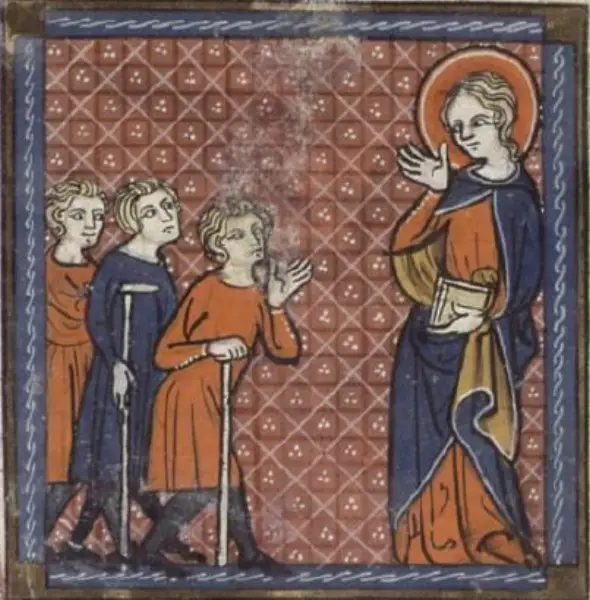
The stories gathered around Petronilla paint a virgin martyr of the apostolic age. Her beauty, the tales run, led Peter to shut her in a tower, beyond the reach of would-be husbands; her cure from palsy at the apostle's hands became her best-known miracle in art, the subject of a fifteenth-century tapestry made for the bishop of Beauvais. The legend of her death tells of a pagan king, Flaccus, who demanded her hand in marriage; her refusal took the form of a hunger strike, from which she died — chastity defended unto death, in the pattern Roman Christians loved. Her attributes gather up these tales: the early Christian maiden with a broom, the woman spurning a ring offered by a king, the maiden found incorrupt, flowers woven into her hair, when her coffin was opened during renovations; the woman accompanied by a dolphin, and the sick being healed at the apostle's side. Whether she suffered under Domitian, as one tradition holds, or at the end of the first century, the church of Rome kept her feast under 31 May, a date the martyrologies of Bede and his imitators adopted and fixed forever.
§ Identity
Tomb, Sarcophagus, and Translation
Virtually every sixth- and seventh-century register of the resting places of Rome's most honored martyrs locates her grave on the Via Ardeatina, close to those of Nereus and Achilleus. Excavation confirmed the lists completely: a church of Saint Petronilla, built into the Catacomb of Domitilla, was discovered with memorials that removed all doubt that the three saints were once venerated there. Behind the apse of the basilica, in a crypt beneath, the sealing slab of a burial yielded a painted image of Petronilla receiving a deceased woman named Veneranda into heaven, her name inscribed beside the picture — a work executed shortly after 356, as an inscription in the tomb proves. Her own remains rested in a marble sarcophagus which Pope Paul I translated to St. Peter's Basilica; the Liber Pontificalis records its inscription, of the golden Petronilla, the sweetest daughter. Sixteenth-century notices insist that the inscription's opening word read Aur, which would make the martyr's full name Aurelia Petronilla. The sarcophagus itself was rediscovered under Pope Sixtus IV in the chapel of Old St Peter's, where the pope hastened to inform Louis XI of France of the finding, so closely was the saint already tied to the French crown.
§ Burial
The Testimony of the Catacombs
It is clearly established that Rome venerated Petronilla as a martyr in the fourth century, a testimony scholars accept as certainly historical notwithstanding the later legends that know her only as a virgin. The painted memorial from the tomb of Veneranda, with its inscription naming Petronilla a martyr, carries the title from within a few years of 356; once a fourth-century basilica rose above her grave beside Nereus and Achilleus, devotion spread far and her name found its way into the martyrologies. She appears in the legendary Acts of Nereus and Achilleus and in the Liber Pontificalis, there described as a virgin rather than a martyr, and the same notice traveled out of that legend into the medieval martyrologies and thence into the Roman Martyrology as it stands today. No pope ever canonized her; hers is a cult raised by the devotion of the Roman cemeteries themselves, one of the oldest continuous memories the church of Rome possesses. Her feast under 31 May has kept its place since Bede, and On 31 May a Mass in the Vatican basilica is celebrated for France, with the French living in Rome gathered for it.
§ Veneration
Patroness of France
In 757 the coffin carrying Petronilla's mortal remains was translated to an old circular building near Old St Peter's — the mausoleum of the emperor Honorius, reworked as the Chapel of Saint Petronilla — and there her story joined the history of France. Charlemagne and Carloman were counted Peter's adopted sons after the imperial coronation of 800; the maiden then held to be Peter's own child stood forward as patroness of the two rulers and of the accords struck between popes and Frankish emperors. Her chapel became the burial place of French kings. When the new St Peter's rose in the sixteenth century the old chapel was demolished and her relics moved to an altar dedicated to her near the cupola, a chapel graced by embellishments associated with Michelangelo and Bramante. Guercino painted his great altarpiece of her burial in 1623; a mosaic copy took its place in 1730, and the original, carried to Paris in 1797, returned to Rome in 1815 and hangs today in the Capitoline Museums. The dauphins of France claim her as patroness because their emblem, the dolphin, was said to have been discovered carved upon her sarcophagus; even a village church at Whepstead in Suffolk keeps her dedication.
§ Chapel of St Petronilla
Timeline
- 356
A painted memorial showing Petronilla receiving the deceased Veneranda into heaven is made in her crypt, shortly after this year
§ Burial
- 679
A chapel and altar in her honor are built in the Mercian abbey founded by Osric at Gloucester
§ Veneration
- 757
Her coffin is translated to the mausoleum of Emperor Honorius near Old St Peter's, reworked as the Chapel of St Petronilla
§ Chapel of St Petronilla
- 1623
Guercino paints The Burial of St. Petronilla as an altarpiece for her church
§ Chapel of St Petronilla
- 1730
The Guercino canvas is transferred to the Quirinal Palace, and a mosaic copy by Cristofari takes its place over the altar
§ Chapel of St Petronilla
- 1797
Guercino's original painting is shipped to Paris
§ Chapel of St Petronilla
- 1815
The painting returns to Rome and is placed in the Capitoline Museums
§ Chapel of St Petronilla
The Record
- Patron of
- Dauphins of France·Mountain travellers·Treaties between popes and Frankish emperors·Invoked against fever
- Symbols
- Early Christian maiden with a broom·Set of keys·Dolphin·Being healed by Peter the Apostle·Spurning a marriage proposal·Incorrupt in her coffin with flowers in her hair
- Canonization
- Pre-congregation; venerated at Rome as a martyr from at least the 4th century
Prayer
Bibliography
Show 5 sources
- Herbermann, Charles, ed. (1913). "St. Petronilla". Catholic Encyclopedia. New York: Robert Appleton Company.
- Kirsch, Johann Peter (1911). "St. Petronilla". In Herbermann, Charles (ed.). Catholic Encyclopedia. Vol. 11.
- De Rossi, Giovanni Battista. Roma sotterranea, I, 180–1.
- Quentin, Les martyrologes historiques. Paris, 1908.
- Orlin, Eric (2015). Routledge Encyclopedia of Ancient Mediterranean Religions. Routledge.
Profile text adapted from the Wikipedia article, licensed CC BY-SA 4.0.
Pray with this saint every day
Save St. Petronilla to your favorites, read the full profile, and get feast-day reminders in the Saints app.
Get the Saints AppFree on the App Store for iPhone and iPad