
died c. 450·Feast October 4
St. Petronius of Bologna
Fifth-century bishop and father of Bologna's churches
Overview
Petronius, who died around the year 450, shepherded the church of Bologna as its bishop in the fifth century and remains one of the city's chief patrons. He came of a noble Roman house whose members held high office at the imperial court in Milan and in the provincial administrations at the turn of the fifth century; his father, likewise named Petronius, probably served as praetorian prefect. Drawn early to the ascetic life, the future bishop gave himself to its practices even in youth and is thought to have made a pilgrimage to Jerusalem. Elected and consecrated to the see of Bologna about 432, he adorned the city with churches, above the complex of Santo Stefano, designed in imitation of the Jerusalem sanctuaries of Golgotha and the Holy Sepulchre, together with churches of Santa Lucia and of Santi Bartolomeo e Gaetano. Contemporaries ranked his virtues among the glories of Italy. He died before 450, under the emperors Theodosius II and Valentinian III.
The Complete Life
A Son of the Roman Nobility
The oldest notices of Petronius come from a letter of Eucherius, bishop of Lyon, addressed to Valerianus, and from Gennadius' book on illustrious men, and both agree in placing him among the Christian aristocracy of the late fourth and early fifth centuries. His family belonged to the Roman nobility and was distinguished at the highest level: its members occupied prominent positions at the imperial court in Milan and in the provincial governments of the age. His father, who bore the same name, was probably praetorian prefect, since a Petronius is known to have held that office in Gaul between 402 and 408, and the treatise on the ordination of a bishop that circulates under the name Petronius belongs to the elder man. Eucherius hints that the future bishop himself had discharged some important secular responsibility before he renounced the world. What impressed his contemporaries, however, was not his lineage but his character: even as a young man he embraced the discipline of asceticism, and his reputation for virtue, Eucherius tells us, made him renowned throughout Italy.
§ Life
From the Court to the Altar
Petronius turned from the career open to a man of his rank to serve the Church, becoming a Christian minister as a convert from noble Roman society and rising to the priesthood. In his youth he had already bound himself to the practices of the ascetic life, and at some point, the sources suggest, he undertook the long journey to Jerusalem, perhaps as a pilgrim to the holy places whose memory would later shape his greatest work. His learning and holiness did not long remain private. About the year 432 the clergy and people of Bologna chose him as their bishop, and his consecration bound the former courtier to a city on the frontier between Italy and the troubled north. There he exercised an episcopal ministry marked by the same austerity he had practiced from his earliest years, and under his care the local church took on a new and lasting shape, its life ordered around the sanctuaries he would raise in honor of the passion and resurrection of Christ.
§ Life
Jerusalem Rebuilt in Bologna
As bishop, Petronius proved a builder whose churches changed the face of Bologna. His principal undertaking rose over the site of Santo Stefano: a church in honor of Saint Stephen, conceived in conscious imitation of the complex of shrines that stood on Golgotha and over the Holy Sepulchre at Jerusalem, so that pilgrims unable to reach the East could walk the mystery of Christ's passion in the streets of their own city. Around that central achievement he added others, erecting the church of Santa Lucia and the original building of Santi Bartolomeo e Gaetano, each contributing to a sacred topography that made Bologna itself a place of pilgrimage. His contemporaries testified to the spirit within these works: Eucherius held his virtues in renown across Italy, and Gennadius preserved the memory of a bishop who had joined noble birth to apostolic zeal. When he died, before 450 and within the joint reigns of Theodosius II and Valentinian III, he left behind a diocese physically transformed and a model of the Christian city that later ages would never entirely forget.
§ Life
The Saint of the City
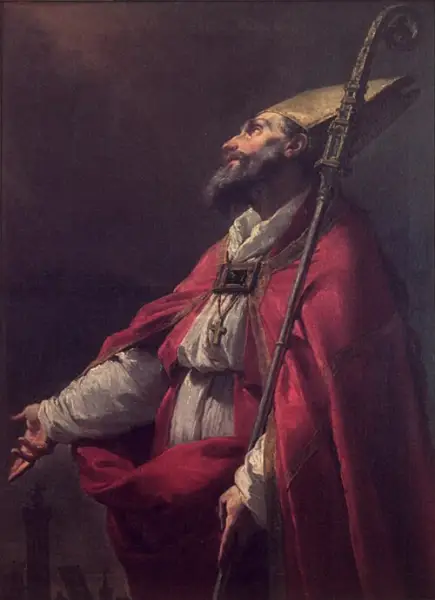
The memory of Petronius never faded from Bologna, and in the course of the twelfth century a legendary account of his life began to circulate. His relics came to light in 1141, and shortly afterwards a church was raised in the city in his honor. The devotion of the Bolognese soon outgrew that first sanctuary: in 1390 there was begun the enormous Basilica of San Petronio, planned on a scale intended to make it one of the greatest churches in Christendom, and for centuries its unfinished vastness has dominated the heart of the city. In 2000 his remains were carried in solemn translation from Santo Stefano to the great basilica that bears his name, uniting the church he built with the one built for him. The Church keeps his feast on October 4, and in art he appears as a bishop with the likeness of the city in his hand, the clearest statement of his place as the city's patron and father in God.
§ Veneration
Memory in Stone and Art
Few bishops have left so legible a mark upon a city. The complex of Santo Stefano, seven churches joined in imitation of the Jerusalem sanctuaries, remains one of Bologna's most venerated sites, and the Basilica of San Petronio, begun in 1390, ranks among the largest brick churches in the world. Artistic tributes accumulated across the centuries: Innocenzo Francucci da Imola painted him in glory, Francesco del Cossa portrayed him in the Pala dei Mercanti, and Michelangelo himself carved a statue of the saint for the Basilica of San Domenico, while another figure watches over the Piazza di Porta Ravegnana. Scholars have continued to weigh the questions his life leaves open, debating the attribution of writings connected with his name and the exact course of a career that straddled the Roman aristocracy and the fifth-century Church. But for the people of Bologna the essentials have never been in doubt: Petronius is the holy bishop who gave their city its holiest buildings and its enduring patron.
§ Veneration
Timeline
- 432
Chosen and consecrated bishop of Bologna.
§ Life
- 450
Died at Bologna before 450, in the joint reign of Theodosius II and Valentinian III.
§ Life
- 1141
Relics discovered at Bologna; a church was raised in his honor shortly afterwards.
§ Veneration
- 1390
Work begun on the vast Basilica of San Petronio, planned on a grand scale in his name.
§ Veneration
- 2000
Relics translated from Santo Stefano to the Basilica of San Petronio.
§ Veneration
The Record
- Major works
- Church of Santo Stefano, Bologna (foundation)·Church of Santa Lucia, Bologna (foundation)·Church of Santi Bartolomeo e Gaetano, Bologna (foundation)
- Patron of
- Bologna
- Symbols
- Depicted as a bishop holding a model of the city of Bologna
- Canonization
- Pre-congregation; honored as a patron saint of Bologna since the early centuries
Prayer
Bibliography
Show 6 sources
- Kirsch, Johann Peter. "St. Petronius." The Catholic Encyclopedia, Vol. 11. New York: Robert Appleton Company, 1911.
- Butler. "Saint Petronius, Bishop of Bologna, Confessor." Lives of the Fathers, Martyrs, and Principal Saints, 1866. CatholicSaints.Info, 13 August 2018.
- Ferguson, George (1961). Signs and Symbols in Christian Art. New York: Oxford University Press, p. 139.
- Lanzoni, Francesco (1907). San Petronio vescovo di Bologna nella storia e nella leggenda. Roma: Pustet.
- Mathisen, Ralph W. (1981). "Petronius, Hilarius and Valerianus: Prosopographical Notes on the Conversion of the Roman Aristocracy." Historia: Zeitschrift für Alte Geschichte, Band 30, pp. 106–112.
- Paolini, Lorenzo (2015). "Petronio, santo." Dizionario Biografico degli Italiani, Volume 82.
Profile text adapted from the Wikipedia article, licensed CC BY-SA 4.0.
Pray with this saint every day
Save St. Petronius of Bologna to your favorites, read the full profile, and get feast-day reminders in the Saints app.
Get the Saints AppFree on the App Store for iPhone and iPad