
8th century·Feast January 4
St. Pharaildis
Virgin of Ghent, patron of battered wives and sick children
Overview
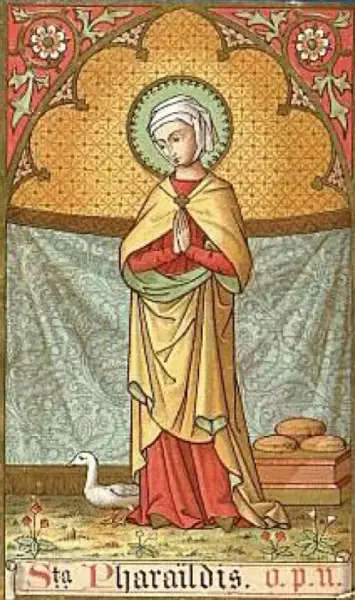
Pharaildis, called Veerle in Dutch, is an eighth-century Belgian virgin honored as one of the patron saints of Ghent. Born in that city, she belonged to a family of saints: her father was Witger, Duke of Lorraine, her mother Amalberga of Maubeuge; her brothers and sisters — Emebert, Reineldis, Ermelindis and Gudula — were themselves honored as saints, and Gertrude of Nivelles raised her. Though she had made a private vow of virginity, she was married as a girl against her will to a nobleman, who insisted that her fidelity belonged to him rather than to God. Because she refused him and slipped away at night to visit the churches, he abused her physically, and she endured the violence of her marriage until widowhood freed her, still a virgin, to devote herself to the poor. Her cult is documented from the eighth century onward, and around 754 Agilfrid, abbot of Saint Bavo's Abbey, gathered her relics and brought them to Ghent. Wonder stories gathered about her name: a well whose waters healed sick children, bread turned to stone in a miser's pantry, and a cooked goose restored to life from skin and bones. She died on January 5 in her ninetieth year, and the Church keeps her feast on January 4.
The Complete Life
Born into a Family of Saints
Ghent gave Pharaildis birth, and holiness gave her a heritage. Her father was Witger, Duke of Lorraine, and her mother Amalberga of Maubeuge, herself a saintly figure whose name the Flemish Church still honors, and the children of the marriage read like a litany: Emebert, Reineldis, Ermelindis and Gudula, every one of whom received the veneration of the faithful. Her own formation was entrusted to Gertrude of Nivelles, the abbess whose monastery stood among the most celebrated in the Low Countries, so that the girl was raised from childhood within the orbit of prayer and disciplined piety. The sources are reticent about the details of her upbringing, and her dates remain imprecise, but the outline is clear enough: a daughter of the Carolingian aristocracy, connected by blood and education to the holiest houses of her region, and early instructed in the faith she would later defend at such cost. To this family setting her legend attributes the purity of intention that would define her, a consecration of the heart formed under Gertrude's care and confirmed by her own private vow.
§ Life
A Vow Defended Within Marriage
The central trial of Pharaildis' life arose from the collision between her own consecration and her family's designs. Despite the private vow of virginity she had made to God, she was married in her youth, against her will, to a man of noble rank. Her husband took the position that the contract of marriage bound her fidelity to him and to him alone, that what she owed to God was of no account beside what he claimed for himself, and when she would not yield he repaid her refusal with violence. Her nightly visits to the churches, made while the household slept, gave him further cause for rage, and he beat her for those journeys as well. She did not capitulate. Through years of abuse she maintained both the vow of her heart and the duties of her state, a witness that later generations would find exemplary in its endurance. Only widowhood released her, and she emerged from the marriage intact, a virgin still, with her conscience unbroken and her devotion undimmed by suffering.
§ Life
Widowhood and Works of Mercy
Freed at last from the household that had been the scene of her trials, Pharaildis gave her widowhood to charity, devoting herself to the poor of Ghent and the surrounding country. The sources sketch this period of her life briefly, but its direction is unmistakable: the energies that had been spent in defending her vow now flowed outward in almsgiving and service, and the virgin who had suffered abuse in her own home became a protector of the weak. She reached an extreme old age, dying on January 5 in her ninetieth year, her long life spanning most of the century in which the Christian institutions of the Low Countries took durable shape. Wonder stories attached themselves to her memory and reveal what the faithful believed her to care about. She was said to have called forth a spring whose waters cured sick children, to have turned hidden loaves into stone when a miserly woman refused bread to the hungry, and to have restored a cooked goose to life from nothing but skin and bones, the miracle that made the bird her emblem forever.
§ Life
Cult and Relics at Saint Bavo's
No formal act of canonization ever established the cult of Pharaildis; her sainthood rests on the devotion of the Flemish Church, and that devotion is old indeed, for her cult is documented as early as the eighth century, within living memory of her own lifetime. About the year 754 Agilfrid, abbot of the great abbey of Saint Bavo at Ghent, obtained her relics and had them brought to the city of her birth, where they became the object of solemn veneration. The Church assigns her feast to January 4, the eve of the anniversary of her death, and in the late nineteenth century her feast, kept under the affectionate name of Fru Verelde, ranked among the major festivals of Ghent, as the account of 1882 records. In popular religion she stood close to the people: invoked for children's illnesses, for unhappy marriages, for the abused and for widows, and pictured in her icons with the goose of her most famous miracle at her feet, she remains among the beloved patron saints of the city.
§ Veneration
The Goose of Ghent
The memory of Pharaildis has lived on in Ghent under her Flemish name of Veerle, borne in the streets and festivals of the city long after the circumstances of her life were forgotten. Her insignia, the goose, recalls the tale in which she brought a cooked bird back to life working only from its skin and bones, a wonder that made her the natural advocate of small and defenseless creatures, and the chroniclers of her cult recorded other marvels in the same key: the healing well that rose at her prayer, and the bread of the miser hardening into stone, a sermon in miniature on the duties of the rich to the poor. Her patronage gathered up the wounds of her own biography, for the Church commends to her intercession difficult marriages, victims of abuse, widows, and children stricken with disease, all conditions she had known in the flesh. In the calendar her feast falls on January 4, and in the city of her birth her name endures in the folklore that still calls her Fru Verelde.
§ Veneration
The Record
- Patron of
- Ghent, Belgium·Bruay, France·childhood diseases·difficult marriages·victims of abuse·widows
- Symbols
- A goose at her feet
- Canonization
- Pre-congregation; her cult is documented from the eighth century
Prayer
Bibliography
Show 7 sources
- Rabenstein, Katherine (March 1999). "Pharaïldis of Ghent." Saint of the Day, January 4. SaintPatrickDC.org. Archived from the original on 2017-06-03.
- Jones, Terry. "Pharaildis." Patron Saints Index. Archived from the original on 2008-02-12.
- Engelbert, Omer. The Lives of the Saints. Christopher and Anne Fremantle, trans. New York: Barnes & Noble, 1998. Nihil obstat 1951.
- Monks of Ramsgate. "Pharaildis." Book of Saints, 1921. CatholicSaints.Info, 21 October 2016.
- Eckenstein, Lina. Woman under Monasticism: Chapters on Saint-Lore and Convent Life between A.D. 500 and A.D. 1500. Cambridge University Press, 1896.
- Jones, G. R. (22 June 2005). "Pharaildis, virgin (c. 740)." Saints at a Glance. University of Leicester. Archived from the original on 2007-02-06.
- Behringer, Wolfgang (1998). Shaman of Oberstdorf: Chonrad Stoeckhlin and the Phantoms of the Night. H. C. Erik Midelfort, trans. University of Virginia Press, pp. 42–43.
Profile text adapted from the Wikipedia article, licensed CC BY-SA 4.0.
Pray with this saint every day
Save St. Pharaildis to your favorites, read the full profile, and get feast-day reminders in the Saints app.
Get the Saints AppFree on the App Store for iPhone and iPad