
died 792·Feast December 1
St. Philaretos
The Merciful of Amnia, Model of Almsgiving
Overview
Philaretos the Merciful of Amnia, who died in 792, was a Byzantine aristocrat of Paphlagonia whose unworldly generosity made him one of the most beloved saints of the Orthodox East. Born to wealth in the Anatolian town of Amnia, he married Theoseba and raised three children, Ioannes, Hypatia, and Evanthia. When Arab raids stripped his estates and left him only a pair of oxen, a cow with her calf, a beehive, and a donkey, he gave even these to the needy, consoling his angry wife with the assurance that his real riches were stored away beyond the reach of any raider. The story of the cow sent after her calf to a neighbor made him the very type of the alms-giver who holds nothing back. When Empress Irene sought a bride for her son Constantine VI, the imperial party lodged with Philaretos; struck by his household, they chose his granddaughter Maria in the first recorded bride-show, and his family's fortune returned in abundance. He refused titles and fine clothing, feasted the poor, and died at about ninety in his own home, charging his family to give alms as he had done.
The Complete Life
A Magnate of Paphlagonia
Philaretos belonged to an illustrious local family of the Byzantine Anatolian magnates, landowners whose seat was at Amnia in Paphlagonia. Bringing him up in Amnia during the eighth century were two Christians, Georgios and Anna; he went on to inherit money and add to it by marriage, taking as his wife Theoseba, herself a woman of means; three children, Ioannes, Hypatia, and Evanthia, were born to them. Nothing in his circumstances inclined him toward poverty — he was a man of the provincial gentry with an estate to manage and a name to keep. Yet, as his grandson Niketas writes in the hagiography that preserves him, he possessed an unworldly generosity, remembering the scriptures' insistence that what is done for the least of these is done for Christ. The Paphlagonia of his lifetime was a frontier province: Islamic raids reached within a few days' ride of Constantinople, and the Life describes its lands as harried by the Ishmaelites. One such raid eventually stripped his household down to a couple of oxen, a cow with her calf, a beehive, and a donkey. To the hagiographer the catastrophe was providential — the test that revealed what the rich man actually trusted.
§ Introduction
Giving to the Measure of Christ
The Life builds its portrait from a sequence of exchanges in which Philaretos always gives too much. Left by the raiders with a cow and her calf, he gave the calf to a neighbor who wished to begin a herd; when Theoseba protested that he had no pity — that he had separated the cow from her calf — he agreed with her and summoned the man to take the cow as well. In a time of famine he told his wife to distribute wheat to a beggar; she insisted the family first be provided for, then mocked his excess by telling him to give half the load, and he answered by giving the man his entire supply and his donkey besides, while his household wept over the loss. The Lord repaid him, the story says, when a friend brought him forty bushels of wheat. When imperial favor later returned him to abundance he refused expensive clothing and titles, had three purses stuffed — one with gold, one with silver, one with copper — and poured all three out among the needy without pausing to weigh the metals. His grandson presents him as a fool for Christ, a man whose folly was the gospel's arithmetic carried to its end.
§ Introduction
The Bride-Show and a Blessed Death
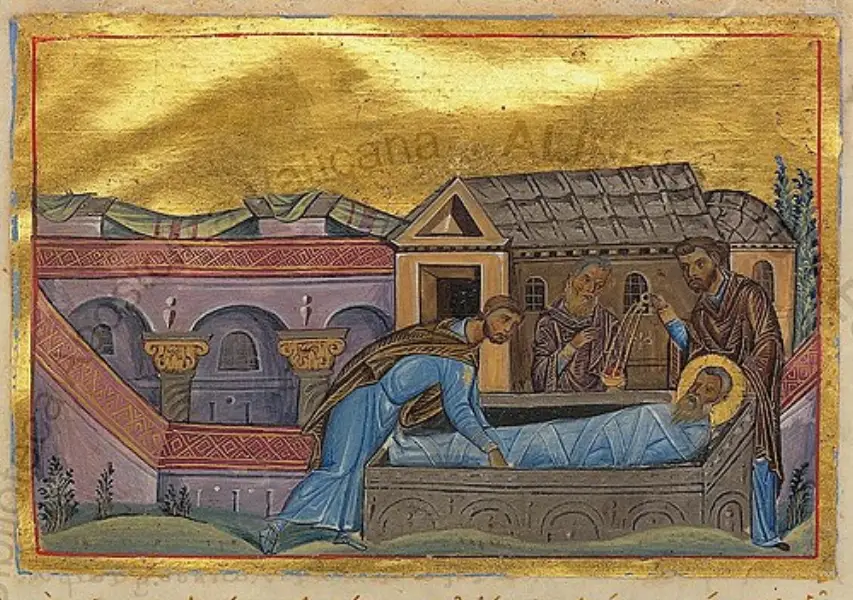
In his old age came the reversal that fixed his family in imperial history. Empress Irene, searching the empire for a bride for her son Constantine VI, sent her commissioners to Amnia, where they were received at a feast in Philaretos' house and were so impressed by the man and his household that they chose his granddaughter Maria — the first recorded bride-show. Maria married the emperor; Philaretos used the wealth that followed to provide for the poor on a new scale, hosting banquets for them and distributing alms without discrimination. Near the end, at the age of ninety, he begged the mother superior of Constantinople's Rodolphia convent to grant him a grave within its walls, leaving her gold and telling her that his death would come in ten days; it came as he said. He died in 792 at home beside his family, his last charge to them that they give alms as he had done. Theoseba spent the remainder of her life working at the restoration of churches and monasteries. His feast is kept on 1 December, and his memory endured at the Constantinopolitan monastery of his burial.
§ Introduction
A Grandson's Hagiography and an Imperial Dynasty
The Life of Philaretos, written by his grandson Niketas, is prized by historians as well as by the faithful. It preserves a picture of Paphlagonia under the pressure of Islamic raids and a rare near-contemporary account of an imperial bride-show and the politics of Irene's regency — the text even styles the empress Basileus, in the masculine, acknowledging the power she wielded. But the work also carries unmistakable political undertones. When Constantine VI wrested power from his mother he repudiated Maria and put her away; the family that had risen through her marriage suddenly stood exposed. Historians have suspected as much: the Life may have been composed by Niketas precisely to restore the family's standing and burnish its name, fastening its pedigree to a revered holy ancestor once the divorce had left it exposed. Sainthood in that age required investment — a cult, churches built across imperial territory, endowments to sustain petitions to bishops and synods — and Philaretos' descendants had the means. Whatever the motives behind its composition, the portrait that resulted gave the Eastern Orthodox Church one of its tenderest saints, whose very name became a byword for almsgiving.
§ Introduction
In Their Own Words
You have no pity on us, you merciless man, but don't you feel sorry for the cow? You have separated her from her calf.
I have hidden away riches and treasure
The Record
- Canonization
- Pre-congregation; ancient cult in the Eastern Orthodox Church
Prayer
Bibliography
Show 2 sources
- "Righteous Philaret the Merciful of Amnia in Asia Minor". oca.org. The Orthodox Church in America. Retrieved February 25, 2026.
- Rydén, Lennart, and Nicetas. The Life of St Philaretos the Merciful Written by His Grandson Niketas: A Critical Edition with Introduction, Translation, Notes, and Indices. Uppsala: Uppsala University Library, 2002.
Profile text adapted from the Wikipedia article, licensed CC BY-SA 4.0.
Pray with this saint every day
Save St. Philaretos to your favorites, read the full profile, and get feast-day reminders in the Saints app.
Get the Saints AppFree on the App Store for iPhone and iPad