
died c. AD 68·Feast November 22
St. Philemon
Recipient of Paul's letter and martyr of Colossae
Overview
Philemon was an early Christian of Asia Minor whose name endures because a private letter addressed to him became part of the New Testament. Paul of Tarsus wrote to him at Colossae on behalf of Onesimus, who may previously have been Philemon's slave, asking his friend to take him back. The letter is addressed not to Philemon alone but also to Apphia, described as their sister and possibly Philemon's wife, to Archippus their fellow soldier, and to the assembly that gathers under Philemon's roof, a greeting that reveals a wealthy Christian of standing whose home served as a gathering place for the faithful. Ancient tradition describes Philemon as a minister of the Church, possibly a bishop, and the roll of the Seventy Apostles, credited to Dorotheus of Tyre, calls him bishop of Gaza. The Menaia appointed for 22 November remember him as a holy apostle who, together with Apphia, Archippus, and Onesimus, suffered martyrdom at Colossae in the first general persecution, under the emperor Nero. He is venerated by the Eastern Orthodox, Catholic, and Lutheran churches.
The Complete Life
A House That Held a Church
Philemon belonged to the Christian community of Colossae, a city in the Roman province of Asia in Asia Minor. The New Testament letter that bears his name shows a man of substance: Paul writes to him as a dear friend and fellow worker, greets at the same time Apphia, described as their sister and possibly Philemon's wife, and Archippus, their fellow soldier, and sends greeting to the church that gathers in Philemon's house. That a congregation met under his roof indicates both his means and his leadership; his home served the Christians of Colossae as a place of assembly at a time when the faith possessed no basilicas and no public standing, and the whole architecture of a local church consisted of such households opened to the brethren. Ancient tradition describes him as a minister of the Church, possibly a bishop, and later catalogues would number him among the Seventy. In the list attributed to Dorotheus of Tyre he appears as bishop of Gaza, an office the epistle itself does not mention but which testifies to the eminence the tradition assigned him.
§ Philemon (biblical figure)
The Letter on Behalf of Onesimus
The event that fixed Philemon's name in the memory of the Church was a private letter from Paul of Tarsus, delivered to him at Colossae on behalf of Onesimus, who may previously have been his slave. The apostle asks his friend to take Onesimus back, and the brief writing, known ever after as the Epistle to Philemon, entered the Christian Scriptures precisely because it was preserved in the archive of one household's reconciliation. The address of the letter reveals the circle it concerned: Philemon the dear friend and fellow worker, Apphia the sister, Archippus the fellow soldier, and the church meeting under the same roof. For the communities of Asia Minor such a house was the whole fabric of the early Church, at once gathering place, table of hospitality, and seat of a minister's care. Eastern iconography remembers the scene, setting Paul, Philemon, and Onesimus who delivers the letter into a single decorated page. In this quiet correspondence the growth of the first congregations can still be traced, one household and one appeal at a time, and the moral weight of the apostle's request fell upon a layman whose generosity was already proven.
§ Philemon (biblical figure)
Martyr and Equal to the Apostles
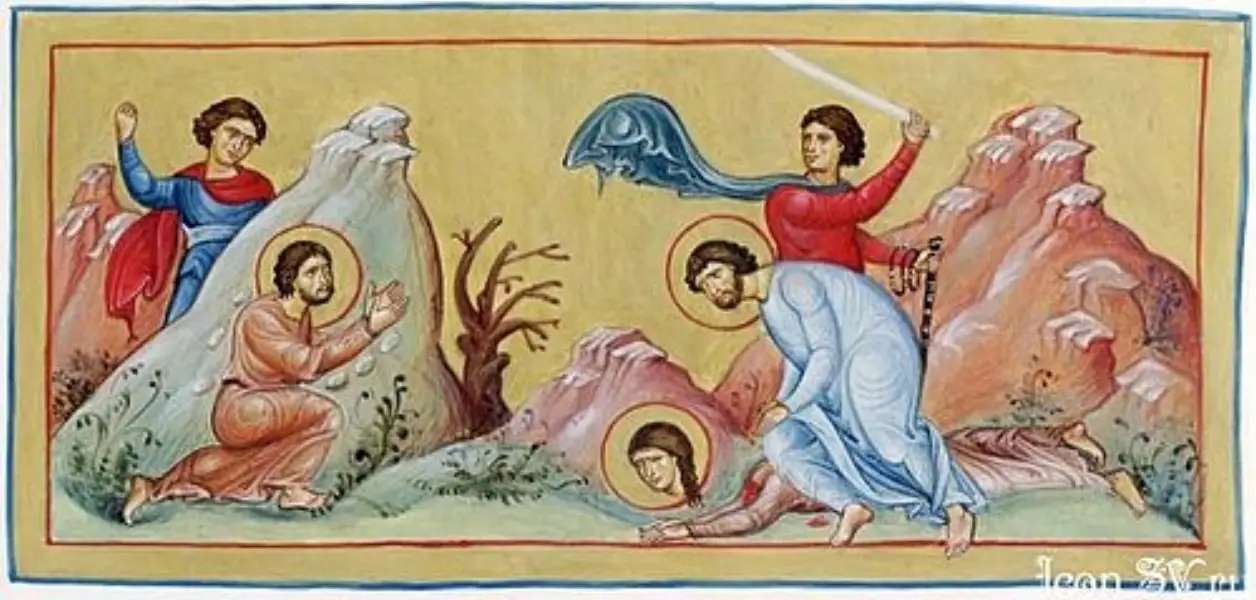
Philemon is honored as a saint by the Eastern Orthodox Church, the Catholic Church, and Lutheranism, styled Equal to the Apostles in the Orthodox tradition and reckoned among the martyrs in the Latin Church. The Menaia appointed for 22 November describe him as a holy apostle who endured martyrdom at Colossae side by side with Apphia, Archippus, and Onesimus, when Nero's first general persecution broke out. The same feast unites in memory the whole household that the epistle addresses, so that the woman who received the apostle's greeting and the slave whose cause he pleaded are venerated beside him. His commemoration falls on 22 November in both Eastern Orthodox and Latin Catholic use, while Lutherans keep his memory on 15 February. He died, by the Church's tradition, about the year 68, and wherever the letter to him is read he stands as the friend whom an apostle trusted, the householder whose reconciliation with Onesimus became Scripture, and the bishop, as the ancient lists say, of Gaza. The letter that once crossed the distance between an apostle's captivity and a Colossian house now crosses every age, and with it travels the name of the friend who received it.
§ Philemon (biblical figure)
In Their Own Words
to Philemon, our dear friend and fellow worker, also to Apphia our sister (possibly Philemon's wife) and Archippus our fellow soldier, and to the church that meets in your home
The Record
- Canonization
- Pre-congregation; honored as Equal to the Apostles in the Eastern Orthodox Church and as a martyr in the Latin Church
Prayer
Bibliography
Show 6 sources
- Philemon 1:1–2, New International Version
- Philemon 1:12
- Nicoll, W. R., Expositor's Greek Testament on Philemon, accessed 11 December 2023
- In the Latin Vulgate, and at Philemon 1:2 in its Douai-Rheims translation
- "Philemon", The Catholic Encyclopedia, Herbermann, Charles, ed., New York: Robert Appleton Company, 1913
- Const. Apost., VI, 46
Profile text adapted from the Wikipedia article, licensed CC BY-SA 4.0.
Pray with this saint every day
Save St. Philemon to your favorites, read the full profile, and get feast-day reminders in the Saints app.
Get the Saints AppFree on the App Store for iPhone and iPad