
c. 608 – 684·Feast August 20
St. Philibert of Jumièges
Monastic founder of Jumièges and Noirmoutier
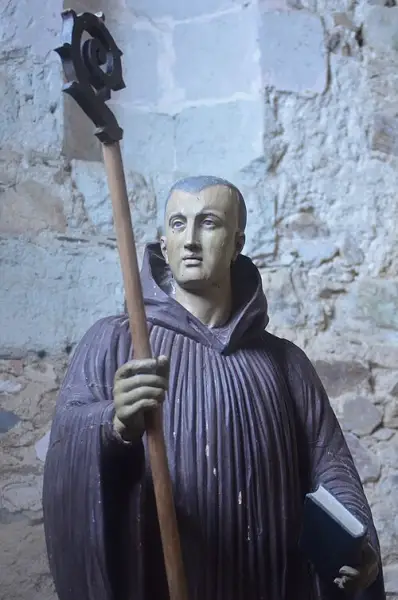
Overview
Philibert of Jumièges, born in Gascony around 608, was an abbot and monastic founder whose houses stretched from the Seine to the Atlantic. His father Filibaud was a magistrate of Aire-sur-l'Adour, and Philibert was his only son; presented at the court of Dagobert I, where his friendship with Saints Ouen and Wandregisel turned him toward the cloister. After serving as abbot of Rebais from 650, and leaving it amid disputes over the strictness of the rule of Columbanus, he traveled among the monasteries of Luxeuil and Bobbio to compare their rules and constitutions. In 654, through the influence of Queen Balthild, he received land from Clovis II and founded Notre Dame de Jumièges, for which he drew up a rule combining Benedict, Macarius, Basil, and Columbanus. Conflict with the mayor of the palace Ebroin cost him royal favor, imprisonment, and exile before his restoration. Around 676 he founded a monastery on the island of Noirmoutier, whose monks reclaimed marshland and worked the salt pans. After Ebroin's death he returned briefly to Jumièges, founded nunneries at Pavilly and Montivilliers, and died around 684. His relics, carried from the Vikings to Tournus in 875, made that abbey a great center of his cult.
The Complete Life
From a Magistrate's House to the Court
Philibert was born in Gascony around the year 608, an only child; his father Filibaud served as a magistrate of Vicus Julius, the town now called Aire-sur-l'Adour. Position and inheritance promised him a secular career, and when manhood came he was granted a place at the court of Dagobert I at Metz, the center of Merovingian power. There he met Saints Ouen and Wandregisel, two men whose own lives were given to the Church and whose friendship would redirect his own. Through them the ideals of Frankish monasticism reached the young courtier, and he came to see that the palace in which he stood was not the summit of human ambition but a road that could lead away from it. He sought and obtained the king's permission to leave the court for the cloister, an unusual release for a youth of his prospects, and entered the monastery of Rebais, which Ouen and his brothers had founded on land donated by Dagobert himself. The passage from magistrate's son to royal page to monk traced in one life the movement of a whole Frankish aristocracy toward the monastic vocation.
§ Life
Abbot of Rebais and Student of the Rules
At Rebais Philibert advanced until, in 650, he took over the abbacy from his friend Agilus. His tenure, however, was troubled from within: disagreements arose among the monks over how strictly the rule of Columbanus ought to be observed, the severe discipline the Irish missionaries had brought to the continent. Rather than preside over a divided community, Philibert left Rebais and spent time traveling among the monasteries of the age, including Luxeuil and Bobbio, comparing their rules and constitutions at first hand. These years of wandering made him one of the most knowledgeable legislators of Western monasticism, a man who had compared the living traditions of the great houses before drafting a rule of his own. The quarrel at Rebais, in retrospect, proved the making of the founder: it drove him from administration into study, and from study into the foundations that carried his name across the Frankish world. When he next took up the government of monks, he did so as a man formed by the disciplines of Luxeuil and Bobbio as well as by the Irish rigor of his first house.
§ Life
Jumièges and the Test of Power
In 654, through the influence of Queen Balthild of Chelles, Philibert received from Clovis II a gift of land, and there he founded Notre Dame de Jumièges. For this house and his later foundations he composed a rule from what his travels had taught him, weaving together older rules, among them those of Benedict, Macarius, and Basil the Great, and above all the strict rule of Columbanus. The chief labor of the monks was to bring waste land under cultivation, and to the poor and pilgrims the gates stood open. Jumièges quickly became renowned as a place of the spirit, and distinguished men and abbots sought out its abbot for counsel. His independence soon brought him into conflict with power. Philibert confronted Ebroin over his treatment of Leodegar, Bishop of Autun, who died a martyr; Ebroin was mayor of the palace of Neustria. Ebroin retaliated: for a time Philibert lost the favor of Ouen and the royal family, was briefly imprisoned, and was not permitted to return to Jumièges. He chose exile from Neustria, withdrawing to Austrasia and the court of Bishop Ansoald of Poitiers, who committed his own abbey of Luçon to Philibert's keeping.
§ Jumièges
Prayer and Husbandry on the Island
Around 676 Philibert resolved to raise a fresh monastery upon the island of Her, now Noirmoutier, with the agreement of Bishop Ansoald, who granted him ground there. On the island the monks joined the evangelization of the coast to an almost total discipline of labor: they carried out agricultural development, dug irrigation channels, opened communication routes, worked the exploitation of salt, and raised the monastic buildings from the ground. This fusion of prayer and husbandry expressed Philibert's ideal of the religious life, in which the reclaiming of waste land was itself an act of worship and the cloister served the poor and pilgrims who came to its gates. Land at Déas was likewise granted him by the bishop, and the Saint-Philbert-de-Grand-Lieu abbey grew from it; five years later, still in concert with the bishop of Poitiers, he and monks from Noirmoutier built up a priory that became the royal house of Saint-Michel-en-l'Herm, its drainage works lying partly at the origin of the Marais Poitevin. In these foundations the abbot's rule took flesh: a community that prayed the solemn office and then bent to the salt pans and the ditches, finding in both a single service of God.
§ Noirmoutier
Return, Reconciliation, and Rest
Ebroin died in 681, and Philibert then went back to Jumièges for a brief stay; his heart was by then given to Noirmoutier, and he did not remain. Before he departed from it forever he made his peace with his old friend Ouen, closing in tranquillity a breach that political violence had opened. Once the favor of his patrons returned he brought other houses into being: the nunnery at Pavilly, and in 682 Montivilliers Abbey, placing communities of women beside his houses of monks and entrusting them to the same discipline of prayer. On his return he continued to supervise his various foundations, traveling among them and governing them through the men and women he had formed in the monastic life. Philibert died around 684 and was buried at Heriou, the island monastery where his last years had been spent and where his monks worked the salt and prayed above his grave. From a Gascon courtier he had become the father of a family of monasteries stretching from the Seine to the Atlantic, and he ended his days where that work was most his own.
§ Later life
The Relics and Their Journey
Philibert was never formally canonized; his cult arose at his tomb and spread with the fortunes of his monks. In 836 the community of Noirmoutier abandoned their island home in the face of Viking attacks and sought refuge on the mainland, carrying the relics of their founder with them; in 875 their wandering ended at the abbey of Tournus, which bears his name, and over it rose the great church of St Philibert that stands there yet. The relics' long journey out of the sea-raiders' path brought fresh houses into being and drew many endowments from the Carolingian court, weaving a wide monastic network. The relics rest within the choir of Tournus's abbey church of Saint-Philibert, shut in a reliquary fashioned by the artist Goudji. On 25 January 1998 the shrine was desecrated: the saint's skull and two of his bones were carried off, an outrage that grieved the pilgrims of Tournus. His feast is kept on 20 August in both the Roman Catholic and Eastern Orthodox churches, and the filbert, or hazelnut, is said to take its name from him, since it ripens in England about his day.
§ Veneration
A Name on the Land
The influence of Philibert's foundations long outlived their founder. Among those inspired by his example was the Irish monk Sidonius of Jumièges, who founded the monastery at Saint-Saëns, extending the Jumièges tradition into new country. Villages across France bear his name — in the Rhone Valley, Anjou, Normandy, and Brittany — remembering the abbot whose monks drained marshes, made salt, and reclaimed the waste lands of the west. The great abbey church of Tournus remains one of the glories of Burgundy, raised over the relics his monks had carried from the sea. On the island of Noirmoutier a grotto of Saint Philbert recalls the house of his later years, and at Saint-Philbert-de-Grand-Lieu the Noirmoutier community raised a Carolingian priory church around 847 in his honor. His rule, drawing together Benedict, Macarius, Basil, and Columbanus, passed the monastic learning of his wanderings to the houses he governed, and the memory of the founder endures wherever the hazel ripens at his feast and the villages of his name mark the fields his monks made fruitful. To walk the roads of the west is still to meet him, in the parish names and the broken cloisters where his monks prayed, worked the salt pans, and made the marshes flower.
§ Veneration
Timeline
- 608
Born in Gascony, the only son of Filibaud, magistrate of Vicus Julius.
§ Life
- 650
Succeeded his friend Agilus as abbot of the monastery of Rebais.
§ Life
- 654
Received land from Clovis II through Queen Balthild's influence and founded Notre Dame de Jumièges.
§ Jumièges
- 676
Founded a monastery for his monks on the island of Her, now Noirmoutier, with land granted by Bishop Ansoald of Poitiers.
§ Noirmoutier
- 681
After the death of Ebroin, returned briefly to Jumièges and was reconciled with Saint Ouen.
§ Later life
- 682
Founded Montivilliers Abbey for nuns, following his foundation of the nunnery at Pavilly.
§ Later life
- 684
Died around this year and was buried at Heriou, the island monastery of his later years.
§ Later life
- 836
The monks of Noirmoutier abandoned their island before Viking attacks and fled to the mainland with his relics.
§ Veneration
- 875
The fugitive community finally settled with his relics at the abbey of Tournus, named in his honor.
§ Veneration
- 25 Jan 1998
His relics at Tournus were desecrated by thieves who stole the saint's skull and two bones.
§ Veneration
The Record
- Major works
- Rule drawn up for Jumièges and his later foundations, drawing on Benedict, Macarius, Basil the Great, and Columbanus·Notre Dame de Jumièges abbey, founded 654·Monastery of Noirmoutier on the island of Her, founded c. 676·Abbey of Saint-Philbert-de-Grand-Lieu at Déas·Priory of Saint-Michel-en-l'Herm, developed c. 681·Nunnery at Pavilly·Montivilliers Abbey, founded 682·Luçon Abbey, governed on behalf of Bishop Ansoald of Poitiers
- Canonization
- Pre-congregation; ancient cult, venerated in the Roman Catholic and Eastern Orthodox Churches
Prayer
Bibliography
Show 7 sources
- Monks of Ramsgate, "Philibert", Book of Saints, 1921, CatholicSaints.Info, 23 August 2016
- "St Philibert", The Concise Oxford Dictionary of the Christian Church, 2nd ed., E. A. Livingstone, ed., OUP, 2013, ISBN 9780198614425
- O'Reilly, Elizabeth Boyle, How France Built Her Cathedrals: A Study in the Twelfth and Thirteenth Centuries, Harper & Brothers, 1921, p. 483
- "Fondation de Jumièges", Directorate of the Archives de France
- "Jumièges Abbey: View of ruins", University of Notre Dame
- Friedrich Prinz, Frühes Mönchtum in Frankreich, 131f, noted in Fouracre and Gerberding
- Alston, George Cyprian, "Benedictine Abbey of Jumièges", The Catholic Encyclopedia, Vol. 8, New York: Robert Appleton Company, 1910
Profile text adapted from the Wikipedia article, licensed CC BY-SA 4.0.
Pray with this saint every day
Save St. Philibert of Jumièges to your favorites, read the full profile, and get feast-day reminders in the Saints app.
Get the Saints AppFree on the App Store for iPhone and iPad