
died 1679·Feast 23 July (died 22 July 1679); also 4 May with the beatified martyrs of England, and 25 October with the Six Welsh Martyrs in Wales
St. Philip Evans and St. John Lloyd
Welsh Priests and Martyrs (Forty Martyrs of England and Wales)
Overview
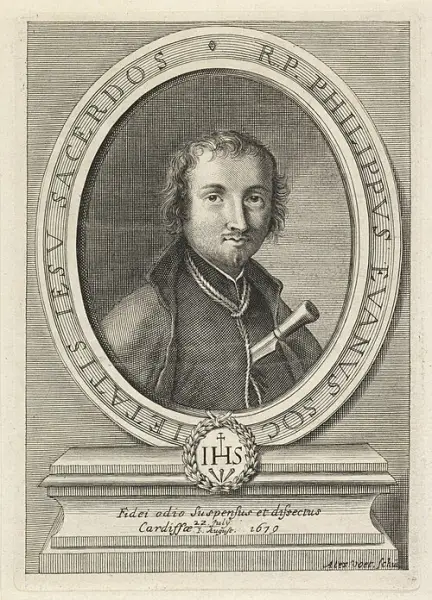
Philip Evans, born at Monmouth around 1645, and John Lloyd, a Breconshire man of about the same age, were Welsh Catholic priests executed together at Pwllhalog near Cardiff on 22 July 1679, casualties of the panic stirred by Titus Oates's fabricated Popish Plot. Evans, a Jesuit, studied at the college of Saint-Omer, entered the Society at Watten in 1665, was ordained at Liège, and laboured four years in South Wales before a £200 reward posted by the priest-hunting magistrate John Arnold in November 1678 led to his arrest at Sker, Glamorgan, in December. Lloyd, a secular priest formed at Saint-Omer's and the English College, Valladolid, had taken the missionary oath in 1649 and spent twenty-four hunted years ministering to covert Catholics since 1654; he was seized at Penlline that November and held in Cardiff Gaol, where the two men met. Tried at Cardiff in May 1679 under the statute of 1584 that made a priest's mere presence treason — the Plot itself was never charged against them — both were condemned. Evans bade his companion farewell from the scaffold; Lloyd answered only briefly, professing that he died in the faith of the Creed, with faith, hope and charity.
The Complete Life
Early Life
Philip Evans was born at Monmouth in 1645 and educated at the Jesuit college of St Omer in Artois; he joined the Society of Jesus at Watten on 7 September 1665, was ordained at Liège, and in 1675 went out to South Wales as a missionary. John Lloyd, the other half of this joint entry, was a Breconshire Welshman and a secular priest — one not belonging to any religious order — educated at St Omer's and from 1649 at the English College, Valladolid in Spain, where he took the missionary oath on 16 October 1649. Wales became his mission field in 1654, and he served the Catholics there in hiding, living out his vocation on the run for twenty-four years. The two men thus represent the two arms of the Welsh mission of the recusancy: the Jesuit and the diocesan priest, working the same hill parishes under the same statutes. Between them, at their arrest in 1678, the two priests had given more than thirty years to the Welsh mission.
§ Philip Evans
Conversion and Vocation
Both men's vocation was the English mission, which every priest sent to it understood as a probable death sentence. Evans spent four years laboring in Wales, and though the official policy was anti-Catholic nothing was done against him — the penal statutes lay in abeyance in practice whenever the government had no scare to answer. Lloyd's quarter-century of itinerant ministry, from 1654 to 1678, was conducted under the same suspension. What changed everything was the Popish Plot: the fabricated conspiracy invented by Titus Oates in 1678, which let every justice of the peace in England and Wales turn priest-hunting into licensed patriotism. In November 1678 John Arnold of Llanvihangel Court near Abergavenny, a justice and a professional hunter of priests, offered £200 for Evans's arrest. The bounty, a very large sum, was posted by a magistrate whose private enthusiasm for the work had already supplied several of the plot's Welsh 'discoveries'.
§ Philip Evans
Mission and Ministry
Evans refused to leave. Despite the manifest dangers he stayed with his flock, and was taken on 4 December 1678 at the home of Christopher Turberville at Sker in Glamorgan — the posse that arrested him being led, by the irony the record preserves, by Turberville's brother Edward, the most notorious of the priest hunters. Lloyd had been arrested a fortnight before, on 20 November 1678, at Turberville's house at Penlline in the same county, and imprisoned in Cardiff gaol, where Evans joined him. The two men then waited five months for trial, the prosecution unable at first to find witnesses who would swear they were priests; the government's difficulty is a small index of how far the Catholic community had gone underground in Wales. The vigor of the hunt in Glamorgan and Monmouthshire in that winter is measured by the fact that two priests who had worked openly enough for years were taken within a fortnight of each other.
§ Philip Evans
Trial and Final Years
The trial came at Cardiff on Monday, 5 May 1679. Neither priest was charged with any connection to Oates's plot — the plot charges were reserved for more prominent victims — but simply with being priests come into England and Wales contrary to the Jesuits, etc. Act of 1584, and on that charge each was convicted of treason for exercising his priestly office. The executions were then put off so long that it seemed they might not happen; the prisoners were allowed unusual liberty, even leaving the prison for recreation, and Evans, a musician, is recorded as playing the harp in his last weeks. The reprieve ended in the summer: both were executed together at Pwllhalog near Cardiff on 22 July 1679, Evans addressing the crowd from the hurdle and both dying for the priesthood rather than for any plot. The hangings followed the full Tyburn ritual of drawing and quartering, and the crowd that gathered at Pwllhalog was, by the surviving accounts, sympathetic rather than hostile.
§ Trial
Canonization
Evans and Lloyd were beatified in 1929 among the Welsh and English martyrs, and canonized by Pope Paul VI on 25 October 1970 as two of the Forty Martyrs of England and Wales. In the Forty they are the Welsh pair of the Popish Plot group, killed in the same judicial frenzy that took Oliver Plunkett and dozens of others, and their joint feast within the group is 25 October, with 22 July kept as their dies natalis. Welsh Catholicism counts them, with John Roberts of Trawsfynydd, as its three martyrs among the forty. The joint treatment of the two men — one cause, one entry in the martyrology — was natural, since they were tried, condemned, and executed together and their bodies shared a grave.
§ Introduction
Legacy
Their memory in Wales attaches to Cardiff and the Glamorgan houses where they worked and died: the execution site at Pwllhalog is marked by a plaque, and the churches and schools of the Cardiff diocese carry their names. Historically they are the standing evidence for two points about the Popish Plot in Wales: that the plot charges were never seriously made there, the statute against priests being sufficient; and that the Welsh mission, thinly staffed and largely ignored for twenty years, was destroyed in a matter of months once hunting was rewarded. The pairing of a Jesuit and a secular priest in one canonization also made them the emblem of the two branches of the missionary clergy. Their joint cult is the older of the Welsh Catholic revivals' possessions, kept continuously from the seventeenth century in the recusant houses that sheltered them.
§ Introduction
Timeline
- 1645
Philip Evans born at Monmouth
§ Philip Evans
- 16 Oct 1649
John Lloyd took the missionary oath at the English College in Valladolid, bound for the English mission
§ John Lloyd
- 1654
Lloyd was despatched to Wales to serve Catholics there in hiding
§ John Lloyd
- 7 Sep 1665
Evans entered the Society of Jesus at Watten
§ Philip Evans
- 1675
Evans was ordained at Liège and despatched to the South Wales mission
§ Philip Evans
- Nov 1678
Justice John Arnold posted a £200 reward for Evans's capture
§ Philip Evans
- 20 Nov 1678
Lloyd was seized at Turberville's house in Penlline and locked up in Cardiff Gaol
§ John Lloyd
- 4 Dec 1678
Evans was taken at Christopher Turberville's home at Sker, Glamorgan
§ Philip Evans
- 5 May 1679
Both priests were tried at Cardiff and convicted of treason for practising their priesthood under the Jesuits, etc. Act 1584
§ Trial
- 22 Jul 1679
The two were executed at Pwllhalog outside Cardiff; Evans died first
§ Executions
- 1878
Two skulls and other bones were found in a box in the attic of a Holywell Jesuit's house
§ Relics
- 15 Dec 1929
Both martyrs were beatified by Pope Pius XI
§ Introduction
- 25 Oct 1970
Pope Paul VI canonized the pair among the Forty Martyrs of England and Wales
§ Canonisation and feast day
- Apr 2021
Stonyhurst College announced it had identified the Holywell bones as those of Lloyd and Evans
§ Relics
In Their Own Words
Adieu, Father Lloyd! Though only for a little time, for we shall soon meet again.
I never was a good speaker in my life. I shall only say that I die in the true Catholic and apostolic faith, according to these words in the Creed, I believe in the holy Catholic Church; and with those three virtues: faith, hope and charity.
The Record
- Patron of
- Tennis and tennis players
- Symbols
- Noose around the neck·Knife in the chest·Harp
- Canonization
- Beatified by Pope Pius XI on 15 December 1929; canonized by Pope Paul VI on 25 October 1970 among the Forty Martyrs of England and Wales
Bibliography
Show 12 sources
- 1 2 3 "The Jesuits: Saints and Martyrs" . Jesuit Singapore Website . Archived from the original on 1 February 2014 . Retrieved 22 August 2018 .
- ↑ "Liturgy Office for England and Wales" . Retrieved 25 April 2015 .
- 1 2 Stanton, Richard (1892). A menology of England and Wales, or, Brief memorials of the ancient British and English saints arranged according to the calendar, together with the martyrs of the 16th and 17th centuries . University of Califor
- ↑ UK Consumer Price Index inflation figures from 1209–2024 based on data from "Inflation calculator" . Bank of England . London. 18 February 2026 . Retrieved 1 April 2026 .
- ↑ Inscription on a portrait in the Royal English College, Valladolid : " San Juan Lloyd, natural de Brecknockshire, Gales, colegical y sacerdote de este Colegeio de San Albano, murió por la fe católica fuera de Cardiff, Wallia, el 22 de Jul
- 1 2 3 4 Wainwright, J (1910). The Catholic Encyclopedia . New York: Robert Appleton Company. retrieved from "St. John Lloyd" . New Advent . Retrieved 16 July 2015 .
- ↑ " "St. John Lloyd", Royal English College, Valladolid" . Archived from the original on 14 January 2014 . Retrieved 4 April 2013 .
- ↑ Rochford, SJ, Tom. "Philip Evans", Jesuits Global
- ↑ Wynn-davies, Therese (10 March 2011). "Spotlight: History of 'death junction' " . The Guardian .
- ↑ Campbell, James. "Remembering the witness of two saints of Wales", Archdiocese of Cardiff
- 1 2 National Calendar for Wales , Liturgy Office for England and Wales, accessed 31 July 2011
- ↑ National Calendar for England , Liturgy Office for England and Wales, accessed 31 July 2011
Profile text adapted from the Wikipedia article, licensed CC BY-SA 4.0.
Pray with this saint every day
Save St. Philip Evans and St. John Lloyd to your favorites, read the full profile, and get feast-day reminders in the Saints app.
Get the Saints AppFree on the App Store for iPhone and iPad