
1507 – 1569·Feast January 9
St. Philip II of Moscow
Metropolitan who defied Ivan the Terrible
Overview
Philip II of Moscow, born Fyodor Stepanovich Kolychov, was Metropolitan of Moscow and all Rus' from 1566 to 1568 and one of the few primates of the Russian Church who dared to contradict Ivan the Terrible openly. Born in Moscow on February 11, 1507 into the old boyar family of the Kolychevs, he was taken as a young man into the court of Grand Prince Vasili III and was said to have been a childhood friend of the future tsar. He abandoned the world for the Solovetsky Monastery on the White Sea, took monastic vows under the name Philip, labored at the iron forge and the bakery, and in time was made hegumen, overseeing the construction of cathedrals, mills and canals that joined seventy-two lakes. Summoned by the tsar to the vacant metropolitan see, he accepted only on condition that the oprichnina be abolished, and was enthroned on July 25, 1566. When Ivan persisted in murder under the oprichnina's aegis, Philip refused him blessing at the Liturgy and rebuked him before the people. Deposed on fabricated charges of sorcery and immorality, he was imprisoned and immured at the Otroch Monastery in Tver, where on December 23, 1569 the tsar's henchman Malyuta Skuratov strangled him. His relics proved incorrupt, and in 1652 he was raised to the honors of a saint and martyr.
The Complete Life
A Boyar's Son at Court
Fyodor Stepanovich Kolychov was born in Moscow on February 11, 1507 into the family of the Kolychevs, an old boyar house reckoned among the noblest of Muscovy, descended from Andrei Aleksandrovich Kobyla. His birth placed him inside the orbit of power: Grand Prince Vasili III took the young man into the royal court, and it was said that from childhood Fyodor was on friendly terms with the tsarevich Ivan, the boy who would grow into Ivan the Terrible. Tradition remembers more than one road that led him out of that world. According to one account he was implicated in the conspiracy of Prince Andrey of Staritsa against Elena Glinskaya, and when the plot was discovered he fled to the Solovetsky Monastery on the White Sea. Another tradition dates his conversion to a single Sunday: on June 5, 1537, standing in church for the Divine Liturgy, he heard the words of Jesus that no man can serve two masters, and resolved on the monastic life on the spot. By this telling he slipped out of Moscow in peasant's clothes and lay hidden for a while at Khizna, a village by Lake Onega, keeping himself by shepherding before seeking the monastery.
§ Biography
The Monk of Solovki
Whatever its occasion, Fyodor's break with the world was complete. He crossed to the monastery at Solovki as a man of thirty, and eighteen months on he made his monastic profession, receiving the religious name Philip. In the monastery he sought the heaviest labor rather than the lightest: labor fell to him at the iron forge and in the bakery, his hands serving the brotherhood's daily bread. Eleven years after his arrival the community chose him as its hegumen, and his abbacy transformed the island monastery. Under his direction two cathedrals rose, together with a brickyard, water-mills, storehouses, and a web of canals linking seventy-two lakes, and Philip was said to have shared in all these toils alongside his brethren. He gave the community a new monastic rule, a typicon to govern its common life, and the monastery experienced a spiritual revival under his government. Most of his projects at Solovki were standing centuries later. The boyar's son who had fled the Kremlin became the most admired monastic superior in the Russian north, and it was this reputation that the tsar, hearing of the indefatigable monk, would soon call to Moscow.
§ Biography
Metropolitan Against the Oprichnina
Ivan the Terrible summoned Philip to occupy Moscow's vacant metropolitan throne, and Philip answered with a condition that no courtier would have dared: he would accept only if the tsar abolished the oprichnina, the regime of terror by which Ivan ruled apart from his own laws. The bargain was made, and on July 25, 1566 saw Philip consecrated to the episcopate and seated on the metropolitan throne of Moscow and all Russia, the thirteenth occupant named without consulting of the Ecumenical Patriarch of Constantinople. For two years the arrangement held, but Ivan persisted in committing murders under the oprichnina's aegis. When Great Lent came round, and with it the Sunday on which the Church venerates the Cross, March 2, 1568, the tsar presented himself at the cathedral for the Liturgy; Philip withheld his blessing, rebuking him publicly for the ongoing massacre. The confrontation sealed both their fates: the Massacre of Novgorod ensued, and Philip's condemnation followed it. In the end Ivan cast the metropolitan down, inventing charges of sorcery and loose living; the boyar's son turned monk was destroyed by the tsar who had once been his friend.
§ Biography
Prisoner at Tver
Philip was arrested during the Liturgy at the Cathedral of the Dormition itself, seized in the sanctuary while serving at the altar. His prison was a squalid cell in the Epiphany Monastery; chains bound him, an iron collar weighed on his neck, and food was withheld day after day. That November the tsar called a Holy Synod, which stripped him of office, and he was transferred to the Monastery of the Fathers, the Otroch Monastery at Tver, where he was immured. There his martyrdom approached. As if aware of his coming death, Philip asked to receive Holy Communion three days before the end. On December 23, 1569, two days before Christmas, Malyuta Skuratov, the tsar's most dreaded agent, entered the monastery cell and strangled the metropolitan he had deposed. Common belief has never doubted that Ivan ordered the murder in payment for that rebuke in the cathedral. Thus ended the life of the boyar Fyodor Kolychov, monk of Solovki, and metropolitan of all Russia, put to death not for doctrine but for refusing to bless bloodshed. The monks of his former community never forgot him, and it was they who secured his body for Solovki once leave could be obtained.
§ Biography
Incorrupt and Glorified
After his martyrdom the monks of the Solovetsky Monastery, the community Philip had governed and adorned, asked leave to bring his body home to their island. When they opened the tomb they found the hierarch's body incorrupt, and reports of healings began at once. In 1590 the translation of his remains from Tver to the Solovetsky Monastery took place, and the monastery that had received the fugitive boyar now kept his relics. The greater honor came a lifetime on: in 1652 Nikon, patriarch of Moscow, prevailed on Tsar Alexis to have Philip's relics returned to Moscow, the city from which he had been led away in chains, and in that same year the Russian Orthodox Church glorified him, proclaiming him a saint. His chief shrine is the Dormition Cathedral in Moscow, the very cathedral where he had been arrested at the Liturgy and where he had refused the tsar his blessing. The Church set his memory on January 9 as his main feast, on July 3 for the translation of his relics, and on October 5 among the Synaxis of the Hierarchs of Moscow, so that the martyr of the oprichnina is venerated three times each year.
§ Commemoration
Memory of a Fearless Hierarch
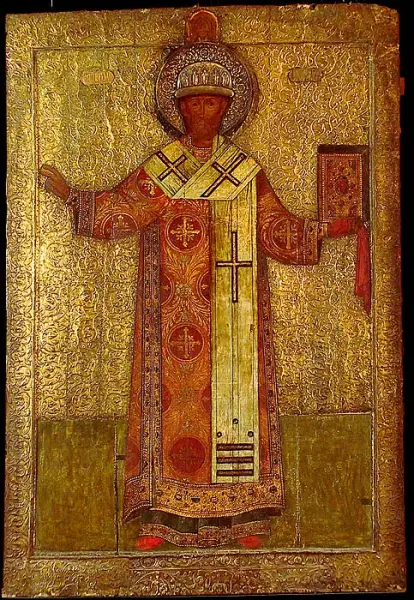
Philip's commemoration took institutional form over generations. The special day honoring the metropolitans and wonderworkers of all Russia, the Synaxis of the Hierarchs of Moscow, had been established by Patriarch Job in 1596 in honor of Saints Peter, Alexis, and Jonah; in 1875 Saint Innocent, Metropolitan of Moscow, proposed that Philip be added to their company, and on October 5 he is celebrated among them. His relics rest in a reliquary in the Dormition Cathedral, and his iconography shows him vested as a hierarch with the omophorion, holding the Gospel Book, his right hand raised in blessing, a man of dark beard flecked with grey. His story has proved as compelling to artists as to the faithful: Sergei Eisenstein placed him at the center of Ivan the Terrible, his 1945 film on the tsar, and Pavel Lungin returned to the same confrontation in his 2009 drama Tsar. He is remembered as one of the tiny company of metropolitans with the nerve to cross Ivan the Terrible to his face, the standard by which courage in the Russian episcopate has been measured ever since, and his veneration continues in both the Eastern Orthodox and Russian Byzantine Catholic Churches.
§ Commemoration
Timeline
- 11 Feb 1507
Born in Moscow into the old boyar family of the Kolychevs.
§ Biography
- 5 Jun 1537
Resolved to become a monk while standing in church for the Divine Liturgy, and secretly left Moscow for the north.
§ Biography
- 25 Jul 1566
Consecrated bishop and seated on the metropolitan throne of Moscow and all Russia, after demanding the oprichnina's abolition.
§ Biography
- 2 Mar 1568
Withheld his blessing from Ivan the Terrible at the cathedral Liturgy and denounced the massacre then under way to his face.
§ Biography
- Nov 1568
The tsar summoned the Holy Synod, which deposed him from the metropolitan see.
§ Biography
- 23 Dec 1569
Strangled in the Otroch Monastery at Tver by the tsar's minion Malyuta Skuratov, two days before Christmas.
§ Biography
- 1590
His relics were translated from Tver to the Solovetsky Monastery, their incorruption having been found when the tomb was opened.
§ Commemoration
- 1652
Patriarch Nikon persuaded Tsar Alexis to bring his relics to Moscow, and he was glorified as a saint that same year.
§ Commemoration
The Record
- Major works
- Construction of two cathedrals, a brickyard, water-mills, storehouses, and a network of canals connecting 72 lakes at Solovetsky Monastery·A new monastic rule (typicon) for the Solovetsky community
- Symbols
- Vested as a hierarch with omophorion, holding a Gospel Book, with his right hand raised in blessing·Iconographically depicted with a medium-sized dark beard with flecks of grey
- Canonization
- Glorified in 1652 by the Russian Orthodox Church
Prayer
Bibliography
Show 6 sources
- "Святой Филипп, митрополит Московский" — профессор Георгий Петрович Федотов. azbyka.ru
- S. Bulgakov, Handbook for Church Servers, January 9. Kharkov, 1900, p. 22
- "Житие митрополита Филиппа". Библиотека литературы Древней Руси, Том 13, часть 21 из 22. azbyka.ru
- "Hieromartyr Philip, Metropolitan of Moscow and All Russia". Orthodox Church in America
- "Филипп, митрополит московский и всея Руси". Brockhaus and Efron Encyclopedic Dictionary, 1906
- Attwater, Donald and Catherine Rachel John. The Penguin Dictionary of Saints, 3rd edition. New York: Penguin Books, 1993
Profile text adapted from the Wikipedia article, licensed CC BY-SA 4.0.
Pray with this saint every day
Save St. Philip II of Moscow to your favorites, read the full profile, and get feast-day reminders in the Saints app.
Get the Saints AppFree on the App Store for iPhone and iPad