
1515 – 1595·Feast May 26
St. Philip Neri
Apostle of Rome and founder of the Oratory
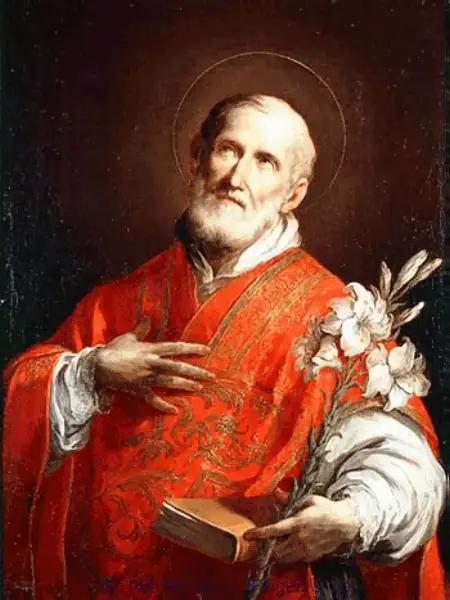
Overview
Philip Neri, born Filippo Romolo Neri, was an Italian priest of the Catholic Church whose Congregation of the Oratory, a body of secular clergy devoted to pastoral care and works of charity, made him one of the great pastoral reformers of his age, and became so identified with the city of his ministry that he is called the Second or Third Apostle of Rome, after Peter and Paul. Born in Florence on July 21, 1515, to a lawyer's family, he was sent at eighteen to assist a wealthy uncle near Monte Cassino, where a religious conversion turned him from hopes of inheritance to the things of God. He moved to Rome in 1533 and for seventeen years lived there as a layman, tutoring, studying, serving the sick and the poor, and walking the streets to draw ordinary people into conversation about the faith. In 1548 he founded a confraternity to aid pilgrims and convalescents, and in 1551 he was ordained a priest, settling at the hospital of San Girolamo della Carità, where his informal evening meetings grew into the Congregation of the Oratory, formally established by papal bull in 1575 at the church of Santa Maria in Vallicella. His joyful spirit, shrewd humor, and gift for friendship drew the great and the poor alike; among his disciples were Caesar Baronius, Palestrina, and many who entered the infant Society of Jesus. He died in Rome in 1595, was beatified in 1615, and canonized in 1622.
The Complete Life
The Florentine Years
Filippo Romolo Neri was born in Florence on July 21, 1515, the son of Francesco di Neri, a lawyer, and Lucrezia da Mosciano, whose family belonged to the nobility in the service of the state. The boy was carefully raised and was taught by the friars of San Marco, Florence's celebrated Dominican house, and in later life he ascribed most of his progress to two of his teachers there, Zenobio de' Medici and Servanzio Mini. At eighteen, in 1533, his family dispatched him to Romolo, an uncle running a prosperous merchant business at San Germano, today's Cassino, a Neapolitan town lying in the shadow of Monte Cassino, hoping he would assist in the business and inherit the fortune. Philip won his uncle's confidence and affection, but the stay bore different fruit: there he experienced a religious conversion, and from that point he ceased to care for the things of this world. In the same year of 1533 he left San Germano for Rome, where his life's work would be done. The move marked the beginning of a dedication to missionary labor within the city itself, first as a tutor in the household of the Florentine aristocrat Galeotto Caccia, then through three years of study under the Augustinians, and finally in the service of the sick and the poor that would earn him the title of Apostle of Rome.
§ Early life
A Layman's Apostolate in Rome
For seventeen years Philip lived in Rome as a layman, probably without any thought of becoming a priest, and the work of those years shaped everything that followed. He ministered to the city's sick and poor, and also to its prostitutes, carrying the Gospel to the people the institutions of the Church rarely reached. In 1538 he took up the street mission that made his name, ranging across Rome to strike up conversation with anyone he encountered and lead them gently toward the things of God. His manner was not that of the preacher in a pulpit but of the friend in the street, and it worked. Around 1544 he came to know Ignatius of Loyola, and many who followed Philip went on to give their lives to the young Society of Jesus, so that this layman of the Roman streets became quietly instrumental in the first years of the Jesuits. In 1548, with his confessor Persiano Rossa, he brought into being the Confraternity of the Most Holy Trinity of Pilgrims and Convalescents, created to look after the thousands of poor pilgrims who crowded into Rome in jubilee years and to relieve patients discharged from the hospitals while still too weak to work. The confraternity met for prayer at the church of San Salvatore in Campo, where the devotion of the Forty Hours' Exposition of the Blessed Sacrament was first brought to Rome.
§ Founding of the Oratory
The Birth of the Oratory
In 1551 Philip was ordained, first deacon and then priest on May 23, and thought briefly of going to India as a missionary until his friends persuaded him that Rome itself offered work in abundance. He settled with companions at the hospital of San Girolamo della Carità, and 1556 saw him give a first, tentative shape to the Congregation of the Oratory, the institute forever linked with his name. At the outset it amounted to evening gatherings in a hall: prayer and hymnody, passages read from Scripture, the fathers, and the Martyrology, capped by an exposition of some religious topic. The musical settings of scenes from sacred history performed at these gatherings took the name oratorio from the room that housed them, and Giovanni Pierluigi da Palestrina, one of Philip's followers, composed music for the services. The program grew; the members preached sermons in different churches every evening, an entirely new idea in Rome, and Philip himself spent long hours in the confessional, effecting many conversions there. In 1564 the Florentines called him to oversee their new church of San Giovanni dei Fiorentini, and his society acquired such figures as Caesar Baronius, Francesco Maria Tarugi, and Ottavio Paravicini, all future cardinals. When the company needed a church of its own, the little parish of Santa Maria in Vallicella was given them, pulled down, and rebuilt in splendor; there, under a papal bull dated July 15, 1575, Philip formally organized the Congregation of the Oratory, whose church was consecrated early in 1577. He insisted to the end that every Oratory founded beyond Rome should be autonomous and self-governing, a rule confirmed by Gregory XV in 1622.
§ Founding of the Oratory
The Saint of Holy Joy
Philip embodied a spirituality of contradictions: popular veneration joined to intensely personal piety, deep involvement in the Church joined to the reform of a corrupt Rome and an indifferent clergy. His signature was joy. Playful humor and a quick, shrewd wit were his trademark; he maintained that gladness of spirit is more Christian than melancholy, and that the heart which rejoices advances toward perfection more readily than the heart that broods. That conviction explains both the crowds he drew and the place he keeps in the folklore of Rome's poor. He prayed to get through today without fearing tomorrow, and his whole bearing was that of what Frederick William Faber called practical commonplaceness, a modern gentleman of courtesy, sportive gaiety, shrewd common sense, and neat dress, in a modern room, with no marks of poverty, who nevertheless carried an ascetic piety unlike any accredited type before his day. Nothing in his genius was monastic or medieval: he preached often and to the people, prayed outside convention, and practiced private devotion that burned hot though it followed no system, suited to a secular age that the old monastic forms could no longer leaven. When his body was examined after death, two ribs were found broken, which his contemporaries attributed to the expansion of his heart while praying fervently in the catacombs around 1545; Benedict XIV diagnosed a simple aneurysm, but Philip and those who confessed to him read in it the working of divine love. His gentleness toward animals is cited in the Catechism of the Catholic Church beside that of Francis of Assisi as an example to be followed.
§ Personal character
Peacemaker and Dying Father
Though Philip ordinarily kept clear of politics, he broke his rule in 1593–1595 for the sake of peace in France. Clement VIII had placed Henry IV under sentence of excommunication and turned his ambassador away, notwithstanding the king's formal renunciation of Calvinism; Philip saw that the pope's intransigence would drive Henry back into heresy and rekindle the civil war. He directed Caesar Baronius, the Oratorian who then served as the pope's confessor, to withhold absolution from the pope and lay down the office unless the anathema was lifted; the whole College of Cardinals had backed the papal policy, yet Clement yielded at once. Henry learned the facts only years afterward and testified warm gratitude for the timely intervention. Philip governed the Oratory until his death and was succeeded by Baronius. His own death came as he would have wished, in the middle of service: on the day of the Feast of Corpus Christi in 1595 he spent the daylight hours hearing confessions and receiving visitors, and around midnight he began to hemorrhage. Baronius read the commendatory prayers over him and asked for a blessing on the spiritual sons gathered at the bedside; speech had left him, and he answered with the sign of the cross, a final blessing, and died. The Chiesa Nuova, Santa Maria in Vallicella, holds his remains.
§ Political activity
Raised to the Altars
Philip's passage to the altars was unusually swift for his era. He was beatified by Pope Paul V on May 11, 1615, only twenty years after his death, and canonized by Pope Gregory XV on March 12, 1622, the same pontiff's brief that confirmed the Oratory's constitution of autonomous congregations. Guido Reni's great altarpiece of the Madonna appearing to the kneeling saint, painted in 1614–1615 for the chapel dedicated to Philip in Santa Maria in Vallicella to mark the beatification, established the iconographic model repeated for the next two centuries, with the composition centered on the saint's mystical experience rather than the apparition itself. The painters of the following generations kept his image before the Church: Pietro da Cortona painted him healing Clement VIII of gout between 1640 and 1642 and filled the vault of the Vallicella with his vision of the Virgin supporting a collapsing beam during the church's reconstruction; Carlo Maratta, Francesco Solimena, Giovanni Battista Tiepolo, Sebastiano Conca, and Jacopo Zoboli all gave the saint canvases for Roman, Neapolitan, and Lombard churches. His memorial is kept on May 26, and the Church of England remembers him with a commemoration on the same day, a rare ecumenical reach for a Counter-Reformation Roman. Many miracles had been attributed to him in life and after death, and his influence was acknowledged in the conversion to personal holiness of many powerful figures within the Church itself.
§ Death and veneration
Oratory, Music, and the Seven Churches
The congregation Philip founded bears his stamp to this day. The Oratory endures as a pontifical society of apostolic life, its priests and lay brothers sharing a common life without formal vows, its rules approved by Paul V in 1612 and leaving a freedom of action unusual among religious foundations; each Oratory is an independent, self-governing community, usually named for its city, administering parishes or campus ministries as its locality requires. The movement spread early through Italy and crossed borders in a distinct French form: the Oratory of Jesus, founded in Paris in 1611 by Pierre de Bérulle, inspired by Philip's model though governed by a Superior General, shaped the French school of spirituality of the seventeenth century, counted Malebranche and Massillon among its members, and after suppression in the Revolution was revived in 1852. Philip's gift for sanctifying delight survives most visibly in music and pilgrimage. His encouragement of the lauda spiritual in the oratory services drew composers of the rank of Palestrina and Tomás Luis de Victoria, and the musical meditations of his evening meetings gave the oratorio its name and its lasting place in sacred art. In 1553 he began the one-day walking pilgrimage to Rome's seven pilgrim churches, from St. Peter's to St. Mary Major, with prayers, hymns, and brief sermons at each station and a meal of bread, wine, cheese, eggs, apples, and salami in the gardens of the Villa Mattei, where musicians played while the pilgrims rested. Designed as a counterpoint to the raucous Carnival, the walk caught on so widely that from it grew the Holy Thursday custom of visiting the seven churches, and the street between St. Paul Outside-the-Walls and San Sebastiano still bears the name Via delle Sette Chiese.
§ Legacy
Timeline
- 21 Jul 1515
Born in Florence, son of the lawyer Francesco di Neri and Lucrezia da Mosciano.
§ Early life
- 1533
Sent at eighteen to help in his uncle Romolo's business at San Germano near Monte Cassino; his stay there brought the conversion that turned his life.
§ Early life
- 1533
Left San Germano to live in Rome.
§ Early life
- 1538
Undertook the citywide mission that made him famous, walking Rome to draw its people into talk of the faith.
§ Founding of the Oratory
- 1544
Made the acquaintance of Ignatius of Loyola; many of Philip's disciples would find their vocations in the young Society of Jesus.
§ Founding of the Oratory
- 1548
Founded with his confessor Persiano Rossa the Confraternity of the Most Holy Trinity of Pilgrims and Convalescents, ministering to poor pilgrims and discharged hospital patients.
§ Founding of the Oratory
- 23 May 1551
Ordained a priest, having received the minor orders and the diaconate that year, and settled at the hospital of San Girolamo della Carità.
§ Founding of the Oratory
- 1553
Began the tradition of the one-day pilgrimage to Rome's seven principal churches, from St. Peter's to Santa Maria Maggiore, with prayer and a shared meal.
§ Seven Churches Walk
- 1556
Tentatively founded the Congregation of the Oratory, a series of evening meetings with prayers, hymns, Scripture readings, and musical settings that gave the oratorio its name.
§ Founding of the Oratory
- 1564
Accepted, with the consent of Pope Pius IV, the care of the Florentines' new church of San Giovanni dei Fiorentini while keeping charge of San Girolamo.
§ Founding of the Oratory
- 15 Jul 1575
Established the Congregation of the Oratory, his community of secular priests, under a papal bull, taking possession of Santa Maria in Vallicella.
§ Founding of the Oratory
- 1587
Named superior of the Oratory for life, while requiring that every congregation founded elsewhere on his model govern itself as an autonomous house.
§ Founding of the Oratory
- 1593
Intervened to reconcile Henry IV of France with the Church, directing Baronius to refuse the pope absolution unless the excommunication of the king was withdrawn.
§ Political activity
- 25 May 1595
Died in Rome on the evening of the Feast of Corpus Christi, after a day spent hearing confessions and receiving visitors.
§ Death and veneration
- 11 May 1615
Beatified by Pope Paul V.
§ Death and veneration
- 12 Mar 1622
Canonized by Pope Gregory XV.
§ Death and veneration
In Their Own Words
A joyful heart is more easily made perfect than a downcast one.
Let me get through today, and I shall not fear tomorrow.
The Record
- Major works
- Founding of the Congregation of the Oratory (1575)·Confraternity of the Most Holy Trinity of Pilgrims and Convalescents (1548)·The Seven Churches Walk pilgrimage tradition·Promotion of the laude and the musical form of the oratorio
- Patron of
- Rome, Italy·Candida, Italy·Mandaluyong, Philippines·Albuquerque, New Mexico·US Special Forces·Institute of Christ the King Sovereign Priest·Catbalogan, Philippines·laughter·joy·comedians·artists·writers
- Canonization
- Beatified May 11, 1615, by Pope Paul V; canonized March 12, 1622, by Pope Gregory XV
Prayer
Bibliography
Show 6 sources
- Danieli, Francesco (2009). San Filippo Neri. La nascita dell'Oratorio e lo sviluppo dell'arte cristiana al tempo della riforma. San Paolo: Cinisello Balsamo
- Ingold, A M.P. (1911). "The Oratory of Saint Philip Neri". In Herbermann, Charles (ed.). Catholic Encyclopedia, Vol. 11. New York: Robert Appleton Company
- Smither, Howard E. (2001). "Filippo Neri". In Sadie, Stanley; Tyrrell, John (eds.). The New Grove Dictionary of Music and Musicians, 2nd ed. London: Macmillan
- Walsh, M., ed. (1991). Butler's Lives of the Saints. New York: HarperSanFrancisco
- Chisholm, Hugh, ed. (1911). "Neri, Philip". Encyclopædia Britannica, Vol. 19 (11th ed.). Cambridge University Press, pp. 389–390
- Ponnelle, Louis and Bordet, Louis (1932). St. Philip Neri and the Roman Society of His Times (1515–1595)
Profile text adapted from the Wikipedia article, licensed CC BY-SA 4.0.
Pray with this saint every day
Save St. Philip Neri to your favorites, read the full profile, and get feast-day reminders in the Saints app.
Get the Saints AppFree on the App Store for iPhone and iPad