
AD 40 – 103 (traditional)·Feast May 12
St. Philip of Agira
Hieromartyr and first missionary to Sicily
Overview
Philip of Agira, whose name survives in the variants Argirò, Aggira, Agirone, Agirya and Argira, was an early Christian clergyman whose life reaches the present through two parallel accounts that set him in different centuries. The traditional biography, preserved in writings ascribed to Athanasius of Alexandria, sets him in the first century: a native of Cappadocia, in the land we now call Turkey, born in the year 40 and put to death as a hieromartyr on May 12 in the year 103, in Roman Sicily. The second version, attributed to a writer named Eusebius, places his birth in Thrace in the time of the emperor Arcadius in the fourth century, his father Theodosius a Syrian, his mother Augia a Roman of noble rank. That account tells how his elder brothers were lost to drowning while fishing, and Philip gave himself thereafter to the service of God. Whatever the truth of his origins, both traditions agree in what they report of his work: the pope sent him to preach in Sicily, where his miracles were many, exorcisms above all, and is honored as the first Christian missionary to visit the island, remembered under the title Apostle of the Sicilians.
The Complete Life
The Two Lives of Saint Philip
No other early missionary has left so divided a biographical record, for two complete and parallel stories of Philip of Agira were handed down, each giving a different century for his life. The older and traditional account travels under the authority of Athanasius of Alexandria: it makes Philip a native of Cappadocia, born in the year 40, a priest of the apostolic generation who died a hieromartyr on May 12 in the year 103 in Roman Sicily. The second biography, ascribed to an author named Eusebius, moves him to the fourth century, in the days of the emperor Arcadius, and supplies a family: a Syrian father named Theodosius and a noble Roman mother named Augia, living in Thrace. This account tells that his older brothers were drowned while fishing, a loss that turned Philip wholly to the service of God. The Church has never discarded either tradition, and the saint himself remains greater than the uncertainty of his legend: a man set apart for God by grief and grace, whose ministry to Sicily is the one fact every account holds in common.
§ Saint Philip of Agira
Apostle of the Sicilians
Philip was sent by the pope to preach the Gospel in Sicily, and in that commission he holds a distinction granted to no other figure of the island's Christian memory: he is honored as the first Christian missionary ever to visit Sicily. For this reason tradition gave him the title Apostle of the Sicilians, the name by which generations of the island's faithful have known him. His preaching, the accounts agree, was accompanied by wonders; he performed many miracles during his Sicilian ministry, and among them exorcisms were especially his mark, so that his power over evil spirits became the trait most firmly attached to his name. The town of Limina in Sicily remembers that he lived there, and the mountains of the island keep his presence in their village cults. Beyond this labor and its fame, the sources fall silent: nothing else about his career can be certainly stated. What remains is the outline of a missionary life, sent from the center of the Church to an island without the faith, and fruitful there beyond all record. The island remembered its first herald of the faith.
§ Saint Philip of Agira
Patron of Agira and Żebbuġ
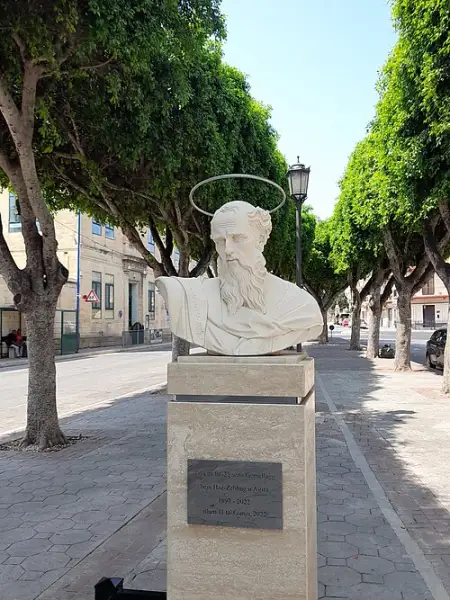
Philip's feast is kept on May 12 in both the Catholic and Eastern Orthodox Churches, and his cult took root so deeply in Sicily that Agira, the city whose name carries his own, claims him as patron, and putatively his relics came to light in the church dedicated to him there. He is honored also at Limina, where the celebration runs across the eleventh, twelfth, and third Sunday of May each year, drawing the surrounding countryside into an annual renewal of his memory. His patronage crossed the sea to Malta, where the city of Żebbuġ claims him as its own, and in modern times it reached further still: Philip is counted among the patron saints of the United States Army Special Forces, a distinction joined to his ancient reputation as a powerful exorcist. The Saint Philip of Agira whose bust stands in Żebbuġ thus connects an obscure early priest, known only through two rival biographies, to communities on three islands and to soldiers of a distant republic, all of them persuaded that the first missionary to Sicily remains a friend in heaven.
§ Veneration
Timeline
- 40
Born, according to the traditional biography, in Cappadocia.
§ Saint Philip of Agira
- 12 May 103
Died in Sicily, honored as a hieromartyr.
§ Saint Philip of Agira
The Record
- Patron of
- Agira, Sicily, Italy·Żebbuġ, Malta·United States Army Special Forces
- Canonization
- Pre-congregation hieromartyr venerated in the Catholic and Eastern Orthodox Churches
Prayer
Bibliography
Show 4 sources
- Daidone, Pina (1998). La vita di San Filippo d'Agira, ch.1 Premessa alla Vita di S. Filippo; La questione delle due agiografie e agiografie riferite
- Ὁ Ἅγιος Φίλιππος ὁ Ἱερομάρτυρας ὁ Ἀργύριος. 12 Μαΐου. ΜΕΓΑΣ ΣΥΝΑΞΑΡΙΣΤΗΣ
- CatholicSaints.Info — Saint Philip of Agira
- Catholic Online – Saints & Angels – Patron Saints
Profile text adapted from the Wikipedia article, licensed CC BY-SA 4.0.
Pray with this saint every day
Save St. Philip of Agira to your favorites, read the full profile, and get feast-day reminders in the Saints app.
Get the Saints AppFree on the App Store for iPhone and iPad