
1572 – 1597·Feast February 5
St. Philip of Jesus
Franciscan missionary and martyr of Nagasaki
Overview
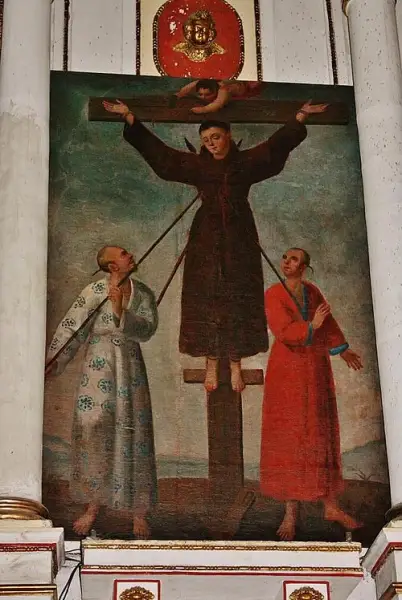
Philip of Jesus, born Felipe de las Casas Ruiz, was a Franciscan missionary of New Spain who died among the Twenty-six Martyrs of Japan and became the first Mexican Catholic saint. Born in Mexico City in 1572 to parents recently emigrated from Spain, he took the habit among the Reformed Franciscans of the Province of St. Didacus, the community Peter Baptista had planted in Mexico. Religious life, though, did not hold him: he walked away for a merchant's career in the Philippines, then sought readmission and was received again at Manila in 1590. Judged ready for ordination, he was sent to Mexico, since the vacant see of Manila left no bishop to ordain him, and he sailed on July 12, 1596 aboard the San Felipe. A storm drove the ship onto the coast of Japan; the seizure of its cargo of soldiers, cannon and ammunition aroused the suspicion of Toyotomi Hideyoshi that the missionaries were agents of conquest, and he ordered the Franciscans arrested. Philip was imprisoned, mutilated, and marched through Kyoto, Osaka and the road to Nagasaki, and on February 5, 1597 he died bound to a cross on the Mount of the Martyrs, pierced with a spear. His bones were carried home to Mexico City in 1598, and he is honored as patron of the Mexican capital.
The Complete Life
A Son of New Spain
In Mexico City in the year 1572, Felipe de las Casas Ruiz came into the world, his parents having lately left Spain for the new viceroyalty, and he grew up a Creole in the capital of New Spain at the height of its missionary age. The Franciscan reform had reached Mexico through the Province of St. Didacus, founded there by Peter Baptista, the friar with whom Philip would one day die, and as a young man Philip joined these Reformed Franciscans. Religious life, however, did not hold him at first. After some months in the order he grew tired of it and walked away, taking up a merchant's career and sailing for the Philippines, another colony of the Spanish crown, where he lived as a layman in the world. The experiment did not satisfy him either. The desire for the friary returned, and he sought readmission to the Franciscans, asking to begin again where he had failed. The order received him a second time at Manila in 1590, and this return proved final: the unsettled novice of Mexico City would die a martyr of the universal Church.
§ Life
The Road Home Through Japan
After some years back in the habit, Philip's superiors judged him ready for ordination to the priesthood, and a practical obstacle shaped the journey that would decide his fate. The episcopal see of Manila stood vacant, and with no bishop available in the Philippines to ordain him, Philip was sent across the Pacific to Mexico, where the Church could confer the sacrament. He sailed on July 12, 1596 aboard the galleon San Felipe, bound for the land of his birth. The voyage met with catastrophe: a storm drove the vessel onto the coast of Japan. The province's governor seized the vessel and threw crew and passengers alike into prison: among them Friar Juan de Zamorra of the Franciscans, three more Franciscan friars, two Augustinians, and a Dominican. When soldiers, cannon and ammunition were discovered in the ship's hold, a terrible suspicion took shape: that the vessel had come to prepare the conquest of Japan, with the missionaries sent ahead to smooth the way. One of the crew gave credence to the story, and it enraged Toyotomi Hideyoshi, the Taikō, whom Europeans called Taicosama. Thus a friar sailing innocently to his own ordination was caught in the machinery of imperial fear.
§ Life
Arrest in Kyoto
On December 8, 1596, Hideyoshi commanded the arrest of the Franciscans at the friary in Miako, the city now called Kyoto, where Philip had gone. Guarded in their own friary until the last day of December, the friars were then moved to the city jail. Their company was a portrait of the mission in miniature: six Franciscan friars, seventeen Japanese Franciscan tertiaries, and the Japanese Jesuit Paul Miki with his two native servants. On January 3, 1597 the sentence of humiliation began; the prisoners' ears were cut, and through the streets of Kyoto they were dragged in show before a jeering public. On January 21 they were taken to Osaka, and from Osaka they were driven on the long winter road toward Nagasaki, which they reached on February 5, 1597. Philip had come to Japan against every intention, a castaway on a hostile shore, and he and his companions were about to give the Church of Japan its most famous witness. The road from Kyoto to Nagasaki became a public spectacle of the faith, walked by a Mexican, his Spanish and Japanese brethren, and a Jesuit of the native church.
§ Life
The Mount of the Martyrs
At Nagasaki the prisoners were taken to a mountain near the city, known afterward as the Mount of the Martyrs. There they were bound upon crosses in the sight of the assembled multitude, and after hanging thus, they were pierced with spears. Philip died on February 5, 1597, at the age of twenty-four or twenty-five, killed by asphyxiation on the cross that the executioners finished with their blades. He died among the company now honored as the Twenty-six Martyrs of Japan, the group that included his old superior Peter Baptista and the Jesuit Paul Miki. The death was meant as a warning to every Christian in Japan; instead it became the seed of their veneration across two continents. The following year, 1598, Philip's bones were brought home across the Pacific to Mexico City, where the Creole who had left the friary and returned to it was received as a martyr and a treasure of the capital. The young man who had once abandoned religious life for commerce had ended as the first of his nation's saints. The cross that was meant to terrorize Japan had instead sent a new saint home to Mexico.
§ Life
From Beatification to Canonization
The Church moved with unusual swiftness to honor the martyrs of Nagasaki. Philip was beatified within the Roman Catholic Church on September 14, 1627, in Vatican City by Pope Urban VIII, thirty years after his death, while the memory of the crucifixions was still fresh in Japan and in New Spain. The cause advanced again in the following century, and on June 8, 1862, in Vatican City, Pope Pius IX canonized Philip together with his companion martyrs, raising the Twenty-six to the altars of the universal Church. By then the cult of the martyrs had shaped Catholic identity on both sides of the Pacific: in Mexico, where Philip was venerated as the first Mexican Catholic saint and the glory of the capital's native-born faith, and in Japan, where the mountain at Nagasaki remained a place of Christian memory through centuries of persecution. His liturgical commemoration was fixed on February 5, the anniversary of the crucifixion, and his icons show him with the spear, the palm branch, and the cross of his passion. In both lands the martyr of Nagasaki stands as the sign that the faith had taken root on Mexican soil.
§ Beatification and canonization
Patron of Mexico City
Philip of Jesus holds the patronage of Mexico City, the capital of Mexico and its largest city, the place of his birth and of the bones returned to it in 1598. His intercession is invoked also in Colima, in Nagasaki itself, where the martyrs are honored as the city's own, in Santa Cruz del Quiché in Guatemala, in Ozatlán in El Salvador, and at El Viso del Alcor in Spain, a geography that traces the Spanish Catholic world from Andalusia to the Philippines. His story has lived in culture as well as liturgy: in 1949 Mexican cinema brought his story to the screen in the film Philip of Jesus, Julio Bracho directing and Ernesto Alonso playing Philip, carrying the martyr of Nagasaki into the cinema of his homeland. For Mexican Catholicism he remains a founding figure of sanctity, the proof that the new world could produce its own saints; for the Franciscan order, a son who failed once and was received back; and for the Church universal, one of the Twenty-six whose crosses on the Nagasaki hillside turned an act of repression into an enduring witness.
§ In popular culture
Timeline
- 1572
Born in Mexico City to parents recently emigrated from Spain.
§ Life
- 1590
Re-entered the Franciscan order and was admitted again at Manila.
§ Life
- 12 Jul 1596
Sailed for Mexico aboard the San Felipe to receive ordination.
§ Life
- 8 Dec 1596
Toyotomi Hideyoshi ordered the arrest of the Franciscans at the friary in Miako, where Philip had gone.
§ Life
- 30 Dec 1596
Transferred with the other prisoners from the friary to the city prison.
§ Life
- 3 Jan 1597
His ears were cropped and he was paraded through the streets of Kyoto.
§ Life
- 21 Jan 1597
Taken with the other prisoners to Osaka, to be marched onward to Nagasaki.
§ Life
- 5 Feb 1597
Crucified on the Mount of the Martyrs near Nagasaki and put to death by spear.
§ Life
- 1598
His bones were brought back to Mexico City.
§ Life
- 14 Sep 1627
Beatified in Vatican City by Pope Urban VIII.
§ Beatification and canonization
- 8 Jun 1862
Canonized with his companion martyrs by Pope Pius IX.
§ Beatification and canonization
The Record
- Patron of
- Mexico City·Colima (city)·Nagasaki·Santa Cruz del Quiché·Ozatlán·El Viso del Alcor
- Symbols
- spear·palm branch·cross
- Canonization
- Beatified September 14, 1627, by Pope Urban VIII; canonized June 8, 1862, by Pope Pius IX
Prayer
Bibliography
Show 6 sources
- Morgan, Ronald J. Spanish American Saints and the Rhetoric of Identity, 1600–1810. Tucson: University of Arizona Press, 2002, pp. 143–169
- "The First Mexican-Born Martyr: A Castaway Friar who was Crucified in Japan". EWTN
- "Figure of St Philip de Jesus", National Heritage Board, Singapore
- Bihl, Michael. "St. Philip of Jesus." The Catholic Encyclopedia, Vol. 12. New York: Robert Appleton Company, 1911
- Boxer, C. R. (1951). The Christian Century in Japan: 1549–1650. University of California Press, p. 164
- Villarreal, Roberto (2005-03-23). "Cine en su Casa / Vida santa. Felipe de Jesus". El Norte, p. 4
Profile text adapted from the Wikipedia article, licensed CC BY-SA 4.0.
Pray with this saint every day
Save St. Philip of Jesus to your favorites, read the full profile, and get feast-day reminders in the Saints app.
Get the Saints AppFree on the App Store for iPhone and iPad