
1st century·Feast May 3
St. Philip the Apostle
Apostle of Bethsaida and martyr of Hierapolis
Overview
Philip the Apostle was one of the Twelve Apostles of Jesus according to the New Testament, and later Christian tradition assigns his preaching to Carthage, Greece, Syria, and the lands of Asia Minor. He came from Bethsaida in Galilee, the town of Andrew and Peter, and bore a Greek name and probably the Greek language, which made him the natural link between Jesus and the Greek-speaking pilgrims of Jerusalem. The Gospel of John records that Jesus called him directly, and that it was Philip who brought Nathanael to the Lord. He appears at the feeding of the five thousand, where Jesus tests him with the question of how to feed the crowd, and at the Last Supper, where his request to be shown the Father draws from Jesus the teaching on the unity of Father and Son. The earliest post-biblical witnesses, Clement of Alexandria and Polycrates of Ephesus as gathered by Eusebius, remember him as a married man with daughters, buried at Hierapolis in Phrygia together with two of them. The apocryphal Acts of Philip embellish the account of his death in that city, crucified upside down and preaching from his cross until he died. His relics were honored at Hierapolis from the first century and later rested in Rome; his feast, kept with that of James the Less, falls on May 3 in the Roman Rite, and the Eastern Orthodox Church celebrates him on November 14.
The Complete Life
Called from Bethsaida
Philip belonged to the inner circle of witnesses from the first. All three synoptic Gospels and the Book of Acts list him among the apostles, always in the fifth place, and the Gospel of John preserves the story of his calling as a disciple of Jesus. He was a native of Bethsaida, the Galilean fishing town that also produced Andrew and Peter, and the evangelist connects him with those brothers from the same city; yet John is careful to say that Jesus found and called Philip directly, with no mention of any prior discipleship under John the Baptist. Philip's first recorded act as a disciple was evangelical: he found Nathanael, the man often identified with Bartholomew, and brought him to Jesus. Alban Butler counts him among the guests at the marriage feast of Cana. Among the four evangelists, it is John who gives Philip the most room. There Jesus tests him at the feeding of the five thousand, asking how the crowd could be fed, and Philip's answer about the loaves became one of his lasting emblems. His name was Greek and he probably spoke the language; the Greek-speaking pilgrims who came up to Jerusalem may even have known him; when certain Greeks at the feast wished to see Jesus, they came to Philip, and he joined with Andrew to carry the request to the Lord. At the Last Supper his plea to be shown the Father gave the Lord the opening to teach the disciples how fully the Son shares the Father's life.
§ Life
The Witness of the Early Church
The New Testament falls silent after the Resurrection, but the earliest historians of the Church preserved Philip's later life. Eusebius, in his history of the early Church, passes along Clement of Alexandria's report that Philip, like Peter, was a husband and father who gave his daughters in marriage; Polycrates is cited next, confirming that Philip was a married man with three daughters, buried at Hierapolis along with two of them, while the third rested at Ephesus. These witnesses place the apostle's maturity in Phrygia, in the Roman province of Asia, where Hierapolis became the center of his memory. An unnamed work, the Acts of Philip, from a writer who was likely a near contemporary of Eusebius, tells of the apostle's preaching and wonders: sent forth after the Resurrection with his sister Mariamne and Bartholomew, Philip preached in Greece, Phrygia, and Syria. The appendix to that work gives an embellished narrative of his martyrdom at Hierapolis, a story embroidered by legend but rooted in the city where Polycrates knew his grave. A story handed down in the apocryphal epistle that Peter is said to have sent Philip, a text of the late second or early third century, keeps the memory when Philip undertook a sole missionary enterprise and was reluctant to rejoin the other apostles gathered at the Mount of Olives, a glimpse of an independent apostolic journey otherwise unrecorded.
§ Early traditions
Martyrdom at Hierapolis
Philip died at Hierapolis, the city of his grave, and the manner of his death was told in more than one form. According to the appendix of the Acts of Philip, headed as the account of the apostle's martyrdom, his preaching and a miraculous healing converted the wife of the city's proconsul, and the furious proconsul put Philip, Bartholomew, and Mariamne to the torture. Next the two men were nailed to crosses head downward, and Philip preached on from his. The sermon from the cross moved the crowd to release Bartholomew, but Philip refused to be taken down, and he died where he hung, a martyr who turned the instrument of his execution into a pulpit. Another tradition gives a different form to his death, remembering him as put to the sword by beheading rather than crucifixion, though still at Hierapolis. The Christian East kept the memory vividly: the Menologion of Basil II depicts the scene, and the Church listed him among the Red Martyrs, those who shed their blood for the faith. Whatever the precise form of his end, the apostolic antiquity of the cult was never doubted, for the city that killed him became the city that kept his tomb, and pilgrims wore out its marble floors over the centuries that followed.
§ Early traditions
The Tomb Beneath the Basilica
Philip's relics came to rest in the crypt of the Basilica of Santi Apostoli in Rome, and a relic of the apostle is likewise honored at the Church of St. Philip the Apostle in Cheektowaga, New York. The greater discovery, however, was made in the field. In 2011 the Italian archaeologist Francesco D'Andria claimed to have located Philip's tomb while digging at ancient Hierapolis, not far from today's Turkish city of Denizli. That tomb, first-century in date and empty of relics, lay at the heart of a three-naved basilica of the fourth or fifth century, the Church of the Sepulchre, centerpiece of a hillside pilgrimage complex that antiquity raised to the apostle; Greek invocations carved long ago venerating Philip are carved into the walls of both tomb and church, and a sixth-century bread stamp shows him holding the loaves of the feeding miracle beside the twin churches. The marble floors of the Church of the Sepulchre were worn down by the thousands who came to pray there. In 2012 the ecumenical patriarch Bartholomew of Constantinople, head of the Orthodox church, offered the liturgy of St. Philip at both sanctuaries, the Sepulchre and the martyrion standing some forty yards off, restoring the ancient pilgrimage. Philip's liturgical memory flourishes on both sides of the divided Church: May 3 in the Roman Rite, November 14 as the primary Orthodox feast, the day before the Nativity Fast sometimes called Philip's Fast, with Armenian and Coptic commemorations in November as well.
§ Possible tomb location
Timeline
- 1945
A Gnostic text bearing Philip's name was found among the Nag Hammadi library discoveries, and the apocryphal Letter from Peter to Philip surfaced in the same find.
§ Apocryphal writings
- 1960
In the short-lived calendar reform, his feast with that of James was transferred from May 1 to May 11 in the Roman Rite.
§ Philip the Apostle
- 1969
The Roman calendar assigned his feast to May 3, where it has remained.
§ Philip the Apostle
- 2011
Italian archaeologist Francesco D'Andria claimed to have discovered Philip's tomb during excavations at ancient Hierapolis, near modern Denizli in Turkey.
§ Possible tomb location
- 2012
Bartholomew, ecumenical patriarch in Constantinople, offered the liturgy of St. Philip at the Sepulchre church and the martyrion of Hierapolis.
§ Possible tomb location
The Record
- Patron of
- Cape Verde·hatters·pastry chefs·San Felipe Pueblo, New Mexico·Uruguay
- Symbols
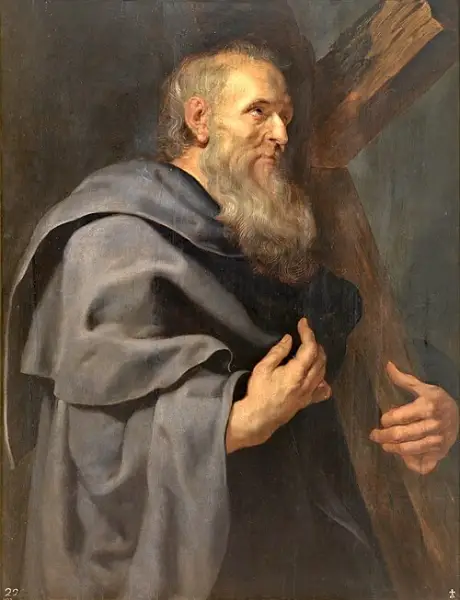
- Red Martyr·elderly, bearded man·holding a basket of loaves·Tau cross
- Canonization
- Pre-congregation martyr venerated by all Christian denominations that honor saints
Prayer
Bibliography
Show 7 sources
- Eusebius, Historia Ecclesiastica III.30–31; translated in G.A. Williamson, Eusebius: The History of the Church. Harmondsworth: Penguin, 1965, pp. 40f
- Craig A. Blaising, "Philip, Apostle" in The Encyclopedia of Early Christianity, ed. Everett Ferguson. New York: Garland Publishing, 1997
- Schaff, Philip (1885). Ante-Nicene Fathers, Volume 8. Christian Classics Ethereal Library
- Drane, John (2010). Introducing the New Testament. Lion Books, p. 240
- Martha Lee Turner, The Gospel According to Philip: The Sources and Coherence of an Early Christian Collection, p. 9. E. J. Brill, 1996
- Fred Lapham, An Introduction to the New Testament Apocrypha. London: T&T Clark International, 2003, p. 78
- "Tomb of Apostle Philip Found". biblicalarchaeology.org, 16 August 2014
Profile text adapted from the Wikipedia article, licensed CC BY-SA 4.0.
Pray with this saint every day
Save St. Philip the Apostle to your favorites, read the full profile, and get feast-day reminders in the Saints app.
Get the Saints AppFree on the App Store for iPhone and iPad