
1st century AD·Feast October 11
St. Philip the Evangelist
One of the Seven Deacons of Jerusalem
Overview
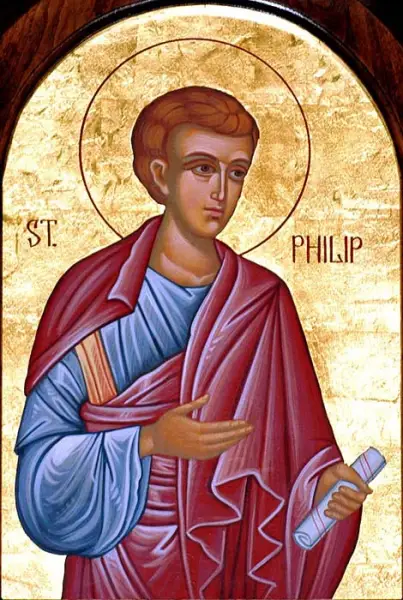
Philip the Evangelist stands among the most vivid figures of the earliest Christian generation. Bearing a Greek name, he first appears in the Acts of the Apostles as one of the Seven appointed to oversee the daily care of the poor in the Jerusalem church, an office created after discontent arose between the Greek-speaking and Hebrew-speaking members of the community. When violence broke out after the killing of Stephen, Philip carried the gospel into Samaria, where his preaching and wonders drew many converts, Simon Magus among them. Directed by an angel to the desert road from Jerusalem to Gaza, he explained the prophets to an Ethiopian court official and baptized him, an encounter that tradition has long cherished as the seed of the Ethiopian Church. Carried away by the Spirit, he preached through the coastal towns until he reached Caesarea Maritima, which became his home. There he brought up four daughters renowned as prophetesses, and there he welcomed the Apostle Paul as a guest on the final journey that led toward Jerusalem.
The Complete Life
A Greek Name in the Jerusalem Church
Philip bore a Greek name, and the detail is more than ornamental, for it marks him out among the first believers as a representative of the Greek-speaking wing of the Jerusalem community. The Acts of the Apostles introduces him in its sixth chapter, at a moment of internal strain: murmuring had arisen from the Hellenists against the Hebrews, because their widows were being overlooked in the daily distribution of food. The twelve apostles, unwilling to abandon prayer and the ministry of the word, asked the community to select seven men of good reputation, full of the Spirit and wisdom, to take charge of this service. Philip was one of those seven, remembered ever afterwards among the Seven Deacons of the earliest church. The office was practical rather than ceremonial, yet it placed him at the very centre of the community's common life, entrusted with the material welfare of its poorest members. In this service he stood beside men such as Stephen, whose witness would soon reshape the movement, and Prochorus, Nicanor, Timon, and Parmenas, names preserved in the same list.
§ New Testament
Preacher in Samaria and on the Gaza Road
After the martyrdom of Stephen a severe disturbance scattered the young church, and Philip went down to a city of Samaria. There he proclaimed the Christ with such effect that crowds gave heed to his words, and the account records extraordinary cures that accompanied his preaching. Even Simon Magus, a local figure of power and astonishment, accepted the message and was baptized among those who believed. From Samaria an angel of the Lord directed Philip southward to the wilderness road that runs from Jerusalem toward Gaza. On that road he came upon the chariot of an Ethiopian, a court official in charge of the treasury of the queen of the Ethiopians, returning from worship in Jerusalem and reading the prophet Isaiah aloud. Philip ran alongside, asked whether the man understood what he read, and beginning from that very passage told him the good news of Jesus. At a stretch of water beside the road the official asked for baptism, and Philip obliged at once. When they came up out of the water the Spirit of the Lord caught the evangelist away, and he was found at Azotus, the ancient Ashdod, from which he passed through the cities, preaching until he came to Caesarea.
§ New Testament
The Apostle to the Ethiopian Eunuch
The meeting on the Gaza road occupied a place of lasting importance in the church's memory, for it has traditionally been taken to mark the beginning of the Ethiopian Church. The man Philip baptized returned to his own country carrying a faith he could not fully explain to others, and the African Christian tradition of later centuries looked back to that chariot ride beside the desert road as its founding hour. Philip himself thus became a bridge figure: a deacon of the Jerusalem community whose obedience in a single journey carried the gospel beyond the land of Israel, across the frontier of ethnicity and ritual purity that divided Jew from Gentile. Later readers also pondered the part played by Scripture in the encounter, since the evangelist did not argue from first principles but began from the page the traveller was already reading, the sorrowful and vindicated servant of the prophet Isaiah. The story fixed in Christian imagination the pattern of every evangelist's work: to draw near, to ask a question, to open the sacred text, and to let the joy of the newly baptized hasten him on his way home.
§ New Testament
Caesarea and the House of the Four Daughters
Philip settled at Caesarea Maritima, the Roman administrative capital of Judaea, and made it his permanent home. Some twenty years after the events recorded in the eighth chapter of Acts, the city once again enters the narrative: the Apostle Paul and his companions, travelling toward Jerusalem for the last time, lodged with Philip, who is there given the title by which he is known to history, the evangelist. The term is rare in the New Testament, appearing elsewhere only twice, and its use here distinguishes this Philip plainly from Philip the Apostle. In that household at Caesarea the visitors met a striking feature of the family: four unmarried daughters who prophesied. Their gift made the house a small centre of Christian prophecy, and it preserved the evangelist's memory in the communities that valued such testimony. According to Eusebius, the Apostolic Father Papias of Hierapolis later met these daughters and received information from them, and a modern scholar has found no strong reason to dispute that contact. In the quiet coastal city, far from Jerusalem, the deacon of the first chapter of the story ended his days in honour.
§ New Testament
Feasts and the Memory of the Evangelist
The church has kept Philip's memory with remarkable agreement across its divided branches. East and West alike keep Philip the Deacon on October 11: the date is observed by Eastern Orthodox and Roman Rite Catholics, by the Missouri Synod Lutherans, and by the whole Anglican Communion, the Episcopal Church in the United States and the Anglican Church of Southern Africa among them. In the Orthodox tradition he is counted among the Seventy Apostles and honoured with the rank of Protodeacon, and this feast is kept on January 4. Very early, however, his figure became entangled with that of Philip the Apostle, a confusion made easy because a respected figure in the apostolic company might easily earn the title of apostle in its broader meaning, one stretching past the original Twelve. A late tradition carries him to Tralles in Anatolia, where he is said to have governed that church as bishop. Through all these shifting memories the evangelist himself endures as he appears in Acts: a man quick to obey an angel, glad to explain a prophet to a stranger, and at home among praying women.
§ Feasts
The Record
- Canonization
- Pre-congregation; honoured as a saint since the apostolic age across the Catholic, Orthodox, and Protestant traditions
Prayer
Bibliography
Show 7 sources
- Sasson, Avi; Marom, Roy; Kharanbeh, Saleh (20 August 2025). Bayyarat al-Khuri: An Ecclesiastical Agricultural Estate in Caesarea, Israel. Palestine Exploration Quarterly. doi:10.1080/00310328.2025.2515756
- Matthews, Christopher (2002). Philip: Apostle and Evangelist: Configurations of a Tradition. Brill. ISBN 978-9004120549
- Salmon, George (1894). A historical introduction to the study of the books of the New Testament (7th ed.)
- Chisholm, Hugh, ed. (1911). Philip the Evangelist. Encyclopaedia Britannica, Vol. 21 (11th ed.). Cambridge University Press, p. 376
- Martyrologium Romanum (Editio Altera ed.). Typis Vaticanis. 2004. OCLC 254598655
- Kinnaman, Scot A.; Lane, Laura L. (2010). Lutheranism 101. Concordia Publishing House. ISBN 978-0-7586-2505-2
- Lesser Feasts and Fasts 2018. Church Publishing, Inc. 17 December 2019. ISBN 978-1-64065-235-4
Profile text adapted from the Wikipedia article, licensed CC BY-SA 4.0.
Pray with this saint every day
Save St. Philip the Evangelist to your favorites, read the full profile, and get feast-day reminders in the Saints app.
Get the Saints AppFree on the App Store for iPhone and iPad