
1st century·Feast January 4
St. Philologus of Sinope
Apostle of the Seventy from Sinope
Overview
Philologus of Sinope belongs to the company of the Seventy Disciples whom the Lord sent out ahead of him, and his name has been carried by the Church's memory since the apostolic age. His home city was Sinope on the Black Sea coast of Asia Minor, a Greek port whose later Christian history would make it famous. The liturgical books commemorate him with the rest of the Seventy on January 4, and a second feast on November 5 joins him with the saints Patrobas, Hermas, Linus, and Gaius, fellow workers whose names stand near his in the closing greetings of the Letter to the Romans. A tradition reported by modern scholarship holds that he was likely the father of Marcion of Sinope, the second-century shipowner whose teaching split from the Church and gave rise to Marcionism, so that the apostle's own son is remembered as one of the faith's most formidable opponents. The Church sings to him as a shining star whose miracles brought enlightenment, an apostle who entreats the merciful Lord to forgive the transgressions of our souls.
The Complete Life
Among the Seventy and in the Roman Greetings
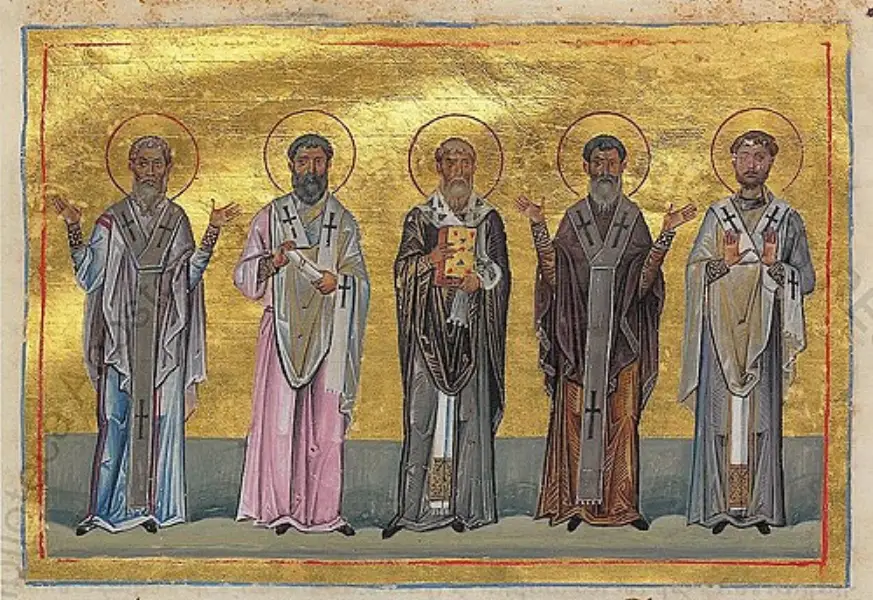
The Church numbers Philologus among the Seventy Disciples, the wider circle of messengers chosen by the Lord beyond the Twelve and sent out in pairs to every city and place he intended to visit. Their company included figures as various as Stephen the first martyr, Titus the companion of Paul, and many whose names survive only in the apostolic greetings. Philologus belongs to this second group, and his commemoration with the full choir of the Seventy falls on January 4, the day the Eastern calendar reserves for them together. A second and more intimate memorial keeps him on November 5 in the company of Patrobas, Hermas, Linus, and Gaius, the very cluster of names with which his own appears in the sixteenth chapter of the Letter to the Romans, where Paul sends greetings to the saints in the imperial capital. In an ancient illustration of the Menologion of Basil II his figure is grouped with Patrobulus, Hermas, Linus, and Caius among the Seventy, a visual testimony to how firmly the tradition fixed his place in the apostolic generation.
§ Philologus of Sinope
Sinope, Hymns, and a Troubled House
The city that gave Philologus his title, Sinope, stood on the northern shore of Asia Minor where the Black Sea meets the Greek world, and in later centuries it produced the most notorious heresiarch of the early Church. Modern scholarship reports the tradition that Philologus was likely the father of Marcion of Sinope, the shipowner and teacher of the mid-second century who rejected the Old Testament and recast the gospel, drawing after him a following so durable that the Church was compelled to define its canon and its faith against him. Whatever the exact bond between them, the contrast is sobering: the apostle who handed on the tradition he had received, and the son whose revision of it his own father's church condemned. Orthodox piety remembers Philologus instead through hymnody. The Troparion sung in Tone 3 invokes him as a holy apostle of the Seventy who entreats the merciful Lord to grant forgiveness of transgressions, while the Kontakion in Tone 4 beholds him as a shining star whose miracles have manifested great enlightenment, and cries to Christ to save those who with faith honour his memory.
§ Hymns
The Record
- Canonization
- Pre-congregation; numbered among the Seventy Disciples of the Lord
Prayer
Bibliography
Show 2 sources
Profile text adapted from the Wikipedia article, licensed CC BY-SA 4.0.
Pray with this saint every day
Save St. Philologus of Sinope to your favorites, read the full profile, and get feast-day reminders in the Saints app.
Get the Saints AppFree on the App Store for iPhone and iPad