
c. 291 – 304·Feast August 11
St. Philomena
Virgin martyr of Rome and wonderworker
Overview
Philomena is honoured as a Greek virgin martyr of the age of Diocletian, though her cult rests on one of the most remarkable archaeological discoveries of modern Rome. On 24-25 May 1802 excavators in the Catacomb of Priscilla on the Via Salaria Nova opened a sealed burial loculus closed with three terracotta tiles whose broken inscription, when rearranged, read Pax Tecum Filumena, peace be unto you, Philomena. Within lay the skeleton of a girl of about thirteen to fifteen, a small vial formerly holding what was taken for blood, and symbols of martyrdom. Her remains were translated to Mugnano del Cardinale in 1805, where devotion grew with extraordinary speed. Miracles were credited to her intercession, most famously the cure of Pauline Jaricot at the shrine in 1835, and Pope Gregory XVI approved her veneration and authorized her feast on 11 August. St John Vianney attributed to her the cures that others attributed to him. On 14 February 1961 the Holy See ordered her name removed from all liturgical calendars, yet her shrine at Mugnano still draws pilgrims from every continent, and she remains known to her devotees as the Wonderworker.
The Complete Life
A Greek Princess and a Vow
Nearly all that is told of Philomena's life derives from the revelations that Maria Luisa di Gesu, a Dominican tertiary of Naples, claimed to have received from the saint herself, accounts which the Holy Office examined on 21 December 1833 and found to contain nothing contrary to the Catholic faith. In her telling, Philomena's father ruled as king in Greece, and he and his consort had both turned to the Christian religion. The child consecrated herself to Christ at about the age of thirteen, taking a vow of virginity that she would seal with her blood. The peace of the little court was broken when the Emperor Diocletian threatened war against her father; the king travelled with his family to Rome to sue for peace, and there the emperor's eye fell upon the young Philomena. He wished to make her his wife, and when she refused, bound as she was by her promise to Christ, his admiration turned to fury. What followed, in the account she gave, was a succession of torments meant to bend her will, each of which left a mark in the symbols that would one day be painted on the tiles of her tomb: the scourge, the anchor, the arrows, and at last the sword.
§ Biography
Cords, Chaplets, and Confraternities
Devotion to Philomena developed sacramentals and associations of its own. The Cord of Philomena, a red and white cord worn beneath the clothing, carried indulgences attached to it, among them a plenary indulgence on the day the cord was first worn, though these were not renewed in the general revision of 1967. The chaplet of Saint Philomena joins three white beads, in honour of the Trinity, to thirteen red beads recalling the thirteen years of her life. A sacramental known as the Oil of Saint Philomena is used in her shrines for the healing of body and soul. The organization of her devotees followed the devotional patterns of nineteenth-century Catholicism. The Messenger of Saint Philomena began publication in Paris in August 1876; on 6 October of the same year the priest Louis Petit founded the Confraternity of Saint Philomena in that city; in November 1886 Pope Leo XIII raised it to the rank of Archconfraternity; and on 21 May 1912 Pope Pius X, by the brief Pias Fidelium Societates, made it a Universal Archconfraternity, declaring its existing statutes fixed, valid, and effective, and any other manner of proceeding null and void, whatever its authority.
§ Veneration
Torments and the Sword
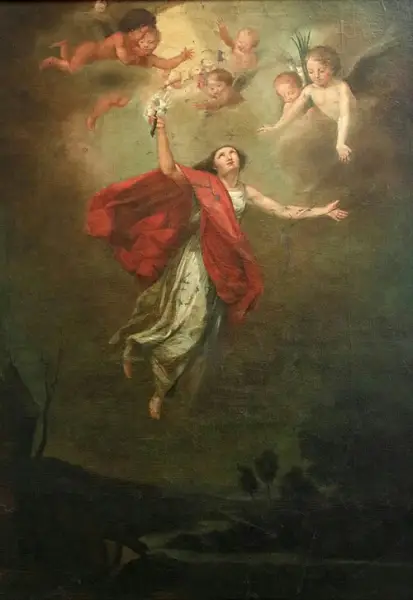
In the revelations recorded by Maria Luisa di Gesu, the refusal of Philomena to yield to Diocletian unloosed a series of torments that her devotees read again in the emblems of her tomb. Scourged until her body failed, she was cured in the night by two angels. Bound to an anchor and thrown into the river, she was raised to the bank when angels cut the rope. Shot through with arrows, she was healed of her wounds the first time; the second time the arrows turned aside; the third time they returned upon the archers and killed six of them, and several of their companions, the account says, became Christians on the spot. Defeated at every turn, the emperor commanded her beheading, and the tradition holds that the sentence was carried out on a Friday at the third hour, the very time of Christ's own death, so that her passing echoed her Master's. She died on 10 August, at about thirteen years of age, and the date became her heavenly birthday, the same day on which, fourteen centuries later, her relics would arrive at Mugnano del Cardinale. The palm, the anchor, the arrows, and the lily leaf on her tomb tiles were read as the whole story told in symbols.
§ Biography
Approval, Feast, and Removal
The rise of Philomena's cult through the apparatus of official recognition was as rapid as its end was abrupt. In 1834 Pope Gregory XVI, moved by the many reported miracles, allowed her veneration; in 1837 he authorized the celebration of her feast on 11 August, beginning in Nola, the diocese that contains Mugnano del Cardinale, and spreading within a short time to other Italian sees. Her name never found a place in the Roman Martyrology, where the beatified and canonized are inscribed, and the Missal's 1920 typical edition mentions her only under 11 August in the section for Masses permitted in particular places, with a Mass taken from the common of virgin martyrs rather than any proper texts of her own. Questions raised by scholars, especially the archaeologist Orazio Marucchi, whose conclusions the church historian Johann Peter Kirsch endorsed, pressed on the date of the inscription and the re-use of tomb materials. On 14 February 1961 the Holy See ordered the feast of Saint Philomena, virgin and martyr, struck from every liturgical calendar, an instruction issued with the application of the 1960 Code of Rubrics, and her cult has continued since as popular devotion rather than liturgical worship.
§ Liturgy
The Tomb on the Via Salaria
The discovery of 1802 began everything. On 24 May, in the Catacombs of Priscilla on the Via Salaria Nova, workers came upon a loculus, a cavity hollowed in the rock of the gallery, and opened it with care the next day. Three terracotta tiles sealed it, bearing in disordered sequence the letters that scholars read, by resetting the leftmost tile at the right, as the farewell Pax Tecum Filumena, peace with you, Philomena. Within lay the skeleton of a girl aged between thirteen and fifteen, and set into the cement lay a tiny glass phial holding traces of what was then presumed to be a martyr's blood, in the archaeology of the period the accepted sign of a saint's grave. The remains were given in 1805 to Canon Francesco De Lucia of Mugnano del Cardinale for his oratory, arriving there on 10 August and moved to the chapel of the new Church of Our Lady of Grace on 29 September. The belief that such vials marked the graves of martyrs was later rejected in the investigations of Giovanni Battista De Rossi, though modern writers such as Mark Miravalle have defended the older view, and a 2005 laboratory study of the tiles concluded they had never been rearranged.
§ Discovery of her remains
Timeline
- 10 Jan 291
Born in Greece, according to the date she revealed in the account of Maria Luisa di Gesu.
§ Biography
- 10 Aug 304
Beheaded in Rome under Diocletian after scourging, drowning, and arrow wounds failed to break her vow of virginity.
§ Biography
- 24 May 1802
Her inscribed burial loculus was found in the Catacombs of Priscilla on the Via Salaria Nova and opened the following day.
§ Discovery of her remains
- 8 Jun 1805
Canon Francesco De Lucia of Mugnano del Cardinale obtained her remains, by then dust and fragments, for his oratory.
§ Discovery of her remains
- 10 Aug 1805
The relics arrived at Mugnano del Cardinale and were placed in the Church of Our Lady of Grace.
§ Discovery of her remains
- 29 Sep 1805
The sacred relics were moved into the chapel of the newly built Church of Our Lady of Grace.
§ Discovery of her remains
- 1827
Pope Leo XII presented the three inscribed terracotta slabs from the tomb to the church at Mugnano del Cardinale.
§ Discovery of her remains
- 21 Dec 1833
The Holy Office declared nothing contrary to Catholic faith in the revelations claimed by Maria Luisa di Gesu.
§ Biography
- 1834
Pope Gregory XVI allowed the veneration of Philomena on account of the many reported miracles.
§ Liturgy
- 10 Aug 1835
Pauline Jaricot, founder of the Society for Propagating the Faith, recovered at the Mugnano shrine.
§ Veneration by other saints
- 1837
Gregory XVI authorized the celebration of her feast on 11 August, first in the Diocese of Nola and then elsewhere in Italy.
§ Liturgy
- Aug 1876
The first issue of the Messenger of Saint Philomena was published in Paris.
§ Veneration
- 6 Oct 1876
The priest Louis Petit founded the Confraternity of Saint Philomena in Paris.
§ Veneration
- Nov 1886
Pope Leo XIII raised the Confraternity of Saint Philomena to the rank of Archconfraternity.
§ Veneration
- 21 May 1912
Pope Pius X raised the Archconfraternity to the rank of Universal Archconfraternity by the Apostolic brief Pias Fidelium Societates.
§ Veneration
- 14 Feb 1961
The Holy See ordered her name removed from all liturgical calendars in an instruction applying the 1960 Code of Rubrics.
§ Liturgy
In Their Own Words
The current statements (regarding St. Philomena) are and remain always fixed, valid and effective; in this way it has to be judged as normative; and if it is proceeded in another way, it will be null and void, whatever its authority.
The Record
- Patron of
- babies·infants·youth
- Symbols
- martyr's palm·crown of white and red roses·arrows·anchor·partially slit throat
- Canonization
- Never formally canonized; her cult received papal approval from Pope Gregory XVI in 1834, and her feast was authorized in 1837 but removed from all liturgical calendars in 1961
Prayer
Bibliography
Show 8 sources
- Acta Apostolicae Sedis, 1961, p. 174. Instruction De calendariis particularibus (1961)
- st philomena. Catholic Online. Retrieved 2019-10-03
- O'Sullivan, Paul (1993). St. Philomena: The Wonder-Worker (8th ed.). TAN, Gastonia U.S.A. ISBN 0895555018
- Missale Romanum 1920
- Enciclopedia dei Santi: Santa Filomena di Roma
- Kirsch, Johann Peter. St. Philomena, in The Catholic Encyclopedia, Vol. 12. New York: Robert Appleton Company, 1911
- Pope Paul VI, Apostolic Constitution Indulgentiarum doctrina (1 January 1967)
- Carter, Michael S. (2018). Glowing With the Radiance of Heaven: Roman Martyrs, American Saints, and the Devotional World of Nineteenth-Century American Catholicism. U.S. Catholic Historian 36, pp. 1-26. doi:10.1353/cht.2018.0001
Profile text adapted from the Wikipedia article, licensed CC BY-SA 4.0.
Pray with this saint every day
Save St. Philomena to your favorites, read the full profile, and get feast-day reminders in the Saints app.
Get the Saints AppFree on the App Store for iPhone and iPad