
1522 – 1589·Feast February 19
St. Philothei of Athens
Martyr and philanthropist of Ottoman Athens
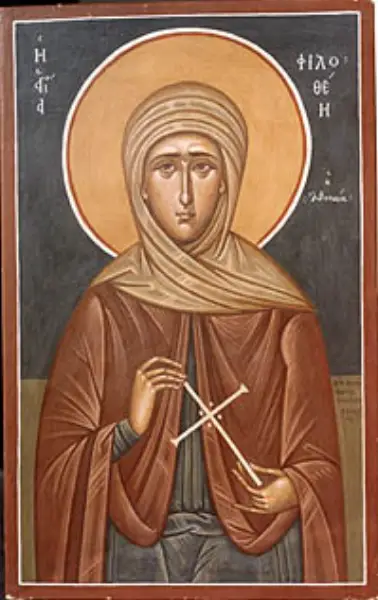
Overview
Philothei of Athens, born Revoula Benizelos, stands among the most beloved figures of the Greek Church under Ottoman rule. She came into the world on 21 November 1522, the long-awaited child of Angelos Benizelos and Syrigi Palaiologina, both members of old Byzantine families who had begged God for offspring. Married unwillingly at fourteen to the noble Andrea Chila and mistreated by him, she was widowed at seventeen and refused every attempt to marry her a second time, choosing instead a life of prayer and charity. When her parents died in 1549 she inherited great wealth, and with it she built: first a convent for women placed under Saint Andrew's patronage, where she received the religious name Philothei, and afterwards a quieter second house at Patisia. She raised hospices and refuges for the aged, opened classrooms for the daughters and sons of Athens, and paid ransom for Greek women dragged into Ottoman harems, sheltering them and moving them by stealth to safe islands at the risk of her life. Assaulted by Ottoman mercenaries within her monastery in October 1588, she succumbed on 19 February 1589 to the harm they inflicted, honoured ever since as a martyr of charity.
The Complete Life
The Long-awaited Child of the Benizelos Family
Revoula Benizelos was born into the highest rank of Ottoman-era Athenian society. Her father, Angelos Benizelos, and her mother, Syrigi Palaiologina, both came from old Byzantine families whose names carried weight through generations of Greek life under Turkish dominion. For years the couple remained childless, and it was only after fervent prayer, the family's account relates, that her mother at last bore a daughter, whom they named Revoula. The circumstances of her birth marked her out from the beginning, and the wealth and standing of her house opened every door in the city to her. Yet the conventions of her class pressed upon her early and hard: against her own will, and still only fourteen, she was given in marriage to the noble Andrea Chila. The union brought her no happiness: Chila abused her. His death came in 1539, when she was barely seventeen, leaving her beautiful, wealthy, and free, and her parents urged her toward a second marriage. She refused them all, remaining at home and giving her days to prayer, while her generosity toward the poor of Athens had already won her the respect and love of the whole community.
§ Life
Widow, Heiress, and Founder of a Monastery
The deaths of her parents in 1549 transformed Revoula from a wealthy daughter into one of the great heiresses of Athens, the owner of extensive holdings across the city and its surrounding lands. She resolved to dispose of that inheritance in a single direction: the service of God and of the suffering people among whom she lived. Embracing the monastic life, she established around the year 1551 a women's monastery placed under the patronage of Saint Andrew, and upon entering it she took the name Philothei, by which history has known her ever since. The house was no retreat from the world but a school within it. There the sisters gave lessons in needlework, weaving, household management, and cookery, so that the women and girls who arrived were readied for dignified domestic life in a society that offered few protections to a woman alone. In an Athens ground down by Ottoman taxation and neglect, the monastery became a place where daughters of poor families learned skills, found shelter, and encountered a form of womanhood independent of both marriage market and necessity. The foundation under Saint Andrew was the first fruit of a philanthropy that would grow to fill her whole life.
§ Life
Philanthropy, Ransom, and Rescue
Philothei is remembered above all for the sheer abundance of her charity. Her convent anchored a network of charitable establishments that reached across Athens and out to the islands of the Aegean Sea. At Patisia she built a second and more secluded monastery, and around it she erected hospices, refuges for the aged, and classrooms for the city's girls and boys, an educational undertaking remarkable for its inclusion of daughters as well as sons. The work that made her both famous and hunted was the ransom of captives. She bought back the freedom of Greeks enslaved by the Ottoman Turks, above all women seized into the harems, and she did not stop at purchase: she sheltered the escaped women, some of them pregnant, within her own houses, and when Turkish pursuers closed in she conveyed them covertly to Tzia, Andros, Aegina, and Salamina, islands where no pursuer could reach them. The cost mounted relentlessly. In a letter of 22 February 1583 to the Venetian Senate she asked for monetary support to discharge debts built up from ransom money, duties, bribes, and taxes owed to the occupying power, while her monasteries suffered repeated plundering and the farming programme that sustained her work lay devastated.
§ Life
Persecution, Beating, and Martyrdom
The end came through the very work of mercy that defined her. Four women who had escaped Ottoman harems ran to her for refuge, and she received them; their pursuers traced them to her doors. Philothei was seized, beaten, and dragged before the magistrate, who threw her into jail. Friends stepped in, buying her freedom from the district governor, but the incident made plain how much her enemies now feared and hated her. As her fame grew among the suffering Greeks of Attica, so did the animosity of those whose power her rescues defied. On 3 October 1588, in the course of the evening vigil, four Ottoman mercenaries forced their way into the Patisia monastery and battered her so violently that she never rose from bed again. For more than four months she lay suffering the effects of the assault, bearing it with the patience that had marked her whole life. On 19 February 1589, at sixty-six, she died in the city of her birth and her labour from what the assault had left in her body. The Church has never doubted that the blows of that October night were the price of her witness, and honours her as a true martyr.
§ Life
A Saint Acknowledged by the Church
The recognition of Philothei's sanctity came swiftly. Only a few years after her death the Church enrolled her among its saints, during the patriarchate of Matthew the Second, whose tenure on the Constantinopolitan throne ran from 1595 to 1600, so that within a decade of her martyrdom her name had entered the synaxaria of the Orthodox world. The Eastern Orthodox Church ranks her among its martyrs, and her memory is kept on 19 February, the anniversary of her death. In Athens her cult took root at the centre of the city's own religious identity: together with Hierotheus and Dionysius the Areopagite, Philothei is venerated as a patron saint of Athens itself, an uncommon distinction for a figure of the Ottoman period. Her relics are interred in the Metropolitan Cathedral of Athens, where the faithful venerate them to this day, and the gratitude of the city is written into its very map, for the district of Filothei bears her name. The liturgical tradition has given her a Troparion in Tone 5, sung by the faithful of Athens and of all the world in honour of the martyred nun.
§ Veneration
Memory in Stone and Story
The physical traces of Philothei's life still anchor her memory in Athens. Her family mansion stands in Plaka, and its great bay window on the south facade looks out over the oldest quarter of the modern city; the Benizelos house is accounted very probably the oldest dwelling in Athens, and it has become a place of pilgrimage for those who come to honour the saint born within it. Her monastic foundations continued the work she gave them long after her death, and the schools, hospices, and charitable houses she scattered through Attica set a pattern of Orthodox philanthropy under Ottoman rule that later generations would study and imitate. The Troparion composed in her honour states the Church's verdict with simplicity: believers pay her honour and delight in her sacred remains, since she gave up this fleeting life for the life without end by her struggle and martyrdom. Heavenly patron of Athens, of women, and of every work of charity, she remains for the Greek Church the model of the active holiness that prays, builds, teaches, ransoms, and finally accepts the blow of the persecutor without withdrawing its hand from the poor.
§ Veneration
Timeline
- 21 Nov 1522
Born Revoula Benizelos in Athens, the child of Angelos Benizelos and Syrigi Palaiologina.
§ Life
- 1536
Married against her will, at the age of fourteen, to the noble Andrea Chila, who mistreated her.
§ Life
- 1539
Widowed at seventeen when Andrea Chila died; she declined her parents' pressure to remarry.
§ Life
- 1549
Her parents died, leaving her the owner of extensive holdings in and around Athens.
§ Life
- 1551
Established her first convent, dedicated to Saint Andrew, and received in religion the name Philothei.
§ Life
- 22 Feb 1583
Wrote to the Venetian Senate asking monetary support for debts incurred through ransoms, duties, bribes, and taxes.
§ Life
- 3 Oct 1588
Four Ottoman mercenaries broke into the Patisia monastery during the evening vigil and beat her severely.
§ Life
- 19 Feb 1589
Died bedridden from the injuries inflicted in the attack on her monastery.
§ Life
In Their Own Words
The Faithful of Athens and all the world honor Philothei the martyred nun and rejoice in her holy relics. For she has exchanged this passing life for the life that knows no end through her struggle and martyrdom; and she begs the Savior to have mercy on us all.
The Record
- Major works
- Women's monastery under the patronage of Saint Andrew, Athens·Second monastery at Patisia·Hospices and homes for the elderly in Athens·Schools for the girls and boys of Athens
- Patron of
- Athens·women·charitable works
- Canonization
- Canonized by the Ecumenical Patriarchate under Patriarch Matthew II, between 1595 and 1600
Prayer
Bibliography
Show 4 sources
- Saint Philothei the Righteous Martyr of Athens, Greek Orthodox Metropolis of Toronto
- St. Philothei of Athens 1522-1589, Pemptousia, 2 November 2011
- Troparia to Saint Philothei, Antiochian Christian Archdiocese of North America
- Topping, Eva Catafygiotu. Philothei the Athenaia, in Holy Mothers of Orthodoxy
Profile text adapted from the Wikipedia article, licensed CC BY-SA 4.0.
Pray with this saint every day
Save St. Philothei of Athens to your favorites, read the full profile, and get feast-day reminders in the Saints app.
Get the Saints AppFree on the App Store for iPhone and iPad