
1st century·Feast September 3
St. Phoebe
Deacon of Cenchreae and Benefactor of the Church
Overview
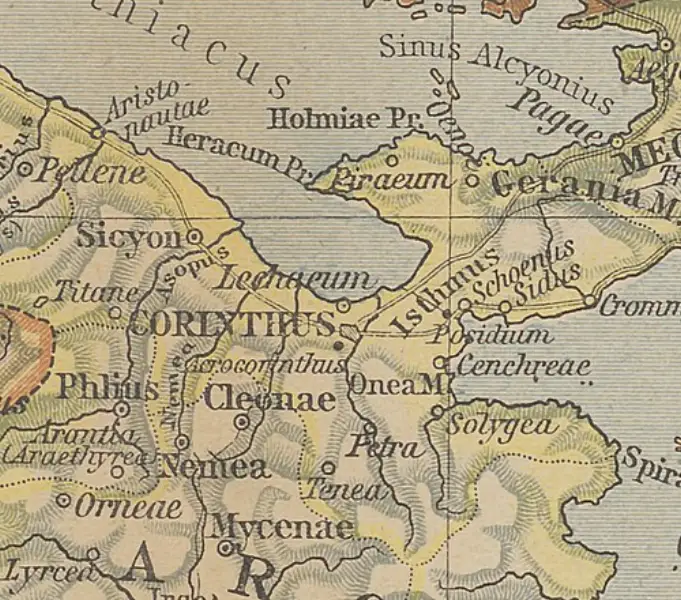
Phoebe was a Christian woman of the first century who served the church of Cenchreae and holds a singular place in the New Testament. In the sixteenth chapter of his Epistle to the Romans, the Apostle Paul commends her to the Christian community at Rome as both a deacon and a benefactor of many, the only woman in his writings to carry those two distinctions together. She was evidently a woman of means: the title prostatis, which Paul applies to her, points to a patroness who gave financial backing to his apostolate, received the church into her home, and extended hospitality to the apostle himself. Paul entrusted her to carry his great letter to the Christians of Rome, a community he had never met, and to present his credentials on his behalf. Scholars continue to weigh the significance of her office and patronage, but the churches of East and West have honored her since antiquity as a deaconess and a witness to the faith, keeping her memory each September.
The Complete Life
Called a Deacon
Paul designated Phoebe with the Greek word diakonos, from which the office of deacon takes its name. In his writings the term sometimes denotes a Christian appointed to serve as a special assistant to the overseers of a church, and at other times simply a servant in a general sense. Yet the church at this inaugural stage of its formation had not settled its offices into consistent, clearly defined shapes, and Rosalba Manes, a student of the New Testament, reads Paul's choice of the word as pointing to something fuller: on her account Phoebe, like Stephen and Philip, exercised a ministry that went past works of charity into preaching and the winning of converts. She stands alone in Scripture as the only woman named as a deacon, a word whose plain meaning is servant. The letter to Timothy, in listing the qualities required of deacons, speaks of the women in the same breath, and translators have long debated whether that passage describes female deacons living by identical standards or simply the wives of male officeholders; the predominant reading follows the old English rendering that speaks of their wives.
§ diakonos
Bearer of the Letter to the Romans
The letter that made Phoebe's name known to every later generation was composed in Corinth between the years 56 and 58, written to win support for a missionary journey Paul hoped to make to Spain. Although he had never set foot in Rome, he knew the Christian community there by report, above all through Priscilla and Aquila, who had lived in the imperial capital before settling in Corinth. Some scholars believe it was Phoebe who carried this epistle to the Roman church. To introduce her, Paul supplied the community with her credentials, for they were not acquainted with the woman who stood before them bearing his letter. Students of the New Testament remain divided over whether the sixteenth chapter, Paul's letter of recommendation for Phoebe, was addressed to the congregation at Rome or to the more familiar community at Ephesus. Whatever the destination, the commission itself is remarkable: a traveling letter of the apostle, destined to become the most theologically weighty document of the Christian Scriptures, was placed in the hands of a woman from a Greek port town. The choice told the Romans everything about the trust the apostle reposed in her.
§ Background
A Patroness of Many
The second title Paul bestows on Phoebe, prostatis, opens a window onto her standing and her generosity. In classical Greek the masculine form of the word signified a chief or leader, or a guardian and protector, often within a religious context, and it later served to render the Roman idea of a patron. Paul's usage shows that the term had lost none of this range by New Testament times. Its application to Phoebe suggests a woman of means who contributed financial support to Paul's apostolate, who in all likelihood received the Cenchreae congregation into her house, and who welcomed Paul himself with shelter and a table whenever he was in the town. Paul himself acknowledges that she had been a benefactor of many, and of him not least. Her patronage, then, was not an ornament of wealth but a form of service: she placed her resources, her house, and her person at the disposal of the gospel, and the apostle judged that a church which had never seen her should know these things before they received her. Riches, in her hands, became the seedcorn of the apostolate.
§ prostatis
Remembered by the Churches
The churches that trace their descent from the apostolic age have kept Phoebe's memory across the centuries. The Catholic Church, the Eastern Orthodox Church, and the Episcopal Church in the United States assign her feast to September 3, the Episcopal calendar ranking it among its Lesser Feasts. The Lutheran Church-Missouri Synod remembers her later in the year, on October 25, while the Evangelical Lutheran Church in America commemorates her with Lydia of Thyatira and Dorcas on January 27, a date set just after the feast of the Conversion of St. Paul and near the commemoration of the early missionaries Silas, Timothy, and Titus. The placement is telling: the churches group her with the first generation of those who carried the faith from Jerusalem to the wider world. In the Coptic Orthodox tradition she is numbered among the disciples of the Lord. Her name means pure, radiant, or bright, and it belonged in Greek mythology to a Titan; the Christian Phoebe gave the name a new and enduring luster. Nineteen centuries on, her name is still read aloud in the assemblies of the faithful whenever the sixteenth chapter of Romans is proclaimed.
§ Veneration
In Their Own Words
I commend to you our sister Phoebe, deacon of the church in Cenchreae. I ask you to receive her in the Lord in a way worthy of his people and to give her any help she may need from you, for she has been the benefactor of many people, including me.
The Record
- Major works
- Delivery of Paul's Epistle to the Romans to the church in Rome
- Canonization
- Pre-Congregation
Prayer
Bibliography
Show 14 sources
- Quient, Allison. "Phoebe: Helper or Leader?" Arise, 14 Mar 2013. Christians for Biblical Equality
- Campbell, Joan Cecelia. Phoebe: Patron and Emissary, Liturgical Press, 2015. ISBN 9780814684023
- Rom. 16:1-2
- Jewett, Robert. Romans: A Commentary (Minneapolis, MN.: Fortress Press, 2007), p. 943
- Borg, Marcus and John Dominic Crossan (2009) The First Paul: Reclaiming the radical visionary behind the church's conservative icon. London: SPCK (51)
- Macy, Gary (1 June 2016). "John Nobili, SJ, Chair of Theology, Santa Clara University". National Catholic Reporter. Retrieved May 17, 2020
- William Arndt et al., A Greek-English Lexicon of the New Testament and Other Early Christian Literature (Chicago: University of Chicago Press, 2000), 230
- Manes, Rosalba. "Phoebe a woman of luminous charity", L'Osservatore Romano, January 2, 2018
- MacDonald, Margaret Y., "Was Celsus Right? The Role of Women in the Expansion of Early Christianity", Early Christian Families in Context: An Interdisciplinary Dialogue, ed. David L. Balch and Carolyn Oziak (Grand Rapids, MI: Eerdmans, 2003), p. 166
- Elwell, Walter A. "Entry for 'Deacon, Deaconess'". Evangelical Dictionary of Theology, 1997
- "Deacon, Deaconess - Baker's Evangelical Dictionary of Biblical Theology Online"
- KJV footnote
- Liddell, Scott & Jones, 1882, Lexicon, s.v.
- Lesser Feasts and Fasts 2018. Church Publishing, Inc. 2019-12-17. ISBN 978-1-64065-235-4
Profile text adapted from the Wikipedia article, licensed CC BY-SA 4.0.
Pray with this saint every day
Save St. Phoebe to your favorites, read the full profile, and get feast-day reminders in the Saints app.
Get the Saints AppFree on the App Store for iPhone and iPad