
c. 815 – 893·Feast February 6
St. Photios the Great
Ecumenical Patriarch and Pillar of Orthodoxy
Overview
Photios the Great, patriarch of Constantinople in the ninth century, stands among the towering figures of Byzantine church history. Born about 815 into a noble family of the capital, related to two earlier occupants of the patriarchal throne, he was reared during the second Iconoclasm, when his father's steadfast defense of the holy icons brought persecution upon the household. A man of vast erudition, he gathered a celebrated library of learning in theology, history, philosophy, law, and medicine, and as a layman served the empire as captain of the guard and chief imperial secretary before taking part in an embassy to the Abbasid court at Baghdad. In 858 Emperor Michael III raised him from the ranks of the laity to the patriarchal throne in place of the deposed Ignatius, an act that ignited the quarrel remembered as the Photian schism. Twice deposed and twice restored, condemned by one council and vindicated by another, he nevertheless governed the Great Church with distinction, fostered the conversion of the Slavs, sought reunion with the Armenian church, and defended the East against the addition of the Filioque to the Creed. He died in exile on 6 February 893, and the Orthodox Church honors him as a saint and confessor.
The Complete Life
A Noble Household Tested by Fire
Photios was born at Constantinople around the year 815 into one of the notable families of the Byzantine capital. Sanctity and ecclesiastical office ran in his line: his mother was sister to Patriarch John VII, and his great-granduncle was Saint Tarasius, who had governed the Church of Constantinople from 784 to 806 under Empress Irene and Emperor Nikephoros I. The family paid dearly for its convictions when the second Iconoclasm began in 814, for his father Sergios was a prominent defender of the icons, and persecution fell upon the household until the restoration of the images in 842. Of his schooling the sources say almost nothing, yet the celebrated library he assembled attests to command of every discipline his age prized, from theology, history, and grammar to philosophy, jurisprudence, and the healing arts, without parallel in his generation. Most scholars doubt that he ever held a university chair, but even as patriarch he taught eager young students in his own home, which became a center of learning, and he counted the mathematician Leo among his friends. Drawn in youth to the monastic life, he took up a secular career instead: through his family's tie to the imperial house he became captain of the guard, then chief imperial secretary, and at an uncertain date journeyed on embassy to the Abbasids of Baghdad.
§ Secular life
From the Court to the Great Church
Photios's ecclesiastical ascent was as sudden as it was extraordinary. After Caesar Bardas and the young Emperor Michael III overthrew the regency of Theodora and the minister Theoktistos in 856, conflict flared between Bardas and Patriarch Ignatius, who refused the caesar entry to Hagia Sophia amid reports of an illicit relationship. Bardas and the emperor answered by confining Ignatius on a charge of treason, leaving the patriarchal throne vacant, and filling it with Photios, a kinsman of Bardas and still a layman. Within a single week he received the whole order of the clergy: tonsured a monk on 20 December 858, he was ordained lector, sub-deacon, deacon, and priest on the four following days, and on Christmas Day, the patronal feast of Constantinople's cathedral, he received episcopal consecration and was enthroned as patriarch. A local synod in 859 examined the irregularity and confirmed both the removal of Ignatius and the election of his successor. But the partisans of the deposed patriarch appealed to Rome, and the internal dispute swelled into an ecclesiastical controversy of ecumenical proportions, one that the passage of more than eleven centuries has never wholly stripped of his name.
§ Patriarch of Constantinople
Schism, Councils, and the Field of Bulgaria
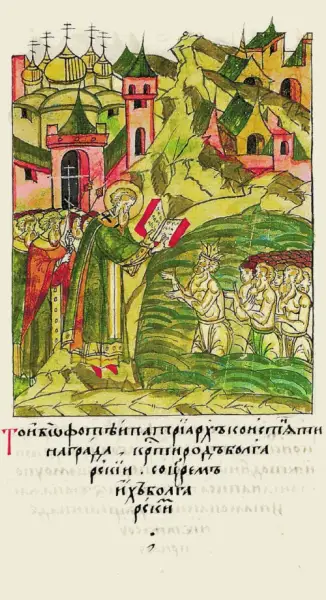
The quarrel over Photios's throne became a quarrel between Constantinople and Rome. Pope Nicholas I dispatched legates to investigate; finding Photios firmly established, they consented to his confirmation at a synod in 861, only for the pope to repudiate them and, at a Roman synod in 863, to depose Photios and reinstate Ignatius, thereby triggering a schism. Four years later Photios convened a council of his own and moved to excommunicate the pope as a heretic because of his teaching on the double procession of the Holy Spirit. Rival claims to jurisdiction over the newly converted Bulgarians embittered the contest still further, though Photios also took a decisive part in the conversion of the Slavs to Christianity. The murder of his patron Bardas in 866 and of Michael III in 867 changed everything: Basil I, the new emperor, courted Rome and the western court, deposed Photios about the end of September 867, and saw him condemned by the council of 869-870. He worked equally for the East, twice striving to bridge the confessional differences between the Greek and Armenian churches. Restored after Ignatius died in 877, he obtained recognition from a council at Constantinople in November 879, standing firm against apology to the pope, the surrender of Bulgaria, and the Filioque.
§ Patriarch of Constantinople
The Monk Beneath the Mitre
Behind the public strife stood a man who had wanted to be a monk. Photios himself says that in youth he inclined toward the monastic life before state service claimed him, and the longing never wholly left him. His two forcible removals from the patriarchate became seasons of monastic endurance: from his first exile at the Skepi monastery he wrote letters that reveal a suffering churchman laboring with patience and persuasion for his restoration, and his final years were passed, like his death, among the monasteries of Armenia. Even the hostile stories told about him acknowledge the power of his mind. His enemies devised the slander that he had purchased knowledge from a magician at the price of his faith, while the famous account of his two-souls theory, a fanciful argument contrived to embarrass Ignatius, displays an intellect that delighted in dialectic. Yet his theology was never mere play. The Mystagogy of the Holy Spirit, his principal dogmatic work, set out the Eastern teaching on the eternal procession of the Spirit with the conviction of a confessor defending the faith of the undivided Church. Scholar and ascetic at once, he joined the discipline of the library to the endurance of the cloister.
§ Patriarch of Constantinople
Deposal, Trial, and Exile
The last years of Photios were bound up with the fortunes of the Macedonian dynasty. During the altercations between Basil I and his heir Leo VI, Photios took the emperor's side, and in 883 his intervention helped dissuade Basil from blinding the prince, who had been accused of conspiracy and confined to the palace. In 886 Basil died of injuries suffered while hunting, and Leo, now emperor, deposed Photios and replaced him with his own brother Stephen, sending the old patriarch into exile at a monastery in Armenia; correspondence with Pope Stephen V confirms that Leo extracted a formal resignation from him. In 887 Photios and his protege Theodore Santabarenos were tried for treason before a tribunal of senior officials headed by Andrew the Scythian. Accounts favorable to Photios imply that the tribunal acquitted him, yet the Pseudo-Simeon chronicle records unmistakably that he was exiled to the monastery of Gordon, and there he died on 6 February 893. He did not remain in disgrace to the end: Leo VI seems to have rehabilitated his reputation within a few years, an epitaph of about 888 portrayed him as the legitimate archbishop and an instrument of unity, and some chronicles record that his body was allowed burial at Constantinople.
§ Patriarch of Constantinople
From Disputed Throne to the Calendar of Saints
Veneration of Photios took root in the environs of Constantinople soon after his death. A manuscript of the Typicon used by the Great Church, copied around the middle of the tenth century, already lists him among the saints with a commemoration on February 6, and the historian Francis Dvornik judged that he must have been honored as a saint by the second half of that century at the latest. The anti-Photian biographer of Ignatius records that partisans of the ex-patriarch strove after his passing to win him recognition as a saint, and the court poet Leo Choirosphaktes composed a poem in his memory alongside verses on other great men of the age. The contemporary Eastern Orthodox Church venerates him as Saint Photius the Great, adorning him with the titles Pillar of Orthodoxy, Equal to the Apostles, and Confessor of the Faith, and assigns his feast to February 6. The Byzantine Catholic Churches likewise commemorate him as a venerable father and confessor. Western judgment of his career remained divided: Catholic tradition upheld a Fourth Council of Constantinople that anathematized him, while the Orthodox Church upheld a later council that reversed the verdict, and the contested assemblies mark the close of the unity represented by the first seven Ecumenical Councils.
§ Veneration
The Leading Light of a Renaissance
Photios is counted among the most famous figures not only of ninth-century Byzantium but of the whole history of the empire. He is judged the strongest and most consequential churchman Constantinople had seen since John Chrysostom, and the foremost mind of his day, the beacon of what is called the renaissance of the ninth century. To the canon law of the East he proved the great systematic compiler: his two-part compilation became and remains the standard repository of early canon law for the Greek Church, holding in the East a place like Gratian's in the West. His literary monument remains extraordinary. The Bibliotheca preserves extracts and abridgements of some 280 volumes, many now lost, and to it the modern world owes nearly everything that survives of Ctesias, of Memnon's history of Heraclea, of Conon, of Diodorus Siculus's vanished books, and of Arrian's no longer extant works. His Lexicon opened the old classical authors to readers, and his Amphilochia, his mirrors for princes, and his letters display a mind that the scholar Tatakes judged turned more to practice than to theory, one that wove humanism into Orthodoxy as an element of Byzantine self-understanding. Adrian Fortescue, no partisan of his cause, judged him among the most astonishing figures the Middle Ages ever produced and remarked that, were it not for the schism that took his name, history would rank him the finest scholar of his century.
§ Assessments
Timeline
- 814
The second Iconoclasm began, and persecution fell on the family of his father Sergios, a prominent iconophile.
§ Secular life
- 842
The restoration of the icons returned his family to imperial favor under the regency of Empress Theodora.
§ Secular life
- 856
Caesar Bardas and Emperor Michael III overthrew the administration of regent Theodora, clearing his path to power.
§ Patriarch of Constantinople
- 25 Dec 858
Tonsured a monk on December 20 and ordained through every minor order in four days, he was consecrated bishop and installed as patriarch on Christmas Day.
§ Patriarch of Constantinople
- 859
A local council in Constantinople confirmed the removal of Ignatius and the election of Photios.
§ Patriarch of Constantinople
- 861
Rome's representatives, finding him securely established, consented at a synod to the ratification of his election.
§ Patriarch of Constantinople
- 862
Opened his first effort to heal the doctrinal rift separating the Greek Orthodox from the Armenian church.
§ Patriarch of Constantinople
- 863
Pope Nicholas I deposed him at a synod in Rome and reappointed Ignatius, triggering a schism.
§ Patriarch of Constantinople
- 867
Convoked a council that moved to excommunicate the pope over the double procession of the Holy Spirit.
§ Patriarch of Constantinople
- Sep 867
Deposed by the new emperor Basil I and banished about the end of September; Ignatius was reinstated in November.
§ Patriarch of Constantinople
- 869
Condemned by the Council of 869-870, which Catholics regard as the Fourth Council of Constantinople.
§ Patriarch of Constantinople
- 870
Bulgaria's return to the Byzantine rite secured an autocephalous church and settled the jurisdictional contest in the East's favor.
§ Patriarch of Constantinople
- 877
Made a second attempt at reconciliation with the Armenian church, the same year as his restoration to the patriarchate.
§ Patriarch of Constantinople
- 26 Oct 877
Replaced his old opponent Ignatius on the patriarchal throne three days after Ignatius died on October 23.
§ Patriarch of Constantinople
- Nov 879
Obtained formal recognition from a council at Constantinople attended by legates of Pope John VIII, while refusing apology and the Filioque.
§ Patriarch of Constantinople
- 883
Helped dissuade Basil I from blinding Prince Leo VI, who had been accused of conspiracy and confined to the palace.
§ Patriarch of Constantinople
- 886
Deposed by Emperor Leo VI upon Basil's death, replaced by Stephen I, and exiled to a monastery in Armenia.
§ Patriarch of Constantinople
- 887
Tried for treason alongside his protege Theodore Santabarenos and banished to the monastery of Gordon.
§ Patriarch of Constantinople
- 6 Feb 893
Died at Bordi, Armenia, aged about seventy-eight, and according to some chronicles was buried at Constantinople.
§ Patriarch of Constantinople
The Record
- Major works
- Bibliotheca (Myriobiblon)·Lexicon·Amphilochia·Treatise in four books against the Manichaeans and Paulicians·Mystagogy of the Holy Spirit·Controversy with the Latins on the Procession of the Holy Spirit·Mirrors of princes for Boris-Michael of Bulgaria and Leo VI·Epitome of Philostorgius's Church History·Numerous surviving epistles
- Canonization
- Canonized in the 10th century; venerated by the Eastern Orthodox Church and Byzantine Catholic Churches
Prayer
Bibliography
Show 18 sources
- Dvornik, Francis (1948). The Photian Schism - History and Legend. Cambridge: Cambridge University Press
- Fortescue, Adrian (2001). The Orthodox Eastern Church. Piscataway, New Jersey: Gorgias Press. ISBN 0-9715986-1-4
- Tougher, Shaun (1997). The Reign of Leo VI (886-912) - Politics and People. Leiden: Brill. ISBN 978-90-04-10811-0
- Treadgold, Warren (1997). A History of the Byzantine State and Society. Stanford, California: Stanford University Press. ISBN 0-8047-2630-2
- Louth, Andrew (2007). Greek East and Latin West - The Church, 681-1071 AD. Crestwood, NY: Saint Vladimir's Orthodox Theological Seminary. ISBN 978-0-88141-320-5
- Mango, Cyril A. (1980). Byzantium - The Empire of New Rome. New York: Charles Scribner's Sons. ISBN 0-684-16768-9
- Tatakes, Vasileios N.; Moutafakis, Nicholas J. (2003). Byzantine Philosophy. Indianapolis: Hackett Publishing Company. ISBN 0-87220-563-0
- Cross, Frank Leslie; Livingstone, Elizabeth A. (2005). The Oxford Dictionary of the Christian Church. Oxford: Oxford University Press. ISBN 0-19-280290-9
- Chadwick, Henry (2003). East and West - The Making of a Rift in the Church: From Apostolic Times until the Council of Florence. Oxford: Oxford University Press. ISBN 978-0-19-926457-5
- Jenkins, Romilly James Heald (1987). Byzantium - The Imperial Centuries, 610-1071 AD. Toronto: Medieval Academy of America. ISBN 0-8020-6667-4
- Lemerle, Paul (1986). Byzantine Humanism. Canberra: Australian Association for Byzantine Studies
- Norwich, John Julius (1991). Byzantium - The Apogee. London: BCA
- Charanis, Peter (1963). The Armenians in the Byzantine Empire. Lisbon: Fundação Calouste Gulbenkian Armenian Library. OCLC 17186882
- Lang, David Marshall (1988). The Armenians - A People in Exile. London: Allen & Unwin. ISBN 9780044402893
- Adontz, Nicholas (1950). "Role of the Armenians in Byzantine Science". Armenian Review. 3 (3): 55-73
- Bromige, Toby (2023). Armenians in the Byzantine Empire: Identity, Assimilation and Alienation from 867 to 1098. I.B. Tauris. ISBN 978-0-7556-4242-7
- Green, Timothy (2006). "Failure of a Mission? Photius and the Armenian Church". Le Muséon. 119 (1-2): 123-168
- Chisholm, Hugh, ed. (1911). "Photius". Encyclopædia Britannica. Vol. 21 (11th ed.). Cambridge University Press. pp. 483-484
Profile text adapted from the Wikipedia article, licensed CC BY-SA 4.0.
Pray with this saint every day
Save St. Photios the Great to your favorites, read the full profile, and get feast-day reminders in the Saints app.
Get the Saints AppFree on the App Store for iPhone and iPad