
died c. 286·Feast October 1
St. Piatus of Tournai
Missionary Bishop and Martyr of Tournai
Overview
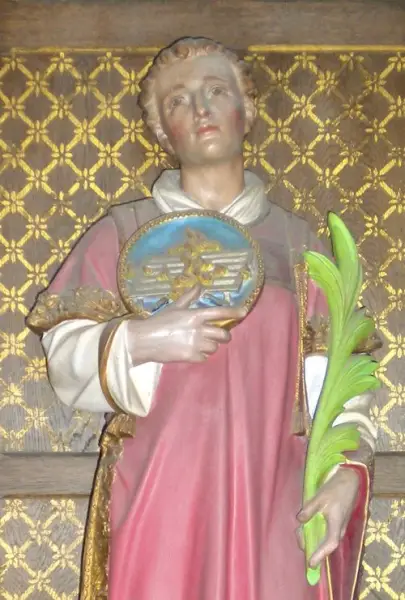
Piatus of Tournai, whose name survives in the forms Piaton, Platon, Piat, and Piato, was an Italian-born missionary who gave his life for the gospel in the Low Countries. A native of Benevento, tradition holds that the pope dispatched him to preach the gospel in Chartres and Tournai, and the same tradition adds that he received ordination at the hands of Dionysios the Areopagite, the fabled first bishop of Paris. His mission ended in blood: under the emperor Maximian, about the year 286, he suffered martyrdom when his executioners cut away the crown of his skull, a wound so distinctive that artists have ever after shown him in images holding the severed portion of his own head. Centuries later Saint Eligius discovered his relics and crafted a reliquary to enshrine them, and portions of his remains rest today at Chartres Cathedral. The Roman Catholic and Eastern Orthodox Churches keep his feast on October 1, and he is honored as the principal patron of Tournai.
The Complete Life
From Benevento to the Mission Fields
Piatus came into the world at Benevento, an ancient city of southern Italy, and there, if tradition is trustworthy, he first heard the call that would carry him across the Alps. The memory of the early Gallican Church relates that the pope sent him north as a missionary to the cities of Chartres and Tournai, placing in his hands the evangelization of lands still held by the old religions. An even more striking tradition surrounds his ordination: he is said to have received holy orders from Dionysios the Areopagite, the convert of Saint Paul who passed into legend as the first bishop of Paris and one of the great missionary bishops of Gaul. Under such a master, Piatus would have belonged to the very first generation of preachers who carried the faith from the Mediterranean world into the towns of northern Gaul. Whatever the exact sequence of his journey, his mission converged on two fixed points, the city of Chartres with its sacred hill and the market town of Tournai on the Scheldt, where his name has been woven into the life of the Church ever since.
§ Piatus of Tournai
The Crown of Martyrdom
The preaching of Piatus closed in the persecution that bears the name of Maximian, the emperor under whom the Christians of Gaul were put to the sword near the end of the third century. About the year 286 the missionary of Tournai was seized for the faith he had come to plant, and he was put to death by a wound of terrible particularity: the executioners sliced away the top of his skull. Ancient writers counted such a death among the most dreadful forms of martyrdom, and the memory of it attached itself permanently to his cult. From the earliest times his images have portrayed him holding the sliced portion of his own head, an attribute at once gruesome and triumphant, for the wounded head carries in Christian eyes the sign of the crown that followed it. The Church of the first centuries enrolled him among its hieromartyrs without any formal process, as was the custom for those who died in confessing Christ, and his memory was entrusted to the altars of the cities he had evangelized. Under Maximian the churches of the north learned what their fathers in the south had long taught: that witness sealed in blood convinces where words alone cannot.
§ Piatus of Tournai
Relics Found by Saint Eligius
The body of the martyr did not long lack honor. Centuries after his death, Saint Eligius, the goldsmith-bishop of Noyon and one of the most revered figures of seventh-century Flanders, discovered the relics of Piatus and made for them a reliquary with his own celebrated craftsmanship, the same art that had adorned the shrines of the Frankish kingdoms. Devotion to the martyr of Tournai took root in both of the cities of his mission. Some of his relics are preserved at Chartres Cathedral, where a chapel and a stained-glass window bear his name, while at Tournai a church is dedicated to him and the city acknowledges him as its patron. The Roman Catholic Church and the Eastern Orthodox Church keep his feast on October 1, and the great procession of Tournai, the city's oldest solemnity, gives his relics a place among the treasures borne through its streets. Thus the missionary who died by the sword of Maximian lives on in stone, glass, and procession on both sides of the old Gallic frontier. Pilgrims who pause beneath the stained glass at Chartres still meet the saint holding the strange token of his victory.
§ Piatus of Tournai
The Record
- Patron of
- Tournai
- Symbols
- holding the top part of his skull
- Canonization
- Pre-Congregation
Prayer
Bibliography
Show 2 sources
- "Saint Piaton of Tournai". CatholicSaints.Info. Retrieved 2025-10-04
- Roman, Alexander. "Chartres Cathedral: When East had already met West". Ukrainian Orthodoxy. Archived from the original on October 4, 2006. Retrieved 2007-03-15
Profile text adapted from the Wikipedia article, licensed CC BY-SA 4.0.
Pray with this saint every day
Save St. Piatus of Tournai to your favorites, read the full profile, and get feast-day reminders in the Saints app.
Get the Saints AppFree on the App Store for iPhone and iPad