
1369 – 1387·Feast July 2
St. Pierre de Luxembourg
Young Cardinal Bishop and Patron of Avignon
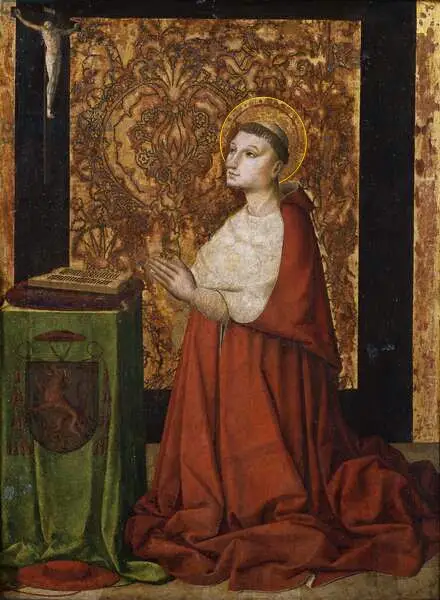
Overview
Pierre de Luxembourg, a French prelate of noble blood, died at seventeen with a reputation for sanctity that all of divided Christendom acknowledged. Born on 19 July 1369 at Ligny-en-Barrois and orphaned in early childhood, he was raised in Paris by his aunt and loaded with ecclesiastical benefices while still a boy: canon of Notre Dame de Paris, canon of Chartres, archdeacon of Dreux, archdeacon of Cambrai. The Western Schism shaped his whole career. Named Bishop of Metz in 1384 by Antipope Clement VII and soon afterward created a cardinal, he governed his diocese with striking austerity, devoting two-thirds of its revenues to the Church and the poor, and labored without success to heal the rift between pope and antipope. Driven from Metz, he withdrew to southern France and died at the Carthusian convent of Villeneuve-lès-Avignon on 2 July 1387, worn out by fever brought on by his harsh self-imposed penances. Adversaries on both sides of the quarrel conceded the profundity of his holiness and his devotion to those in his care. After repeated appeals Pope Clement VII beatified him on 9 April 1527, and Avignon, whose patron he had been named in 1432, has honored him ever since.
The Complete Life
An Orphan of the House of Luxembourg
Pierre de Luxembourg was born on 19 July 1369 at the castle of Ligny-sur-Ornain, the second of six children of Guy of Luxembourg, Count of Ligny, and Mahaut de Châtillon. Fortune struck the household early: his father died in 1371, his mother followed seven years later, and the boy was left an orphan before he could have known them well. His aunt Jeanne, the countess of Orgières, took him to Paris and raised him there amid the splendor and peril of the French court. The family's nobility secured his advancement in the Church almost before boyhood had ended. In 1377 he began his studies at the Parisian college, and in 1379 the cathedral chapter of Notre Dame de Paris elected him a canon. His childhood held one episode that fixed the imagination of his contemporaries: in 1381 he journeyed to London and offered himself to the English as a hostage to obtain his brother's release. The English, perplexed and enthralled by the offer, returned the brother to France, and King Richard II invited the young Luxembourger to remain at his court. Pierre declined the royal favor and went back to Paris, resolved on the priesthood.
§ Life
Benefices and the Desire for the Cross
The road to the priesthood opened before Pierre with astonishing speed. In 1381, the year of the hostage episode, he took a canonry in the chapter of Notre Dame de Chartres and received the archdeaconry of Dreux in that same diocese; in 1382 Cambrai elected him its archdeacon; and around 1379 or the years immediately following he received ordination. Honors that men twice his age spent lifetimes pursuing had gathered on one adolescent head. Yet the record of his inner life points away from ambition. His heart belonged to the passion and cross of Christ, a love that would govern both his conduct as a bishop and the penances that shortened his life. In an age when the sons of great houses accepted rich benefices as a form of inheritance, Pierre appears to have treated his canonries and archdeaconries as trusts to be discharged rather than revenues to be enjoyed. The ascetic instinct, formed in the Paris of his aunt's household and tested in the London of Richard II, was already carrying him toward the extraordinary renunciations of his episcopal years, when he would divide a bishop's income among strangers and punish his own body without mercy.
§ Life
Bishop of Metz in a Divided Church
In 1384 the episcopal see of Metz fell vacant, and its fillings became a quarrel of the Western Schism: the Kingdom of France backed Antipope Clement VII, while the Holy Roman Emperor stood with Pope Urban VI. The antipope named Pierre, then scarcely fifteen, as Bishop of Metz, and enthroned him there that September, the boy bishop entering his city barefoot on a mule. His government was as brief as it was remarkable. He split the diocesan revenues into thirds, assigning two to the Church and the poor and only one to his own household, and he won the affection of the faithful by his zeal for reform. Secular power proved harder: though he took possession of Metz briefly with armed troops, he was forced to withdraw in 1385, and Urban VI countered by naming Tilman Vuss de Bettenburg as the legitimate bishop. Meanwhile the king and Duke John of Berry had asked the antipope to elevate the young prelate, and on 15 April 1384 Pierre became cardinal priest of San Giorgio in Velabro. Throughout his time as a pseudocardinal he labored to bring the schism to an end, that calamity in which pope faced antipope and rulers faced rulers; his striving came to nothing, but both sides acknowledged the holiness with which they were pursued.
§ Bishop
Austerity and Love of the Crucified
The sanctity that impressed Pierre's contemporaries was not the sanctity of diplomacy but of penance. From his boyhood he had surrendered his heart to Christ's passion and cross, and as bishop and cardinal he translated that devotion into a discipline of body and purse that astonished the age. The revenues of Metz flowed to the Church and the poor; the bishop's share he kept grudgingly, and his household lived in the shadow of his charities. His austerities, self-imposed and unrelenting, were the secret engine of everything he did, and in the end they proved the instrument of his death. Entering his see barefoot on a mule, he dramatized before the crowds of Lorraine a poverty that the princes of the Church had largely abandoned. When his schemes for ending the schism collapsed and he was driven from his diocese, he accepted the failure as another form of the cross he loved. The style of his dying confirmed the style of his living: he asked to be laid in a pauper's common grave, demanding from the world in death the nothing he had clung to in life, and leaving behind the memory of a young man who had worn a prince's rank in a pauper's spirit.
§ Bishop
Avignon and the Seventeenth Year
Driven from Metz, Pierre found his last refuge in the south. On 23 September 1386 the antipope invited him to his court at Avignon, and there he remained until the end of his life. The respite was short. He had fallen ill by March 1387, his body broken at last by the fever that harsh austerities breed in a frame still growing, and on 2 July 1387 he died at the Carthusian convent of Villeneuve-lès-Avignon. He was seventeen years old. He had directed that his body be laid in a common grave among the paupers, and the wish was honored by the monks in whose house he died. The tomb that humility had chosen soon refused its silence: in 1387 the mystic Marie Robine, according to report, found healing at his grave, and the fame of the dead boy spread through Provence. His brother Jean, commissioning on 16 March 1395 a church in honor of Pope Celestine V, now numbered among the saints, had Pierre's body moved there, giving the brief life a permanent resting place. The teenaged cardinal, who had held nothing for himself, had become within eight years of his death the object of a devotion that spread across kingdoms.
§ Bishop
The Long Road to the Altars
The cause of Pierre de Luxembourg moved through the courts of Europe almost before his grave was closed. Queen Maria of Naples made a formal request for his beatification on 1 February 1388, and other nobles and princes joined her. The cause was taken up again and again, only to stall repeatedly, in 1389 and 1390 and once more in 1433 and 1435, as wars and the shifting politics of the schism consumed the attention of the papal court. His canonization came up for debate at the Council of Basel, but the council reached no firm verdict. Popular devotion ran ahead of the officials: in 1432 the city of Avignon named him its patron saint, and his cult spread to Metz and Paris and beyond them to Verdun and Luxembourg. At length, 140 years after his death, Pope Clement VII beatified him on 9 April 1527 in Old Saint Peter's Basilica in Rome. The delay proved a mercy of history: the Avignon pope who raised him to the altars was the last pontiff of the great schism's line, and the blessed who had spent his short life striving to unite the Church was declared blessed at last by the Church he had served.
§ Veneration
Relics and Remembrance
The bodily remains of Pierre de Luxembourg traced the map of his devotion across the centuries. In 1597 his relics journeyed to Paris; the French Revolution later left them damaged, as it damaged so many treasures of the French Church. In 1629 Pope Urban VIII authorized the Carthusians to keep a Mass and an Office of their own in his honor, binding the order in whose house he died to his memory. When plague struck in 1640, the vice-legate Sforza placed the city of Avignon under his protection, and the city that had already claimed him as patron in 1432 invoked him again as its shield. Since 1854 his relics have been venerated at the Saint-Didier church in Avignon, and also at Châteauneuf-du-Pape and in his native Ligny-en-Barrois. His feast is kept on 2 July, with 5 July observed by the Carthusians. Painters of the Avignon school pictured the vision granted to the dying cardinal, and four centuries of pilgrims have knelt where the seventeen-year-old bishop wished to lie among paupers. Few lives so brief have left so long a wake of prayer.
§ Veneration
Timeline
- 19 Jul 1369
Born at the castle of Ligny-sur-Ornain, second of the six children of Guy of Luxembourg, Count of Ligny, and Mahaut de Châtillon.
§ Life
- 1377
Began studies at the Parisian college, having been raised in the capital by his aunt Jeanne, countess of Orgières.
§ Life
- 1379
Elected a canon of the cathedral chapter of Notre Dame de Paris while still a boy.
§ Life
- 1381
Went to London and placed himself in English hands as a hostage so that his brother would be freed; the English sent the brother home, and Richard II asked Pierre to stay at court.
§ Life
- 1382
Elected Archdeacon for Cambrai, after becoming a canon of Notre Dame de Chartres and Archdeacon of Dreux the year before.
§ Life
- 10 Feb 1384
Named Bishop of Metz by Antipope Clement VII in the tangled politics of the Western Schism.
§ Bishop
- 15 Apr 1384
Created cardinal priest of San Giorgio in Velabro at the request of King Charles VI and Duke John of Berry.
§ Bishop
- Sep 1384
Enthroned at Metz, entering the city barefoot and riding on a mule.
§ Bishop
- 1385
Forced to withdraw from Metz, which he had held for a brief period with armed troops.
§ Bishop
- 23 Sep 1386
Invited by the antipope to join his court at Avignon, where he remained until his death.
§ Bishop
- 2 Jul 1387
Died of fever brought on by his self-imposed austerities at the Carthusian convent of Villeneuve-lès-Avignon, aged seventeen.
§ Bishop
- 1 Feb 1388
Queen Maria of Naples formally requested his beatification, joined by several other nobles and princes.
§ Veneration
- 16 Mar 1395
His brother Jean ordered the building of a church honoring Pope Celestine V, and Pierre's remains were transferred to it.
§ Bishop
- 1432
Named the patron saint of Avignon by the city that sheltered his last years.
§ Veneration
- 9 Apr 1527
Beatified by Pope Clement VII at Old Saint Peter's Basilica in Rome, 140 years after his death.
§ Veneration
The Record
- Patron of
- Avignon
- Symbols
- Shield·Crucifix·Cardinal's attire
- Canonization
- Beatified by Pope Clement VII on 9 April 1527 at Old Saint Peter's Basilica, Rome
Prayer
Bibliography
Show 10 sources
- "Bishop Bl. Pierre de Luxembourg", Catholic Hierarchy
- "Blessed Peter of Luxembourg, bishop.", Saints of the Diocese of Nîmes
- "Blessed Peter of Luxembourg". Saints SQPN. 1 July 2017. Retrieved 9 October 2017
- "Luxembourg, Pierre De", The Cyclopedia of Biblical, Theological, and Ecclesiastical Literature. (James Strong and John McClintock, eds.) Harper and Brothers; NY; 1880
- Brown-Grant, Rosalind; Damen, Mario, eds. (2022). A Chivalric Life: The Book of the Deeds of Messire Jacques de Lalaing. The Boydell Press. ISBN 9781783277216
- Pascoe, Louis (2004). Church and Reform: Bishops, Theologians, and Canon Lawyers in the Thought of Pierre D'Ailly (1351-1420). Brill. ISBN 9789047406181
- Warner, Marina (1981). Joan of Arc: The Image of Female Heroism. University of California Press. ISBN 0-520-22464-7
- "Blessed Pierre of Luxembourg", FaithND
- "Blessed Peter of Luxembourg", Diocése d'Avignon, April 24, 2008
- The Cardinals of the Holy Roman Church
Profile text adapted from the Wikipedia article, licensed CC BY-SA 4.0.
Pray with this saint every day
Save St. Pierre de Luxembourg to your favorites, read the full profile, and get feast-day reminders in the Saints app.
Get the Saints AppFree on the App Store for iPhone and iPad