
1808-1838·Feast November 24
St. Pierre Dumoulin-Borie
Bishop and Martyr
Overview
Pierre-Rose-Ursule Dumoulin-Borie, born on 20 February 1808, grew up in a Beynat household of the Bas-Limousin middle class, sixth of twelve children. His household held both Revolution and Church in its memory: a godfather who had been a refractory priest, and an uncle whose vote helped send Louis XVI to the guillotine. Schooled first by that priest uncle, he entered the seminary of Servières in 1824 and was ordained at Bayeux on 21 November 1830. The Paris Foreign Missions Society sent him east; he reached Macao on 18 July 1831 and was smuggled into Vietnam by Chinese boatmen past the ban on preaching. Assigned to the South Tonkin mission under persecution, he labored there quietly for years. In 1836, unknown to him, Rome named him titular bishop of Acanthus; he learned of the appointment only after his arrest, while in prison. Condemned on 24 November 1838, he was beheaded the same day, aged thirty. His body, exhumed in secret eleven months later, rests in the Salle des Martyrs of the MEP house in Paris.
The Complete Life
Early Life
Pierre-Rose-Ursule Dumoulin-Borie was born on 20 February 1808 at Beynat in Bas-Limousin, born sixth among the twelve children of Guillaume Borie and Rose Labrunie — a middle-class family of the French southwest remarkable chiefly for the way the Revolution had divided it. His godfather and uncle, Pierre Borie, was a priest who had been refractory during the Revolution, refusing the constitutional church, and afterward curé of Sionac; another uncle, Jean Borie, was an administrator of the Corrèze, a deputy in the Legislative Assembly and the Convention, where he voted for the death of Louis XVI. The boy was thus cradled between the two Frances — the priest who would not bend and the politician who voted for the king's death — and was taught his first lessons by the priestly uncle before leaving in 1824 for the seminary of Servières.
§ Life
Conversion and Vocation
Borie was ordained a priest at Bayeux on 21 November 1830, in the year of another revolution, and immediately gave himself to the church's largest single commitment of that era: the Asian missions of the Paris Foreign Missions Society. He reached Macao on 18 July 1831, and was brought from there to Saigon by Chinese smugglers — evading the Vietnamese ban on proselytizing, in the ordinary conveyance of a contraband mission. He joined the South Tonkin mission, then entering the harshest years of the Minh Mạng persecutions. To be sent there at twenty-three was to accept, with open eyes, the fate that the Society's house in Paris was already recording for many of its members; his own death within seven years confirmed the calculation.
§ Life
Mission and Ministry
Borie persevered in the pastoral task entrusted to him in South Tonkin, working a mission district under persecution — the hidden round of the Tonkin clergy: Mass in concealed stations, night movement, catechists' networks, the instruction of converts who were themselves risking status and property. The sources record his perseverance as the distinguishing note of his work. He remained a mere young priest when Rome — though he knew nothing of it in any usable sense — decided on 30 January 1836 to appoint him titular bishop of Acanthus, a dignity reserved for missioners expected to need episcopal powers, and one which for him arrived almost as a death warrant, since a bishop in Tonkin was a special prize for the persecuting authorities.
§ Life
Trial and Final Years
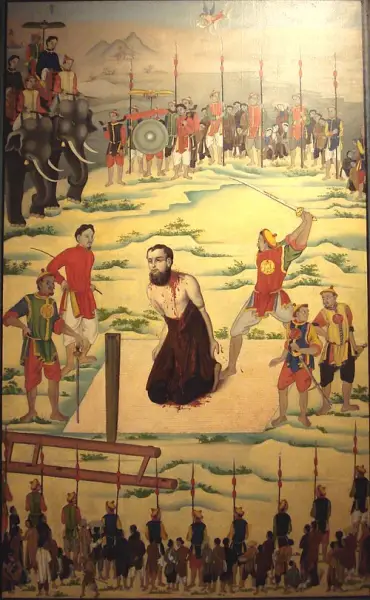
In 1838 Borie was arrested, and in prison he learned of his appointment as titular bishop. The news made his situation worse, not better: the authorities valued a captured bishop, and the offer of life in exchange for apostasy was pressed on him with correspondingly more insistence. He refused. On 24 November 1838 the death sentence was pronounced and carried out the same day, by beheading, in Tonkin; he was thirty years old. Eleven months later his body was secretly exhumed by the Christians and carried away. It rests today in the Martyrs' Room of the Paris Foreign Missions Society in Paris, where the cangue — the heavy collar-board he wore in captivity — is preserved beside it.
§ Life
Canonization
Borie was beatified by Pope Leo XIII on 27 May 1900, in the great beatification of the Tonkin martyrs, among the first of the Vietnamese causes to reach Rome. On 19 June 1988 Pope John Paul II canonized him among the 117 Martyrs of Vietnam, the collective canon of Vietnamese and foreign martyrs killed between the eighteenth century and 1862. In that roll he belongs to the significant group of Paris Foreign Missions Society priests — the Society that has more martyrs in proportion to its members than perhaps any in the Church's history.
§ Introduction
Legacy
Borie's legacy is preserved most concretely in the Martyrs' Room in Paris, where his remains and his cangue keep the material memory of the Tonkin persecution for the Church in France, and more broadly in the Vietnamese church that survived the century he died in. His feast is kept on 24 November. For the tradition of the Foreign Missions Society he is the type of the young priest sent to a closing trap — ordained at twenty-two, landed at twenty-three, dead at thirty — and of the reckoning the Society has always made between its losses and what it built.
§ Introduction
Timeline
- 20 Feb 1808
Born into the middle-class Borie family of Beynat, Bas-Limousin
§ Introduction
- 1824
Left home for the Seminary of Servières after early lessons from his priest godfather
§ Life
- 21 Nov 1830
Ordained a priest at Bayeux
§ Life
- 18 Jul 1831
Landed at Macao on the way to the missions
§ Life
- 30 Jan 1836
Named titular bishop of Acanthus, though he heard the news only while a prisoner
§ Life
- 1838
Arrested during the persecution and kept ministering from prison
§ Life
- 24 Nov 1838
Sentenced to death and beheaded at Tonkin the same day
§ Life
- 1839
His body was secretly dug up eleven months after the execution
§ Life
- 27 May 1900
Beatified by Pope Leo XIII
§ Introduction
- 19 Jun 1988
Canonized by Pope John Paul II together with the Vietnamese Martyrs
§ Introduction
The Record
- Symbols
- Bishop's vestments (though never consecrated)·Cangue (the collar-board worn in captivity)·Palm of martyrdom
- Canonization
- Beatified by Pope Leo XIII on 27 May 1900; canonized by Pope John Paul II on 19 June 1988 among the Vietnamese Martyrs
Prayer
Profile text adapted from the Wikipedia article, licensed CC BY-SA 4.0.
Pray with this saint every day
Save St. Pierre Dumoulin-Borie to your favorites, read the full profile, and get feast-day reminders in the Saints app.
Get the Saints AppFree on the App Store for iPhone and iPad