
1839-1866·Feast March 7 (martyrdom); September 20 (with the 103 Korean Martyrs)
St. Pierre-Henri Dorie
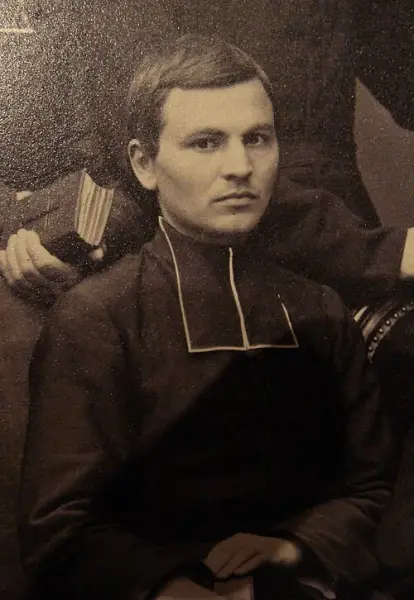
Priest of the Paris Foreign Missions, Martyr of Korea
Overview
Pierre Henri Dorie, born on 23 September 1839 at Saint-Hilaire-de-Talmont in the Vendée, was a French missionary of the Paris Foreign Missions Society put to death for the faith in Korea on 7 March 1866. After Bishop Siméon-François Berneux was arrested and put to death on 7 March 1866, every French missionary in Korea but three was seized and killed: among them Bishop Antoine Daveluy, Father Just de Bretenières, Father Louis Beaulieu, Father Dorie, Father Pierre Aumaître, and Father Martin-Luc Huin, all members of the Paris Foreign Missions Society. The persecution, one of the recurrent purges of the Korean church under the Great Han empire, triggered the French campaign against Korea in October and November of 1866, which in turn reinforced the Korean policy of isolation. Dorie was twenty-six when he died, having spent his short priesthood in a church that lived underground. He was raised to the altars with the whole company of the Korean martyrs, canonized on 6 May 1984 by Pope John Paul II under the name Peter Henricus Dorie, and is venerated on March 7 and again on September 20 with the 103 martyrs, whose ranks include the French missionaries and the Korean lay Christians, nobles and servants alike, killed across the persecutions of the nineteenth century.
The Complete Life
Early Life
Henri Dorie was born on 23 September 1839 at Saint-Hilaire-de-Talmont, a village of the Vendée, the region of France whose stubborn Catholicism had been forged in the fires of the Revolution two generations before. He was born into the world of rural piety that produced, decade after decade, a disproportionate share of France's missionary recruits, the sons of the Vendée and Brittany who filled the seminaries of the Paris Foreign Missions Society. The Society, founded in 1663 to supply Asia with clergy, had by Dorie's time a long roll of martyrs in China, Vietnam, and Korea, and its seminary on the rue du Bac in Paris kept their relics and their portraits before the eyes of the students. Dorie was formed in that atmosphere, ordained for the Society, and designated for Korea, the newest and most dangerous of its missions, where a native church, begun in 1784 from lay initiative, had grown for eighty years under persecution and depended on a handful of French bishops and priests for the sacraments no lay community could supply.
Mission
Dorie's mission in Korea was necessarily clandestine. The Korean court prohibited the Christian religion absolutely, and the missionaries lived in hiding, saying Mass in secret rooms, moving between the houses of lay leaders, and training the catechists who carried the faith through the countryside. The church they served had an astonishing character: founded before any missionary arrived, sustained by laymen and by a line of native martyrs, it was in a real sense the church of the Korean people, with the French clergy as its sacramental skeleton. Dorie joined the mission of Bishop Siméon-François Berneux, the vicar apostolic, working under the constant threat of the periodic crackdowns that had already killed thousands. In 1866 the threat was realized: the regency of the Heungseon Daewongun, hostile to the West in every form, moved against the Christians. Berneux was arrested on 23 February and executed on 7 March, and in the weeks that came after, all but three of the country's French missionaries were seized: Daveluy the bishop who succeeded Berneux, and with him Bretenières, Beaulieu, Dorie, Aumaître, and Huin.
Final Years
The executions of March 1866 took the French missionaries one after another, Dorie among them, and with them many Korean lay Christians, of every rank. The killings had consequences far beyond the church: the French naval expedition that sailed in October to avenge the murders, attacking Ganghwado before withdrawing, confirmed the court in its isolationism and intensified the persecutions, so that the blood of 1866 was followed by more in 1868 and beyond. Dorie died at twenty-six, in a country he had reached only two years before, his priestly life almost entirely hidden from the record; what remains are the facts of his vocation, his arrival, his capture, and his death, and the testimony of the community that venerated him. The Korean church, which kept the memory of its dead through every subsequent disaster, carried the cause of the martyrs to Rome, and in the great canonization of 6 May 1984 Pope John Paul II raised 103 of them to the altar, the French priests of the Paris Society among the Korean laity they had served.
Legacy
Pierre-Henri Dorie belongs to the 103 Korean Martyrs, whose canonization in 1984 was among the largest in the church's history and a recognition of the unique lay foundation of the Korean church. For the church in France he is one of the Vendée's missionary sons, remembered with the other members of the Paris Foreign Missions Society who died in Korea in 1866: Daveluy, Berneux's successor and himself now a saint, Bretenières, Beaulieu, Aumaître, and Huin, whose joint commemoration has long been fixed on 7 March. The persecution that killed them has an ironic afterlife in diplomatic history: the French campaign it provoked, intended to punish the regency, instead deepened Korea's isolation for a decade. The Korean church today, one of the most vital in Asia, honours its founders in the martyrs' shrine at Jeoldusan, built on the execution ground beside the Han river, where the memory of 1866 is kept. Dorie's own contribution was brief, but the church counts by fidelity and not by years, and his few given years were given entire.
Timeline
- 23 Sep 1839
Born at Saint-Hilaire-de-Talmont in the Vendée, France
§ Biography
- 1864
Sails from France for the clandestine Korean mission of the Paris Foreign Missions Society
§ Introduction
- 7 Mar 1866
Put to death at Saenamteo, Seoul, after Bishop Berneux's execution; nearly all French missionaries seized
§ Biography
- Oct 1866
The persecutions provoke the French campaign against Korea, which deepens Korean isolationism
§ Biography
- 6 Oct 1968
Beatified by Pope Paul VI
§ Introduction
- 6 May 1984
Canonized as Peter Henricus Dorie by Pope John Paul II with the Korean Martyrs
§ Biography
The Record
- Major works
- Missionary correspondence preserved in the archives of the Paris Foreign Missions Society
- Patron of
- Korean church (among the 103 Korean Martyrs)·Missionaries (by devotion)
- Symbols
- Missionary's cassock·Palm of martyrdom·Executioner's sword
- Canonization
- Canonized 6 May 1984 by Pope John Paul II among the 103 Korean Martyrs
Prayer
Profile text adapted from the Wikipedia article, licensed CC BY-SA 4.0.
Pray with this saint every day
Save St. Pierre-Henri Dorie to your favorites, read the full profile, and get feast-day reminders in the Saints app.
Get the Saints AppFree on the App Store for iPhone and iPad