
928 – 987·Feast January 10
St. Pietro I Orseolo
Doge of Venice Who Became a Hermit Monk
Overview
Pietro I Orseolo entered the world in 928 as a son of the Orseolo, one of the most influential houses of Venice, descended from the doges Teodato Ipato and Orso Ipato. Chosen to command the Venetian fleet at twenty, he won distinction in campaigns against the Dalmatian pirates while remaining a devout layman. In 976, after a popular uprising ended the reign of Pietro IV Candiano, he was elected doge. His two-year rule restored calm to a wounded city: he rebuilt the ducal chapel that became St Mark's Basilica and the Doge's Palace, founded hospitals, and gave generously to widows, orphans and pilgrims. On 1 September 978, without telling even his wife Felicia Malipiero or his children, he slipped out of Venice by night with Abbot Guarin and three companions, among them Romuald, for the abbey of Saint-Michel-de-Cuxa in southern France. There he embraced severe asceticism, gladly taking the humblest duties, and later withdrew into the nearby forest as a hermit for seven years until his death on 10 January 987. Recognized as blessed in 1027, he was canonized by Pope Clement XII in 1731, and is honored by Catholics and Orthodox alike as a ruler who abandoned a throne for the desert.
The Complete Life
A Son of the Venetian Nobility
Pietro Orseolo was born in 928 near Udine, into the Orseolo, one of the most powerful families of Venice, which counted the doges Teodato Ipato and Orso Ipato among its forebears. His talents appeared early. At twenty he received command of the Venetian fleet and won a soldier's reputation in successful actions against the Dalmatian pirates, who threatened the sea lanes on which the city's trade depended. Alongside his military career he remained an earnest Christian, devoted to the Church from his youth. His household continued the family's prominence: his son Pietro would follow him as doge, reigning as Pietro II Orseolo, and a daughter married Giovanni Morosini of the House of Morosini, binding the Orseolo to another of the republic's leading clans. These years gave him experience of command, familiarity with the republic's politics, and a standing among Venetians that would later place him at the head of the state. They also nurtured the piety that, at the height of his public success, would lead him to surrender everything for the cloister.
§ Early life
Doge in a City Divided
In 976 the doge Pietro IV Candiano perished in a rising provoked by his efforts to establish a monarchy over Venice. The Camaldolese cardinal Peter Damian later claimed that Orseolo had taken part in the conspiracy against Candiano, but the accusation cannot be verified, and the Venetians chose Orseolo as Candiano's successor regardless. His consort was Felicia Malipiero. As doge he proved an able restorer of order in an unsettled city and showed striking clemency toward the widow of his slain predecessor. He erected hospitals, gave shelter to widows, orphans and pilgrims, and from his own purse financed the rebuilding of the ducal chapel — the future St Mark's Basilica — and of the Doge's Palace, both ruined in the violence that had brought him to power. Then, on 1 September 978, without warning even his wife and children, he left the city by night with the abbot Guarin and three companions, among them the young Romuald, and traveled to the abbey of Saint-Michel-de-Cuxa in the county of Conflent in southern France, to take up the monastic habit.
§ Dogeship
From the Palace to Cuxa
At Cuxa the former doge embraced a life of severe asceticism, taking upon himself the lowliest tasks of the monastery. Evidence suggests the step had long been in his thoughts rather than a sudden impulse. His one remaining tie to Venice was a spiritual one: he instructed his grandson Otto, destined to wear the ducal crown himself in 1008, in the practice of Christian virtue. After some years in the community, probably at the urging of Romuald — who would go on to establish the Camaldolese branch of the Benedictines — Pietro withdrew from the abbey into the forest that surrounded it, to live as a hermit. In that solitude he remained for seven years, until the end of his life. The man who had governed a maritime republic and rebuilt its principal church now kept silence among the trees of the Pyrenean foothills, a prince who had exchanged the palace for a cell and found nothing wanting in the exchange.
§ Dogeship
The Interior Shape of His Conversion
Those who recorded his life regarded generosity and humility as the twin marks of Pietro's conversion. As doge he had treated the overthrow of his predecessor not as a victory to be exploited but as a wound in the civic body to be healed, sparing its victims and rebuilding what the mob had burned. His almsgiving — hospitals raised, orphans and pilgrims supported — flowed from the same devotion to the Church that had marked him since his years as a fleet commander. At Cuxa the pattern continued, only intensified: the ruler who had dispensed Venice's treasure now performed the monastery's most menial work, and found in it no humiliation. He kept in view, to the end, the salvation of his own household, instructing his grandson Otto in Christian virtue as his final service to the family he had left behind. His passage from the doge's throne to a hermit's forest shelter became, for later generations, a parable of renouncement accomplished not in bitterness but in peace.
§ Dogeship
Seven Years in the Forest
Pietro's final years were spent in the hermitage he had made in the woods near Cuxa. For seven years he lived there, apart from the abbey yet bound to its rule of prayer, until his death on 10 January 987. His body was laid to rest in the church of the village of Prades in the county of Conflent, where his tomb remained an object of local veneration. He had been doge for barely two years, monk and hermit for nearly a decade; yet Venice did not forget him. Within a generation his memory was honored publicly at home, and the monastery that had received him preserved the story of the prince who had arrived one night in 978 with three companions and asked for nothing but a habit. Fulgenzio Manfredi would later gather his life into a biography, written in 1606 and printed at Venice in 1733, ensuring that the account of his withdrawal from the world survived for posterity.
§ Dogeship
Blessed and Saint
Recognition of Pietro's sanctity came quickly by medieval standards. In 1027, forty years after his death, the local bishop officially declared him blessed. Full canonization followed much later: in 1731 Pope Clement XII confirmed his cultus in an equivalent canonization, celebrated at Rome, and assigned his feast to 14 January. When the Roman liturgical calendar was reformed in 1969, the observance was moved to 10 January, the anniversary of his death. The Camaldolese Hermits, whose tradition descends from his companion Romuald, keep his memory on 19 January. He is venerated in both the Roman Catholic Church and the Eastern Orthodox Church, which also observes his feast on 10 January — a rare concord between East and West. In the iconography of Venice he is remembered as a confessor rather than a martyr, a ruler whose claim to sanctity rested not on a spectacular death but on a deliberate, complete renunciation of power at the height of his career.
§ Veneration
The Portrait with the Scroll
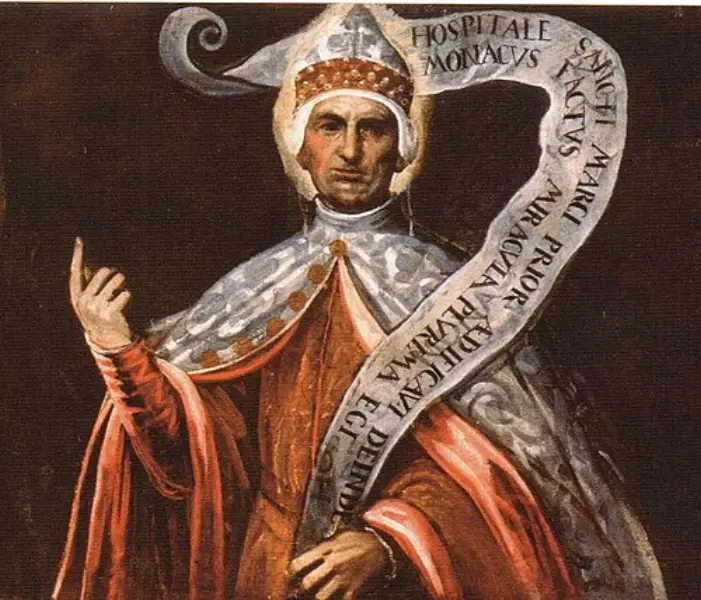
Pietro holds his place in the chronicle of Venetian rulers through the official portrait gallery of the doges in the Doge's Palace. The original cycle, begun in the 1360s under doge Marco Cornaro, presented each ruler in chronological order holding a scroll that summarized his deeds. When fire destroyed the early paintings in 1577, the sequence was repainted, most of the surviving portraits by Domenico Tintoretto. The scroll assigned to Pietro bears a Latin inscription recording that he built the hospice of Saint Mark and, after becoming a monk, worked many miracles — two clauses that compress a remarkable life. Monastic historians preserved a fuller memory: the biography composed by the friar Fulgenzio Manfredi in 1606, brought out by the Venetian librarian Giuseppe Bettinelli in 1733, and the notice given him in the annals of the Camaldolese order, whose founder he had encouraged by his example.
§ Legacy
Timeline
- 928
Born near Udine into the Orseolo family, one of the powerful houses of Venice.
§ Early life
- 976
Elected doge of Venice after the violent fall of Pietro IV Candiano.
§ Dogeship
- 1 Sep 978
Left the city secretly at night with Abbot Guarin and Romuald for Saint-Michel-de-Cuxa in southern France.
§ Dogeship
- 10 Jan 987
Died at Cuxa after seven years as a hermit in the surrounding forest.
§ Dogeship
- 1027
Declared blessed by the local bishop, forty years after his death.
§ Veneration
- 1731
Confirmed as a saint by Pope Clement XII in Rome, who set his feast on 14 January.
§ Veneration
In Their Own Words
HOSPITALE SANCTI MARCI PRIOR ÆDIFICAVI DEINDE MONACUS FACTUS MIRACULA PLURIMA EGI
The Record
- Major works
- Reconstruction of St Mark's Basilica·Rebuilding of the Doge's Palace·Hospitals for the poor of Venice
- Canonization
- Beatified in 1027 by Bishop Arnulf; canonized by Pope Clement XII in Rome, 1731
Prayer
Bibliography
Show 7 sources
- "Latin Saints of the Orthodox Patriarchate of Rome", orthodoxengland.org.uk
- "San Pietro Orseolo (Urseolo)", Santi e Beati
- Marco Pozza, "PIETRO Orseolo, santo", Dizionario Biografico degli Italiani, volume 83, 2015
- Edgcumbe Staley, The Dogaressas of Venice: The Wives of the Doges, London: T. W. Laurie, 1910
- W. H. Turton, The Plantagenet Ancestry, London: Phillimore, 1928
- Guido Grandi, Vita del glorioso prencipe S. Pietro Orseolo doge di Venezia, indi monaco, ed eremita santissimo, per Giuseppe Bettinelli, 1733
- Sebastiano Pedrocco and Paolo Pedrocco, I Dogi nei ritratti parlanti di Palazzo Ducale a Venezia
Profile text adapted from the Wikipedia article, licensed CC BY-SA 4.0.
Pray with this saint every day
Save St. Pietro I Orseolo to your favorites, read the full profile, and get feast-day reminders in the Saints app.
Get the Saints AppFree on the App Store for iPhone and iPad