
1887-1968·Feast September 23
St. Pio of Pietrelcina
Capuchin Priest, Mystic of the Stigmata
Overview
Francesco Forgione was born on 25 May 1887 at Pietrelcina in the province of Benevento, son of Grazio Forgione and Maria Giuseppa Di Nunzio, peasant farmers who prayed the Rosary nightly though they could neither read nor write. Named for Francis of Assisi, the boy decided by five to give his life to God; his father emigrated to America to pay for the tutoring the Capuchins required. Francesco entered the novitiate at Morcone on 6 January 1903, took the habit as Fra Pio, and was ordained a priest on 10 August 1910, his fragile health keeping him at home in Pietrelcina for years. In September 1916 he came to the friary of Our Lady of Grace at San Giovanni Rotondo on the Gargano, where he would remain for life. In August 1918 he described a piercing, burning ecstasy, and on 20 September 1918, while hearing confessions, the five wounds of Christ appeared on his body, remaining fifty years. Crowds and controversy followed: the Vatican investigated and for years restricted his public ministry, confining him to the cloister, while his reputation for healing, reading of souls and bilocation spread. From this soil grew his great work, the hospital Casa Sollievo della Sofferenza, opened in 1956. He died on 23 September 1968; the stigmata had vanished days before, leaving no scar.
The Complete Life
Early Life
Francesco Forgione was born on 25 May 1887 at Pietrelcina, a small town in the province of Benevento in southern Italy, the son of Grazio Forgione and Maria Giuseppa Di Nunzio. His parents were peasant farmers, devout and illiterate, who prayed the Rosary together every evening. They named him after Francis of Assisi, and the boy's inclination to the religious life showed itself early: by the age of five, he later said, he had already decided to give his life to God. The family's poverty was an obstacle to his vocation, since the Capuchins required schooling their son did not have; his father emigrated to work in America to pay for the tutoring. Francesco could read and write little when he entered religious life, yet he proved able to hear confessions and direct souls with an insight that would astonish the educated priests who examined him.
§ Early life
Vocation
Francesco entered the Capuchin novitiate at Morcone on 6 January 1903 and took the habit six days later as Fra Pio, receiving the name of Pius. He made simple vows and then solemn profession on 27 January 1907, all while suffering from ill health so fragile that his superiors doubted he would survive the novitiate. Ordained a priest on 10 August 1910 by Archbishop Paolo Schinosi at Benevento, he celebrated his first Mass four days later. His health prevented him from taking up normal friary work; for several years he lived at home in Pietrelcina with his family, saying Mass and enduring long periods of sickness and of documented experiences of the demonic, which he described in matter-of-fact letters to his spiritual directors. It was a hidden, painful priesthood, spent largely outside the cloister.
§ Priesthood
Mission and Ministry
In September 1916 Fra Pio was sent to the friary of Our Lady of Grace at San Giovanni Rotondo on the Gargano promontory, intending a short stay; it became his home for the rest of his life. His ministry was the confessional. He heard confessions for ten, twelve, and on occasions eighteen hours a day, and penitents described his knowledge of their sins as supernatural — he would name forgotten sins, refuse absolution to the unrepentant, and send the doubtful away comforted. His spiritual direction, preserved in thousands of letters, is direct, affectionate and uncompromising, built on prayer, suffering and the will of God. His counsel to all comers was compressed into a single repeated phrase: pray, hope, and don't worry.
§ Arrival at San Giovanni Rotondo
Spirituality and Teaching
Padre Pio's spirituality was Franciscan and cruciform: the suffering Christ at its centre, the Eucharist and the confessional as its instruments. In August 1918 he experienced a painful mystical piercing of the heart, and on 20 September 1918, while making his thanksgiving after Mass and hearing confessions, the five wounds of Christ appeared on his hands, feet and side. The visible stigmata remained with him for fifty years, examined by doctors who could not explain them. He insisted on being known as a priest rather than a phenomenon, hiding his hands under fingerless gloves and refusing any display. He taught his spiritual children that suffering accepted with love is the shortest road to sanctity, and that the Mass, celebrated slowly and in visible anguish, was the whole of his life condensed into an hour.
§ Citations
Trial and Final Years
Fame brought suspicion. The Holy Office, receiving reports of the phenomena and of disorder around the friary, issued statements from 1923 to the effect that nothing supernatural was proven; Padre Pio was for periods forbidden to say Mass publicly, to hear confessions, or to correspond with his spiritual children, and he obeyed in silence. The sanctions eased only in the 1930s. His earthly work, as he called it, was the hospital: a committee founded on 9 January 1940 began the Casa Sollievo della Sofferenza, opened in 1956, which grew into one of southern Italy's great hospitals, built on the donations of his prayer groups. Among the many who sought him out was Father Karol Wojtyła, the future John Paul II, who had his confession heard by Padre Pio in 1947. He died on 23 September 1968; the stigmata had disappeared, the wounds closed, shortly before his death.
§ Introduction
Canonization
The process that had once sanctioned him ended in his canonization. Pope John Paul II, who had revered Padre Pio since his visit in 1947, beatified him on 2 May 1999 before an enormous crowd in St Peter's Square and canonized him on 16 June 2002. The miracle approved for the beatification concerned the healing of an Italian woman, and that for the canonization the recovery of a boy in San Giovanni Rotondo. John Paul II, who had known him personally, presented him to the Church as a saint of the confessional and of suffering — a priest whose entire apostolate flowed from the Eucharist. Padre Pio is honored on 23 September, the anniversary of his death.
§ Introduction
Legacy
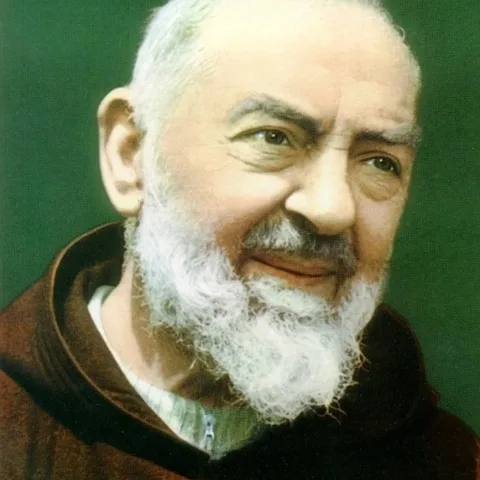
Padre Pio is among the most popular saints of the modern era. The sanctuary at San Giovanni Rotondo draws millions of pilgrims a year to his tomb, and the hospital he founded continues his practical work among the sick. His prayer groups, numbering thousands across the world, were his own answer to the question of what the laity could do for the Church. Devotion to him crosses the usual lines of Catholic piety, and his image — bearded friar with half-gloved hands — is among the most reproduced of any modern religious figure. For his admirers the stigmata and the healings are the point; for the Church that canonized him the point is the priest who spent fifty years in the confessional while bearing wounds he tried to hide.
§ Introduction
Timeline
- 25 May 1887
Born Francesco Forgione at Pietrelcina, in the province of Benevento, to peasant farming parents.
§ Early life
- 1897
Drawn to religious life after meeting a young Capuchin seeking donations in the countryside near his town.
§ Early life
- 27 Sep 1899
Received the sacrament of Confirmation after private tutoring prepared him academically.
§ Early life
- 6 Jan 1903
Entered the Capuchin novitiate at Morcone at age fifteen.
§ Early life
- 22 Jan 1903
Clothed in the Franciscan habit and given the name Fra Pio, with simple vows of poverty, chastity and obedience.
§ Early life
- Jun 1905
Sent by his superiors to a mountain monastery in hopes that cleaner air would help his failing health.
§ Priesthood
- 27 Jan 1907
Made his solemn religious profession as a Capuchin friar.
§ Priesthood
- 10 Aug 1910
Ordained a priest by Archbishop Paolo Schinosi at the Cathedral of Benevento.
§ Priesthood
- 14 Aug 1910
Offered his first solemn Mass as a priest at the church of Our Lady of the Angels in his hometown.
§ Priesthood
- 15 Nov 1915
Drafted into the Italian army during the First World War.
§ World War I and aftermath
- 6 Dec 1915
Assigned to the 10th Medical Corps in Naples.
§ World War I and aftermath
- 4 Sep 1916
Ordered back to community life and moved to the Capuchin friary of Our Lady of Grace at San Giovanni Rotondo.
§ Arrival at San Giovanni Rotondo
- 16 Mar 1918
Declared unfit for military service and given a full discharge.
§ World War I and aftermath
- Aug 1918
Experienced a painful mystical piercing that his director read as a transverberation, beginning on the fifth and ending on the seventh.
§ Transverberation
- 20 Sep 1918
Received the visible stigmata while hearing confessions, wounds he bore for fifty years.
§ Stigmata
- May 1919
Underwent the first of many medical examinations of his wounds, by physician Luigi Romanelli.
§ Luigi Romanelli, medical examination (1919)
- May 1923
The Holy Office formally declared that nothing supernatural had been proven about him and warned the public against his claims.
§ Vatican investigations and declarations
- 1933
Pope Pius XI reversed the ban on his public celebration of Mass.
§ Rehabilitation (1930s to mid-1960s)
- 1934
Permitted once more to hear confessions, and given honorary license to preach.
§ Rehabilitation (1930s to mid-1960s)
- 9 Jan 1940
A committee was formed under his direction to realize his plan for a great hospital open to rich and poor alike.
§ La Casa Sollievo della Sofferenza hospital
- 1947
Heard the confession of the young Polish priest Karol Wojtyła, the future Pope John Paul II, who visited him in person.
§ Prophecy
- 1956
The Casa Sollievo della Sofferenza hospital opened near the friary at San Giovanni Rotondo.
§ La Casa Sollievo della Sofferenza hospital
- 22 Sep 1968
Celebrated his final Mass, marking fifty years since he received the stigmata.
§ Death
- 23 Sep 1968
Died in his cell at San Giovanni Rotondo around 2:30 a.m., aged eighty-one, his stigmata having vanished days earlier.
§ Death
- 26 Sep 1968
His funeral drew roughly 100,000 mourners, and he was buried in the crypt of the church of Our Lady of Grace.
§ Death
- 1982
The Holy See authorized the archbishop of Manfredonia to open an inquiry into his possible canonization.
§ Canonisation
- 1990
Declared a Servant of God, the first formal step toward canonization.
§ Canonisation
- 1997
Declared venerable by Pope John Paul II after the Congregation for the Causes of Saints reviewed his life.
§ Canonisation
- 2 May 1999
Beatified by Pope John Paul II in St. Peter's Square before more than 300,000 faithful.
§ Canonisation
- 28 Feb 2002
The decree of canonization was promulgated by Pope John Paul II after a healed boy's case was studied.
§ Canonisation
- 16 Jun 2002
Canonized by Pope John Paul II in St. Peter's Square before some 300,000 people.
§ Canonisation
- 1 Jul 2004
John Paul II dedicated the new Sanctuary of Saint Pio of Pietrelcina, built to hold the growing crowds of pilgrims.
§ Pilgrimage sites
- 3 Mar 2008
His body was exhumed from the crypt forty years after his death and found fairly well preserved.
§ Exhumation
- Apr 2010
His remains were transferred to a special golden crypt in the Sanctuary of Saint Pio.
§ Pilgrimage sites
- 8 Feb 2016
His relics were exposed for veneration in St. Peter's Basilica during the Jubilee of Mercy.
§ Veneration by popes
In Their Own Words
Pray, hope, and don't worry.
This evening my earthly work has begun. I bless you and all those who will contribute to this work.
I do not know whether my mind was transported there, or what I saw was some sort of representation of the place or the person; I do not know whether I was there with my body or without it.
I want to suffer. This is my desire.
Patience!... I suffer, it is true, but I enjoy it very much.
Jesus tells me that in love it is he who delights me; in pain, however, it is I who delight him.
Vainglory is an enemy of souls who have consecrated themselves to the Lord and given themselves to the spiritual life.
Keep the crucified Jesus in your heart and all the crosses of the world will seem like roses to you.
The Record
- Major works
- Letters (Volumes I-V, correspondence with his spiritual directors)
- Symbols
- Capuchin habit·Stigmata on hands, feet and side, covered with mittens·Rosary·Odour of violets and roses
- Canonization
- Beatified 2 May 1999 by Pope John Paul II; canonized 16 June 2002 by Pope John Paul II
Prayer
Bibliography
Show 12 sources
- ↑ "St. Padre Pio" . Catholic Online . Retrieved 25 October 2023 .
- ↑ "Padre Pio | Italian priest and saint | Britannica" . Encyclopaedia Britannica . Retrieved 18 March 2023 .
- 1 2 3 4 "Padre Pio da Pietrelcina" . Libreria Editrice Vaticana .
- 1 2 3 "Saint Pio of Pietrelcina" . www.bbc.co.uk . BBC . Archived from the original on 8 March 2023 . Retrieved 18 March 2023 .
- 1 2 3 B., Ruffin, Caulbert (1991). Padre Pio : the true story . Our Sunday Visitor Publ. Div. ISBN 0-87973-673-9 . OCLC 243721755 . {{ cite book }} : CS1 maint: multiple names: authors list ( link )
- ↑ "Portale Antenati" . Portale Antenati (in Italian) . Retrieved 27 January 2026 .
- 1 2 3 4 5 6 Ruffin (1991) , p. 444.
- 1 2 3 Kalvelage, F.I., Bro. Francis Mary (13 May 1999). Padre Pio: The Wonder Worker (1st ed.). Our Lady's Chapel, New Bedford, MA: Franciscan Friars of the Immaculate (published 1999). pp. 124– 125. {{ cite book }} : CS1 maint: date and ye
- 1 2 Gerhold, Ryan (20 February 2007). "The Second St. Francis". The Angelus : 12– 18.
- 1 2 3 4 5 "Padre Pio the Man Part 1" . Retrieved 19 January 2008 .
- ↑ Allegri (1993) , p. 15.
- ↑ Castelli (2011) , pages not specified..
Profile text adapted from the Wikipedia article, licensed CC BY-SA 4.0.
Pray with this saint every day
Save St. Pio of Pietrelcina to your favorites, read the full profile, and get feast-day reminders in the Saints app.
Get the Saints AppFree on the App Store for iPhone and iPad