
died c. 480·Feast March 5
St. Piran of Cornwall
Abbot, evangelist, and patron of the tinners
Overview
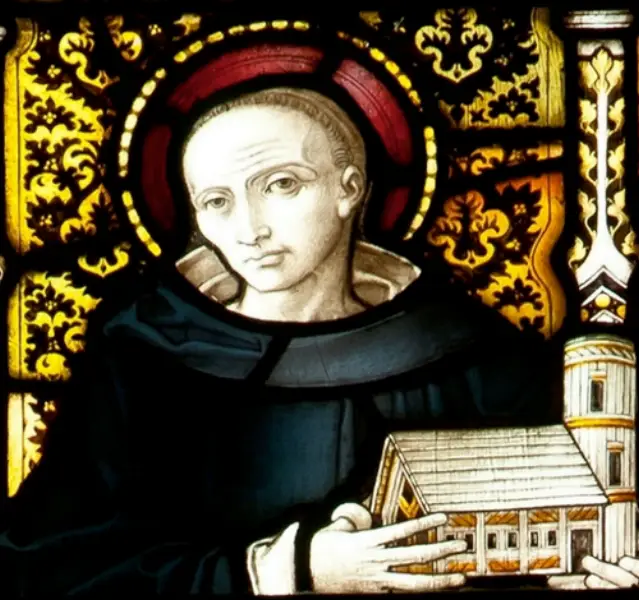
Piran, also called Pyran or Peran, was a fifth-century abbot and saint of Cornwall, most probably of Irish birth, who became the patron of tin miners and the foremost patron saint of Cornwall. Tradition relates that his preaching of the Gospel in Ireland provoked his expulsion: his enemies bound him to a millstone and hurled him from a cliff into a stormy sea, which instantly grew calm and carried him across the water to the sands of Perranzabuloe in Cornwall. There he lived as a hermit, gathered converts — his first companions in legend being a badger, a fox, and a boar — and founded the Abbey of Lanpiran, serving as its abbot. To him is ascribed the rediscovery of tin-smelting, a craft lost since before the Roman era, when the ore in his black hearthstone melted and rose as a white cross, the emblem now borne on Cornwall's flag. He was reportedly put to death by Theodoric, king of Cornwall, around the year 480. His shrine at Perranzabuloe drew pilgrims for centuries, his relics were dispersed among churches, and his feast of 5 March remains Cornwall's national day, celebrated with a march across the dunes to his cross.
The Complete Life
An Uncertain Beginning
Piran belongs to that company of early Celtic saints whose history must be pieced together from tradition, philology, and devoted scholarly argument. The general consensus receives him as an Irishman, a man who spent time in Wales as well and whose preaching of the Gospel in his homeland grew so influential that he was driven out of Ireland for it. His identity, however, has long been entangled with that of Ciarán of Saighir, the Irish founder of the monastery at Seir-Kieran in County Offaly: because Brittonic and Goidelic tongues traded p and k sounds freely, the two names merged from medieval times onward, and the surviving Life of Saint Piran from the fourteenth century — composed, most likely, in the cathedral city of Exeter — is in fact a reworking of an earlier Middle Irish life of Ciarán, adjusted with different parentage and an ending that follows Piran's own career and death in Cornwall. The philologist Joseph Loth argued that the two names could not denote the same man, while G. H. Doble imagined Piran as a Welshman from Glamorgan; other scholars would identify him with Ciarán of Clonmacnoise, whose father is sometimes said to have been a Cornishman. Whatever the truth of his origins, the saint honored in Cornwall was remembered as an abbot whose fame had crossed the Irish Sea, and whose coming to the peninsula changed its history.
§ Life
Across the Sea on a Millstone
The most beloved of Piran's legends tells how he left Ireland. His countrymen, it is said, bound him to a millstone, rolled the stone to the edge of a cliff above a raging sea, and cast him in, intending that both preacher and Gospel should sink together. The sea, we are told, turned calm the moment he touched it, and the stone floated, bearing the saint safely over the waves until it grounded on the sandy beach of Perranzabuloe on the northern coast of Cornwall. There, marooned by his enemies but received by God, Piran established himself as a hermit among the dunes. His austerity and holiness soon drew the attention of the countryside, and the gift of miracles credited to him brought crowds seeking his charitable help. His first disciples, the story cheerfully records, were the wild creatures of the sandhills — a badger, a fox, and a boar — before human converts began to gather around him. Whatever else the tale contains, it preserves the memory of a missionary arrival: a holy man from over the sea, deposited by divine providence on a particular shore, who began again in a strange land the work of evangelization that his own people had tried to drown.
§ Legends
Abbot of Lanpiran and Lord of the White Fire
At Perranzabuloe the hermit's solitude gave way to a community. Converts assembled around Piran, and together they raised the Abbey of Lanpiran, with the saint himself as abbot — the most famous of all the foundations said to have been carried into Cornwall from Ireland. To this house the tradition attaches an achievement of a different kind: the rediscovery of tin-smelting. Cornwall's miners had smelted tin before the Romans reached the island, but the craft had been lost through the centuries, until one day the metal hidden in Piran's black hearthstone — plainly a slab of tin-bearing ore — flowed out under the heat of his fire and rose gleaming to the top in the shape of a white cross. From this wonder the Cornish trace both the recovery of their great industry and the design of their flag, the white cross on black that flies over the county still. The tinner's trade thus came to stand under the abbot's patronage, and the men who worked the treacherous mine shafts of Cornwall kept his day as their holiday. Evangelist, abbot, and unwitting master of metals, Piran bound together the spiritual and economic life of the peninsula in a single legend.
§ Legends
Death in the Sands
The old narratives relate that Piran met a violent end: he was reportedly executed by Theodoric, or Tador, a king of Cornwall, in about the year 480, in the era of Vortigern. Another telling, gentler, describes an abbot worn out with age and infirmity who called his followers to him, spoke to them a final time, and asked that a grave be readied; then, descending into it calmly, he gave up his spirit on the fifth of March, his body lying thereafter in Cornwall beside the waters of the Severn sea. With him, it is said, were laid the remains of Blessed Martin the Abbot, which he had carried from Ireland long before — a last testimony to the Irish ties of his life. His own bones did not rest whole for long. They were exhumed and redistributed among reliquaries for veneration: Exeter Cathedral claimed one of his arms, and the inventory of St Piran's Old Church at Perranzabuloe listed a reliquary containing his head, along with a hearse in which his body was borne in procession. In 1443 the Cornish knight Sir John Arundell left money in his will toward the preservation of the saint's head in the chapel among the sands, an act of devotion paid to a relic nearly a thousand years old.
§ Death and veneration
The Flag of Cornwall
No other saint is so completely woven into the identity of Cornwall. His white cross on black is the county flag itself; the earliest documented appearance of that design is on the fifteenth-century arms of the de Saint-Péran family of Cornouaille in Brittany, and Breton villages named Saint-Peran, Loperan, and Saint-Perran echo his cult across the Channel. His memory marks the map of his adopted land: the churches of Perranuthnoe and Perranarworthal bear his dedication, holy wells at Perranwell and Probus carry his name, the resort of Perranporth was once Porthpyran, and in Canada a peak in the Rocky Mountains is called Mount St. Piran. St Piran's Day, kept on 5 March, has become Cornwall's national celebration, opening a week of Cornish-themed festivity known as Perrantide: hundreds march across the dunes to the saint's cross dressed in black, white, and gold, daffodils are laid at its base, and a play of his life is performed in the Cornish tongue. In 2006 the county's member of parliament petitioned for the day to become a public holiday. Since 1996 a former Methodist chapel at Laity Moor has housed an Orthodox congregation under his patronage, so that the abbot of the sands receives the prayers of East and West alike.
§ St Piran's Day
Timeline
- 5 Mar 480
Reportedly executed by Theodoric, or Tador, king of Cornwall, dying on the date tradition keeps as his feast; the relics of Blessed Martin the Abbot, brought by him out of Ireland, were laid in the grave beside him at Perranzabuloe.
§ Death and veneration
- 1443
In his will the Cornish knight Sir John Arundell left funds to keep safe the saint's head in the chapel among the sands at Perranzabuloe.
§ Death and veneration
- 1996
The former Methodist chapel at Laity Moor became home to the Orthodox Church of Archangel Michael and Holy Piran.
§ Death and veneration
- 2000
A dramatic play of the saint's life, performed in the Cornish language, began to be staged each year at the St Piran's Day celebration.
§ St Piran's Day
- 2006
Cornish Member of Parliament Dan Rogerson urged that 5 March be declared a public holiday for Cornwall in recognition of the saint's day.
§ St Piran's Day
- 2016
St Piran's crab, the hermit crustacean Clibanarius erythropus, was given its name in the saint's honor.
§ Death and veneration
The Record
- Major works
- Abbey of Lanpiran at Perranzabuloe
- Patron of
- patron of tin miners (tinners)·patron saint of Cornwall
- Symbols
- white cross on a black field (St Piran's Flag)·millstone·black hearthstone with smelted tin
- Canonization
- Pre-congregation; venerated since the early medieval period by the Catholic Church, Eastern Orthodoxy, and the Anglican Communion.
Prayer
Bibliography
Show 7 sources
- Doble, G. H. (1965). The Saints of Cornwall. Dean & Chapter of Truro.
- Farmer, David Hugh (2003). The Oxford Dictionary of Saints (5th ed.). Oxford: Oxford University Press. ISBN 978-0-19-860629-1.
- Orme, Nicholas. The Saints of Cornwall. Oxford: Oxford University Press. ISBN 0-19-820765-4.
- Haslam, William (Rev) (1844). Perran-Zabuloe: With an Account of the Past and Present State of the Oratory of St. Piran in the Sands. London: John Van Voorst.
- Loth, Joseph-Marie (1930). "Sur quelques victimes de l'hagio-onomastique en Cornwal: saint Piran, saint Keverne et saint Achebran". Comptes rendus des séances de l'Académie des Inscriptions et Belles-Lettres. 74 (1): 21–23.
- Carter, Eileen (2001). In the Shadow of St Piran. Wadebridge: Lodenek. ISBN 9780946143283.
- Tomlin, E. W. F. (1982). In Search of St Piran: an account of his monastic foundation at Perranzabuloe, Cornwall. Padstow: Lodenek Press. ISBN 9780902899995.
Profile text adapted from the Wikipedia article, licensed CC BY-SA 4.0.
Pray with this saint every day
Save St. Piran of Cornwall to your favorites, read the full profile, and get feast-day reminders in the Saints app.
Get the Saints AppFree on the App Store for iPhone and iPad