
c. 700 – 753·Feast November 3
St. Pirmin
Missionary Abbot and Founder of Reichenau Abbey
Overview
Pirmin, a monk of the Merovingian age, became one of the chief organizers of monastic life in the German lands. Probably a native of the Narbonne region and possibly of Visigothic stock, he belonged to the generation of Christians unsettled by the Arab conquest of Spain at the start of the eighth century. From about 718 he served as abbot of the monastery of Quortolodora at Antwerp, and afterwards won the confidence of Charles Martel, the mayor of the palace of the Franks. That connection opened the Alemannian mission field to him. He helped rebuild Disentis Abbey in what is now Switzerland, and in 724 became abbot of Mittelzell on the island of Reichenau, which he raised into one of the landmark monasteries of the region. Preaching across Alsace and the valleys of the upper Rhine and Danube, he founded or reformed a long series of houses, among them Reichenau, Amorbach, Gengenbach, Murbach, Wissembourg, Marmoutier and Neuweiler. Banished to Alsace for political reasons late in life, he died at the abbey of Hornbach on 3 November 753, where his tomb survives.
The Complete Life
A Visigoth in Frankish Europe
Pirmin was born before 700, probably in the region of Narbonne and possibly of Visigothic stock. His childhood, on this account, fell in a world being overturned: the Arab conquest of Spain in the opening years of the eighth century drove many Visigoths north into Francia, carrying their Christianity and their dislocation into Frankish Europe. Pirmin appears in the record around 718 as abbot of Quortolodora, a monastery at Antwerp in Austrasia, whose monks served the church standing within the old broch known as Het Steen — a building dedicated in the twelfth century to Saint Walpurga. Local memory in the Ardennes preserves another strand of his early career: the count Rohingus invited him to his villa at Thommen near Sankt Vith, and a spring at Kaundorf is said to have received his blessing, its water credited from that time with healing power and marked by a chapel in his honor. By such stages the wandering monk won the favor of Charles Martel, the Franks' mayor of the palace.
§ Biography
The Abbot of Antwerp and the Favor of Princes
Pirmin's monastic career began far from the region of his presumed birth, at Antwerp, where he governed the house called Quortolodora from 718 onwards. The arrangement of his life — a probable Visigothic leading a Frankish monastery, honored in the Ardennes, employed on the Meuse and the Rhine — mirrors the displacement of an entire Christian people in his generation. When the count Rohingus received him at Thommen, and when the springside legend of Kaundorf attached itself to his name, they testified to a reputation for sanctity that traveled with him. Charles Martel's patronage proved decisive: it gave a wandering abbot access to the ducal and noble families of Alemannia whose lands and endowments would make his missionary work possible. Vocation, for Pirmin, was not a single moment but a sequence of doors opened — each monastery, each noble household, each spring of reputed healing — through which he moved steadily toward the great work of his middle years.
§ Biography
Apostle of Alsace and Alemannia
The favor of Charles Martel translated into work. Pirmin was sent to assist the rebuilding of Disentis Abbey in the Alpine valley that lies in present-day Switzerland, and in 724 he was appointed abbot of the Mittelzell house on the island of Reichenau in the Lake of Constance, with which his name has been joined ever since. From Reichenau his activity radiated across Alemannia. His missionary field lay chiefly in Alsace and along the upper Rhine and the Danube, where he preached, baptized and organized, and where he founded or reformed monasteries at Reichenau, Amorbach, Gengenbach, Murbach, Wissembourg, Marmoutier and Neuweiler. He knew how to secure the new foundations: Odilo of Bavaria financed the abbey of Niederaltaich, and Werner I, ancestor of the future Salian dynasty, endowed the new house at Hornbach. Politics, however, could unmake what patronage had built; for reasons the record does not detail, Pirmin was banished to Alsace, and his last years unfolded away from the island abbey that was his greatest creation.
§ Missionary and other activities
Hornbach
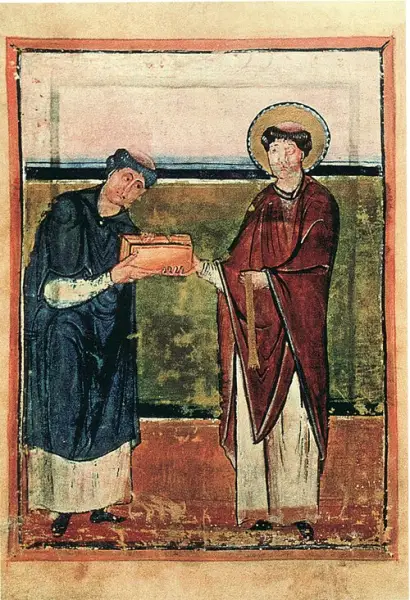
Pirmin's exile ended at Hornbach, where Werner's endowment had raised a new abbey. There he died on 3 November 753, and there his body was entombed; the abbey church kept his grave, and the Hornbach Sacramentary, presented by Abbot Adalbert of Hornbach, shows the abbot offering his manuscript to Pirmin as patron saint. Later generations added a further honor: a relic of the saint came to rest in Speyer Cathedral, and his feast on 3 November was kept in the churches of the region. He had spent a long life in motion — Antwerp, the Ardennes, Disentis, Reichenau, the valleys of the Rhine and Danube, Alsace, Hornbach — yet every halt of the journey left behind either a community of monks, a legend of healing, or a book.
§ Biography
A Cult Confirmed by Observance
Pirmin was never subjected to a formal process of canonization; he belongs to the company of saints whose cult arose where they had worked and whom the church later confirmed by observance. The Catholic Church regards him as a saint, and the Eastern Orthodox Church likewise honors him. His feast is kept on 3 November, the day of his death, and his memory is attached above all to the monasteries he planted and reformed. The surviving tokens of that cult are characteristic of a missionary saint: a tomb at Hornbach that drew the faithful, a relic honored at Speyer Cathedral, healing springs in the Ardennes, and the portrait in the Hornbach Sacramentary where his spiritual son kneels before him. Medieval Alemannia ranked him among the apostles of its countryside, and the houses that owed him their foundation preserved his name in their annals and their liturgies.
§ Pirmin
The Scarapsus and the Network of Abbeys
Pirmin's most durable monument is a book, the Scarapsus — extracts from the single canonical books arranged under his name. It gathers quotations from the Church Fathers and from Scripture, probably for the use of missionaries or for reading in the refectory at monastic meals. Written between 710 and 724, it contains the earliest witness to the present text of the Apostles' Creed, a fact that gives the work a permanent place in the history of Christian doctrine. Around the book stands the network of monasteries: Reichenau, which grew into one of the great centers of learning in the German lands, together with Amorbach, Gengenbach, Murbach, Wissembourg, Marmoutier, Neuweiler, Niederaltaich and Hornbach, each preserving some memory of its founder or reformer. His cult at Hornbach and Speyer kept his name in local devotion, and historians of the conversion of Germany rank him beside Boniface and Willibrord among the makers of medieval Christendom.
§ Missionary and other activities
Timeline
- 718
Became abbot of the monastery of Quortolodora at Antwerp, whose monks served the church in the broch Het Steen.
§ Biography
- 724
Named abbot of the Mittelzell monastery on the island of Reichenau, which became his chief foundation.
§ Biography
- 3 Nov 753
Died at the abbey of Hornbach, where his body was entombed.
§ Biography
The Record
- Major works
- Dicta Abbatis Pirminii, de Singulis Libris Canonicis Scarapsus
- Canonization
- Pre-congregation saint, venerated in the Roman Catholic and Eastern Orthodox Churches
Prayer
Bibliography
Show 7 sources
- Hughes Oliphant Old, The Reading and Preaching of the Scriptures in the Worship of the Christian Church, ch. 3, Wm. Eerdmans, 1998, pp. 137–140, ISBN 978-0-8028-4619-8
- Gall Jecker, Die Heimat des hl. Pirmin des Apostels der Alamannen, Aschendorf, 1927
- Richard A. Fletcher, The Barbarian Conversion: From Paganism to Christianity, University of California Press, 1999, pp. 203–204, ISBN 978-0-520-21859-8
- Theodoricus, "De ecclesia in Antweppo (sic) castello", Codex aureus, Echternach, 1190–1191
- "St. Pirmin Kaundorf", Naturpark Öewersauer
- J. P. Migne, Patrologia Latina 89, 1029 ff.; Eckhard Hauswald (ed.), Scarapsus, Monumenta Germaniae Historica, Quellen zur Geistesgeschichte des Mittelalters 25, Hannover: Hahnsche Buchhandlung, 2010, ISBN 978-3-7752-1025-6
- J. N. D. Kelly, Early Christian Creeds, Longman, 1974, p. 398
Profile text adapted from the Wikipedia article, licensed CC BY-SA 4.0.
Pray with this saint every day
Save St. Pirmin to your favorites, read the full profile, and get feast-day reminders in the Saints app.
Get the Saints AppFree on the App Store for iPhone and iPad