
320 – 417·Feast June 19
St. Pishoy
Star of the Desert, Beloved of our Good Savior
Overview
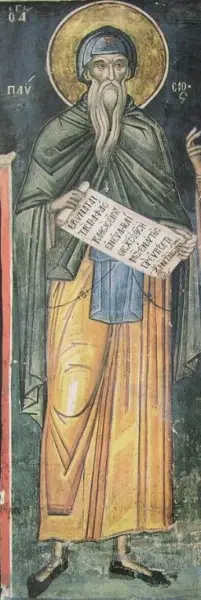
Bishoy, honored in the Coptic Orthodox Church under the titles 'Beloved of our Good Savior' and 'Star of the Desert', and venerated by the Eastern Orthodox tradition under the Greek form Paisios the Great, was a Coptic Desert Father of the fourth and fifth centuries. Born in 320 at Shansa in the Nile Delta, frail in body and youngest of seven brothers, he was marked out for God by his mother's vision of an angel. At twenty he entered the wilderness of Scetes as a monk under Pambo, and after his elder's death settled at the site of the monastery that still bears his name. Many monks gathered around him as their spiritual father, drawn by his love, wisdom, simplicity and kindness. Tradition holds that he saw Christ, who visited him as a weary stranger and promised that his body would not see corruption. Driven from Scetes by the Mazices invasions, he died on 15 July 417 at the mountain of Ansena. His relics, translated in 841, rest at the Monastery of Saint Bishoy in the Nitrian Desert, reportedly incorrupt to this day.
The Complete Life
The Child Pointed Out by an Angel
Bishoy was born in 320 in the village of Shansa — called Shensha or Shesna in other forms of the name — in what is now the Egyptian governorate of Al Minufiyah. He was the youngest of seven brothers, weaker and frailer than any of them, and it was precisely this child that heaven chose. In a vision his mother beheld an angel directing her to give one of her children to God, and the angel pointed at Bishoy. When she offered instead one of her stronger sons, the heavenly messenger insisted that Bishoy was the chosen one. The story sets the pattern of his life: strength disclosed through weakness, and a frail body made the vessel of extraordinary grace. From these Delta origins the sickly boy would travel into the harshest landscape Egypt offered, and there outlast men of iron constitution in the contest of fasting, vigil and prayer that made the desert famous.
§ Life
Monk of Scetes
At twenty Bishoy went out to the wilderness of Scetes and received the monastic habit from Pambo, the same elder who ordained John the Dwarf. When Pambo died, an angel guided the young monk to the site of what is now the Monastery of Saint Bishoy, and there he settled into the life of a hermit. Solitude did not mean isolation from other souls: monks gathered around him and took him as their spiritual father, drawn by his love, wisdom, simplicity and kindness. His austerity, however, was of a severity that astonished even the desert. He bound his hair and his hands upward with a cord fastened to the ceiling of his cell, so that sleep could not steal his night prayers. Such a reputation carried across Egypt: Ephrem the Syrian came to see him, one desert luminary seeking out another. In the mixture of tenderness toward others and ruthlessness toward himself, the monks of Scetes recognized the Gospel's own proportions.
§ Life
Carrying Christ
The Coptic tradition tells that Bishoy saw Jesus more than once. When word spread among his brethren that the Lord was coming, they climbed a mountain together to watch for him; on the way an aged man begged their help and was ignored. Bishoy alone stopped, lifted the old man onto his shoulders, and carried him — discovering as he walked that his burden was Christ himself, who told him that for the measure of his love his body would never see corruption. The same Lord is said to have come to him as a poor traveler whose feet Bishoy washed. These stories are the interpretive key to his asceticism: the rigors of the cell were not self-punishment but hospitality, love practiced at the highest intensity. The iconography that shows him carrying Christ, or kneeling to wash his feet, condenses the whole desert tradition into a single gesture — the weak younger brother of Shansa bearing the weight of God.
§ Life
Defender of the Faith and Builder
Bishoy was known as a defender of Orthodox belief against heresy. Hearing of a hermit of the Ansena mountain who denied that the Holy Spirit exists, he traveled to him carrying a woven basket with three ears. Asked the reason, he replied that everything he did was patterned on the Trinity, since he himself had a Trinity. After long debate from the Old and New Testaments, the old man returned to Orthodoxy. Bishoy's greatest trial came with the Mazices invasions. In 407/408 he abandoned Scetes for the mountain of Ansena, and in that region he met Paul of Tammah at Antinoöpolis, beginning one of the deep friendships of monastic history. He also built there another monastery, the house of Saint Bishoy at Dayr al-Barsha, which still stands near Mallawi. The raider's violence thus produced, by a paradox the desert knew well, both a friendship and a foundation.
§ Life
Death and the Journey of the Relics
Bishoy died on 8 Epip — 15 July — in the year 417, on the mountain of Ansena. His body, like that of his friend Paul of Tammah, became the object of the church's care. On 13 December 841, the Coptic 4 Koiak, Pope Joseph I of Alexandria carried out the saint's long-cherished wish and transferred his remains to the monastery that bears his name in the wilderness of Scetes. The tradition recounts that the boat on the Nile refused to move until Paul's body was brought aboard alongside Bishoy's — the friendship insisting, even in death, on being honored equally. The two bodies lie today in the main church of the Coptic Orthodox monastery in the Natroon Desert, where eyewitnesses testify that Bishoy remains in a state of incorruption, the fulfillment, his devotees believe, of the promise made to him by the stranger he once carried.
§ Departure and relics
Three Monasteries and Two Names
Three monasteries in Egypt carry Bishoy's name: the great house in the Nitrian Desert, where his relics rest; the monastery at Deir el-Bersha near Mallawi, which he founded; and a third at Armant, east of the ancient town. The Red Monastery near Souhag honors a saint of similar name, Bishay, who must not be confused with him — a sign of how deeply his memory soaked into the Egyptian landscape. In Europe his fame traveled under a Greek form: from the fifth century onward he has been known as Paisius the Great, the name under which the Eastern Orthodox Church venerates him, while the Oriental Orthodox churches keep their own Bishoy, the Star of the Desert, the Beloved of our Good Savior. Few desert fathers are remembered under two names in two communions; fewer still left a body the faithful could visit, a friendship the monks still recount, and a basket of three ears that preaches the Trinity to this day.
§ Departure and relics
Timeline
- 320
Born at the village of Shansa, in what is now the governorate of Al Minufiyah, the youngest of seven brothers.
§ Life
- 407
As the Mazices raided Scetes, he left the desert and settled on the mountain of Ansena, where he later befriended Paul of Tammah and founded a monastery at Dayr al-Barsha.
§ Departure and relics
- 15 Jul 417
Died on the mountain of Ansena on 15 July, the Coptic 8 Epip.
§ Departure and relics
- 13 Dec 841
Pope Joseph I of Alexandria transferred his remains, together with those of Paul of Tammah, to his monastery in Scetes.
§ Departure and relics
In Their Own Words
I have a Trinity, and everything I do is like the Trinity
The Record
- Major works
- Monastery of Saint Bishoy in the Nitrian Desert (his hermitage and spiritual home)·Monastery of Saint Bishoy at Dayr al-Barsha, near Mallawi
- Symbols
- Monk carrying Jesus·Monk washing the feet of Jesus
- Canonization
- Pre-congregation saint, venerated in the Oriental Orthodox and Eastern Orthodox Churches
Prayer
Bibliography
Show 6 sources
- Tim Vivian and Maged S. A. Mikhail, The Life of Bishoi: The Greek, Arabic, Syriac, and Ethiopic Lives, American University in Cairo Press, 2022, ISBN 978-1-61797-999-6
- "Paisios the Great", Online Chapel, Greek Orthodox Archdiocese of America
- "St. Pishoy: the Perfect Man", Saint Mina Coptic Orthodox Church
- "Orthodox Monastery of St. Bishoy the Great — Wadi El-Natroun, Egypt"
- "Lives of Saints: Baba 7", copticchurch.net
- "Sacred Ground and Desert Fathers: The Monks and Monasteries of Wadi el Natrun", CSA Living
Profile text adapted from the Wikipedia article, licensed CC BY-SA 4.0.
Pray with this saint every day
Save St. Pishoy to your favorites, read the full profile, and get feast-day reminders in the Saints app.
Get the Saints AppFree on the App Store for iPhone and iPad