
c. 515 – c. 546·Feast October 5
St. Placidus
Benedictine abbot and martyr of Messina
Overview
Placidus was born in Rome around 515 into the family of the patrician Tertullus. As a small boy he was entrusted to Benedict of Nursia at Subiaco and offered to God as an oblate, growing up within the earliest generations of Benedictine monasticism. Gregory the Great records the famous episode in which the young Placidus was pulled from a lake by his fellow monk Maurus, who crossed the water at Benedict's command. Placidus likely followed Benedict to Monte Cassino around 529, on land said to have been granted by his own father. Sent to Sicily, he became abbot of the first Benedictine house in Messina around 541, established on estates donated by his family. In the turbulent years of the Gothic War the monastery was stormed by pirates led by a captain named Mamuca; Placidus was tortured and beheaded together with his brothers Eutychius and Victorinus, his sister Flavia, and some thirty monks, around 546. His remains were recovered from the ruins of the monastery church centuries later, and his cult flourished across Sicily. A papal bull of 1588 confirmed his veneration, and he remains a patron of Messina and other Sicilian towns.
The Complete Life
A Patrician's Son Given to God
Placidus was born in Rome around 515, the eldest son of the patrician Tertullus. His family belonged to the Roman aristocracy that still carried ancient names and extensive estates even as the old imperial order crumbled around them. While he was still a small child, his father made a decision that would define the boy's entire life: around 522, when Placidus was about eight years old, Tertullus brought him to Subiaco and placed him under the care of Benedict of Nursia, dedicating him to God in accordance with the provision of chapter 69 of the Rule of St. Benedict. In doing so he became one of the earliest known oblates, children offered to monastic life by their parents. Within that community he learned the rhythms of prayer, work, and obedience that would carry him to Sicily decades later. The most vivid story of his youth comes from Gregory the Great, who tells how the boy once fell into the lake below the monastery. Benedict ordered the monk Maurus to go to his aid, and Maurus ran across the surface of the water and drew Placidus safely to shore. The episode became one of the most celebrated miracles of early Benedictine history and remained the iconographic emblem of Placidus's life. His name was later inscribed in litanies of the saints immediately after those of Benedict and Maurus, in ninth-century sources from Subiaco and Vallombrosa, a quiet testimony to how deeply he was honored in the tradition that formed him.
§ Life
From Subiaco to Monte Cassino
Placidus grew to manhood inside the cradle of Western monasticism. Around 529, when Benedict left Subiaco for Monte Cassino, the young monk appears to have gone with him. Tradition holds a remarkable detail about that move: tradition held that Tertullus, Placidus's own father, had made the mountain over to Benedict, so that the patrician's family estate became the soil on which the most famous monastery of the Latin West would rise. If so, Placidus's own family contributed directly to the founding of Monte Cassino. Nothing further is recorded of his advancement, but the sources that survive place him unambiguously among Benedict's closest disciples. His name appears in ancient litanies among the confessors, listed immediately after Benedict and Maurus, indicating how early and how firmly he was numbered among the great men of the first generation. This formation mattered for what came next. Benedict did not send untried men to plant monasticism in new lands; he sent those he trusted. When the opportunity arose to carry the Rule across the strait into Sicily, Placidus, though still a young man, was the one chosen to govern the new foundation. The child oblate of Subiaco had become a leader capable of establishing Benedictine life on the island, with all the administrative and spiritual weight that office implied.
§ Life
Abbot in Messina
Around 540, Benedict dispatched a band of monks to Messina to establish the first monastery of the Benedictine Order in Sicily, and in 541 he appointed Placidus as its abbot, though some accounts date the appointment to 536. The foundation drew on family resources once again: the nucleus of the monastery was believed to stand on Sicilian estates belonging to his father Tertullus and his mother Faustina, a noblewoman of Messina, which had likewise been donated to Benedict. On Benedict's instructions a church dedicated to St. John the Baptist was built and joined to the monastery, giving the new house both a spiritual center and a visible landmark in the city. The venture placed a young Roman abbot at the head of monastic life in a frontier island, in an Italy convulsed by the Gothic War. The choice of Placidus suggests the confidence Benedict placed in him and the reach of the patrician family's generosity toward the monastic movement. For a few years the community lived and prayed under his leadership, extending the Benedictine pattern of liturgy and labor to Sicilian soil. That stability would soon be shattered, but the foundation itself endured in memory and, after many destructions and rebuildings, in stone, becoming the root from which later Sicilian monasteries dedicated to Placidus would grow.
§ Messina and death
Martyrdom at Messina
Around 546, the Messina monastery was attacked by pirates commanded by a captain named Mamuca. The sources identify the raiders only as pagan barbarians, which has prompted scholarly conjecture ever since: some historians have suggested pagan Sclaveni from the Adriatic, others Arian Vandals from North Africa or Arian Visigoths from Spain, and still others pirates hired by one of the belligerents of the Gothic War or acting opportunistically on their own account. Whatever their origin, the raiders stormed the monastery and put its inhabitants to death. At Mamuca's command the abbot was bound to an olive tree and deprived of his tongue before the blade fell. His brothers Eutychius and Victorinus and his sister Flavia were executed with him, along with some thirty monks; Flavia was killed by a sword thrust, the monks by beheading. The monastery was sacked and burned to the ground. The violence of the 540s was later confused with two subsequent Saracen destructions of the rebuilt house, around 669 and again in 880, which led to anachronistic depictions of the martyrdom at the hands of North African Muslims. But the core account stands: the young abbot died with his family and his community, a witness to the faith in an age when the Mediterranean world was disintegrating into war and raiding.
§ Messina and death
Confirmation of an Ancient Cult
Placidus was never canonized in the modern sense; his veneration grew organically in Sicily and in the Benedictine tradition from the early centuries onward. Medieval martyrologies honored him, though they sometimes confused the sixth-century abbot with an earlier third-century Roman martyr of the same name, and the two came to share the feast day of 5 October. His name was placed in the Litany of the Saints among the confessors, directly after Benedict and Maurus, in sources attributed to the ninth century. The turning point for formal recognition came with the rediscovery of his remains. Workers uncovered the remains in 1276 among the ruins of the old monastery church. A second discovery came on 4 August 1588, when the Knights of St. John, restoring the Messina church of San Giovanni Battista — by then renamed San Giovanni di Malta — lighted upon the bodies once more; the remains of Placidus with thirty-seven monk martyrs were recognized and placed in the priory church. A bull issued by Pope Sixtus V on 13 November 1588 formally authorized the veneration of Placidus and his companions as saints of the Roman Catholic Church, and mandated annual feast days in Messina: 4 August for the discovery of the relics and 5 October for the martyrdom. The 2001 Roman Martyrology continues to list him on 5 October, as do the Proper Masses of the Benedictine Confederation.
§ Remains
Patron of Messina and Beyond
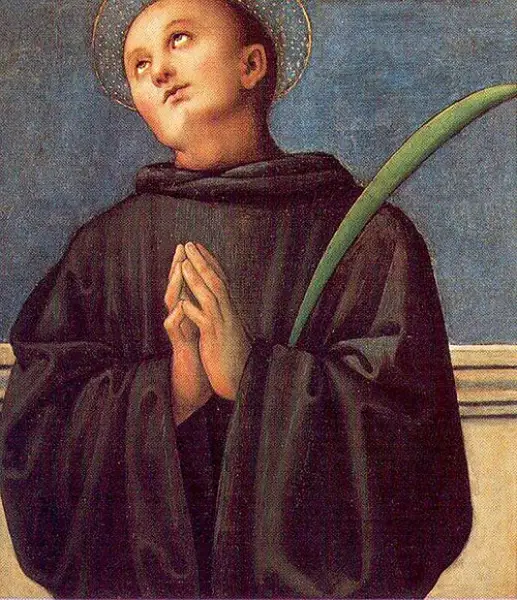
The cult of Placidus spread vigorously through Sicily after the recovery of his relics. In 1361 a group of Sicilian noblemen erected a Benedictine monastery at Colonero, about ten miles south of Messina, naming it in his honor; in 1420 a monastery of Benedictine nuns under his patronage was established in Catania. The Cassinese monk Felice Passero composed an epic poem in Italian ottava rima on the life and martyrdom of the saint, published in Venice in 1589. His feast is kept on 5 October in the Roman Martyrology and in the Benedictine liturgical books. Devotion followed migration: because many immigrants in Easton, Pennsylvania, came from Castel di Lucio, Placidus is venerated there with an annual parade through the South Side on the Sunday before Labor Day. In Sicily itself he holds enduring civic honors, as co-patron of Messina alongside the Madonna of the Letter, and as official patron of Biancavilla, Castel di Lucio, and Poggio Imperiale. Artistic tradition has kept his memory vivid as well, from Perugino's portrait of the saint to Fra Filippo Lippi's depiction of Maurus rescuing him from the lake and Luca Giordano's rendering of his martyrdom with his companions. For Benedictines he stands among the earliest witnesses that the monastic life, planted in hope, can be sealed in blood.
§ Veneration
Timeline
- 515
Born in Rome, eldest son of the patrician Tertullus.
§ Life
- 522
His father placed him, about eight years old, under Benedict's care at Subiaco as an oblate.
§ Life
- 529
Accompanied Benedict on the removal of the community to Monte Cassino.
§ Life
- 540
Benedict dispatched monks to Messina to establish the first house of his order on Sicilian soil.
§ Messina and death
- 541
Appointed abbot of the new Messina monastery; a church of St. John the Baptist was attached to it.
§ Messina and death
- 546
Pirates under Mamuca sacked the monastery; Placidus was tortured and beheaded with his siblings and some thirty monks.
§ Messina and death
- 669
The rebuilt monastery was attacked and destroyed again in a Saracen raid.
§ Remains
- 880
The monastery suffered a further Saracen destruction.
§ Remains
- 1086
Count Roger I of Sicily erected a new church of San Giovanni Battista over the old monastery in Messina.
§ Remains
- 1099
The church was donated to the Knights Hospitaller, who made it their Sicilian headquarters.
§ Remains
- 1276
The remains of Placidus and his companion martyrs were discovered in the ruins of the original monastery church.
§ Remains
- 1361
Sicilian noblemen founded the Benedictine monastery of San Placido Calonerò south of Messina in his honor.
§ Remains
- 1420
Benedictine nuns founded a house under Placidus's patronage at Catania.
§ Remains
- 4 Aug 1588
Knights of St. John rediscovered the bodily remains during restoration of the church of San Giovanni di Malta.
§ Remains
- 13 Nov 1588
Pope Sixtus V authorized the veneration of Placidus and his companions by papal bull.
§ Remains
- 1589
Felice Passero published an epic poem in ottava rima on the life and martyrdom of Placidus.
§ Remains
The Record
- Major works
- First Benedictine monastery in Sicily, at Messina·Church of San Giovanni Battista attached to the Messina monastery
- Patron of
- co-patron of Messina·patron of Biancavilla·patron of Castel di Lucio·patron of Poggio Imperiale
- Symbols
- being rescued from drowning
- Canonization
- Veneration formally authorized by Pope Sixtus V in a bull of 13 November 1588
Prayer
Bibliography
Show 5 sources
- Felice Passero (1589) La vita di San Placido, e suo martirio, descritta in ottava rima dal R.P. don Felice Passero monaco cassinense. Venice.
- D. Jean Mabillon (1703) Annales ordinis S. Benedicti occidentalium monachorum patriarchae, tomus I. Paris v.1.
- Cajo Domenico Gallo (1756) Annali della città di Messina p.144.
- Alban Butler (1866) The Lives of the Fathers, Martyrs, and Other Principal Saints, v.10, p.119.
- Huddleston, Gilbert. "St. Placidus." The Catholic Encyclopedia Vol. 12. New York: Robert Appleton Company, 1911.
Profile text adapted from the Wikipedia article, licensed CC BY-SA 4.0.
Pray with this saint every day
Save St. Placidus to your favorites, read the full profile, and get feast-day reminders in the Saints app.
Get the Saints AppFree on the App Store for iPhone and iPad