
c. 735 – 814·Feast April 4
St. Plato of Sakkoudion
Byzantine abbot, iconodule, and opponent of imperial remarriage
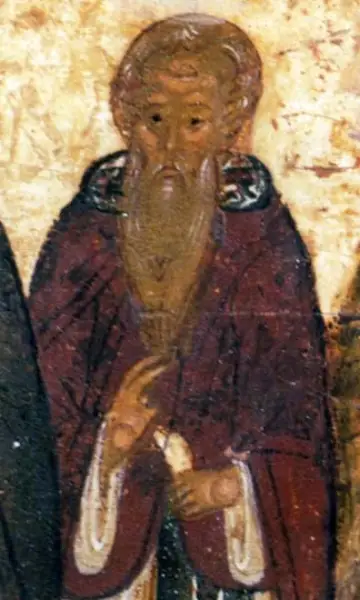
Overview
Plato of Sakkoudion, also known as Plato the Studite, was born around 735, probably in Constantinople. He served the Byzantine state as a minor official before abandoning a promising administrative career to become a monk in 759. His reputation for ascetic discipline grew to the point that he was asked to accept the metropolitan see of Nicomedia and the headship of a monastery in Constantinople, offers he declined. Instead, in 783 he founded the monastery of Sakkoudion on Mount Olympus in Bithynia and became its first abbot, drawing his nephew Theodore the Studite into monastic life. Plato is remembered chiefly for two convictions that brought him into conflict with imperial power. As a staunch defender of the holy images, he took part in the Second Council of Nicaea, which restored the veneration of icons at the close of the first Iconoclasm. Later, when Emperor Constantine VI married Plato's own niece Theodote after setting aside his lawful wife, Plato condemned the union so firmly that the affair became known as the Moechian Controversy. He endured the consequences of his stand and died in Constantinople on 4 April 814. The Church enrolled him among the saints, and his feast is kept on April 4 in both the Orthodox and Catholic traditions.
The Complete Life
From the Civil Service to the Cloister
Plato was born around 735, most likely in Constantinople, the capital of the Byzantine Empire. Like many educated young men of his station, he entered imperial service and worked as a minor official, a path that promised steady advancement within the bureaucracy of the court. Yet the administrative life did not hold him. In 759 he renounced his career and became a monk, turning from the records and petitions of the palace to the disciplined life of prayer. Such conversions were not uncommon in Byzantium, where the monastic houses of Bithynia and the capital drew men of talent and education, but Plato's departure carried particular weight because of what followed. His abilities could not remain hidden behind the monastery walls. In time, ecclesiastical authorities sought him out for offices of far greater public prominence than the one he had abandoned, asking him to accept appointment as metropolitan of Nicomedia, one of the important sees of Asia Minor, and to take charge of a monastery in Constantinople. That a former minor official was considered for a metropolitan throne speaks to the esteem his monastic life had earned. Plato refused both honors, judging that his calling lay elsewhere, in the founding of a community of his own.
§ Saint Plato the Studite Abbot
Founder of Sakkoudion
In 783 Plato established the monastery of Sakkoudion on Mount Olympus in Bithynia, the mountainous region south of the Sea of Marmara that had become one of the great centers of Byzantine monasticism. He became its first abbot and shaped its life from the ground up. Among those whom his example drew into the monastic state was his nephew Theodore, who would become famous to history as Theodore the Studite, abbot of the Studion monastery in Constantinople and one of the towering figures of ninth-century Byzantine religious life. The uncle's influence on the nephew thus extended far beyond the walls of a single Bithynian house. Sakkoudion itself, though a modest foundation compared with the great imperial monasteries, became a center of rigorous asceticism and firm doctrinal conviction. Under Plato's leadership the community developed the character that would make it and its offshoots champions of the holy images and of ecclesiastical independence from imperial interference. Plato's choice to refuse the metropolitan see of Nicomedia in favor of founding a small monastery proved consequential: the house he built became the seedbed of a movement, and the family of which he and Theodore were part became the conscience of Byzantine monasticism in a turbulent age.
§ Saint Plato the Studite Abbot
Icons, Councils, and Imperial Scandal
Plato's public significance rests on two controversies in which he took an unflinching part. The first was the struggle over the holy images. As a committed iconodule, he defended the veneration of icons during the Byzantine Iconoclasm, the imperial policy that condemned image veneration and persecuted those who practiced it. His stand on this question carried him into the councils of the Church: he participated in the Second Council of Nicaea, the assembly that affirmed the doctrine of the iconodules and restored the images to their places of honor. The second controversy was closer to home and, in a sense, closer to the bone. Emperor Constantine VI determined to set aside his lawful wife and marry Theodote, who was Plato's own niece. Family feeling might have counseled silence; principle counseled otherwise. Plato opposed the second marriage with firmness, refusing to treat as lawful a union that the canons of the Church condemned, and his resistance gave the affair its name: the Moechian Controversy. His nephew Theodore carried the same fight forward, and the monks who suffered for it became heroes of Byzantine conscience. Plato thus stood at the head of a tradition in which the monastery, not the palace, defined what the Church would tolerate.
§ Saint Plato the Studite Abbot
Death and Remembrance
Plato lived to see the iconodule cause vindicated by council and the imperial marriage controversy split Constantinople into factions of conscience. He died in Constantinople on 4 April 814, an old man whose life had spanned the crises of Iconoclasm and its aftermath. The date of his death became the date of his feast. The Church recognized his sanctity and enrolled him among the saints, and his memory was preserved in the Byzantine synaxaria, the registers of the saints commemorated day by day. Greek liturgical tradition continues to honor him on 4 April, describing him as the righteous Plato of the monastery of Sakkoudion. He is venerated in the Orthodox Church and in the Catholic Church alike, a rare continuity of remembrance across the centuries and the confessional divides. Historians of the Byzantine world remember him through his nephew's even larger fame: Theodore the Studite, whose reform of the Studion and whose fearless stands against both iconoclast emperors and the Moechian marriage, grew from roots Plato had planted at Sakkoudion. The small monastery on Mount Olympus outlived its founder, and the pattern of principled monastic resistance to imperial overreach, of which Plato was among the first exemplars, shaped Byzantine religious history for generations after his death.
§ Saint Plato the Studite Abbot
Timeline
- 735
Born around this year, probably in Constantinople.
§ Saint Plato the Studite Abbot
- 759
Left his career as a Byzantine minor official and became a monk.
§ Saint Plato the Studite Abbot
- 783
Founded the monastery of Sakkoudion on Mount Olympus in Bithynia and became its first abbot.
§ Saint Plato the Studite Abbot
- 4 Apr 814
Died in Constantinople.
§ Saint Plato the Studite Abbot
The Record
- Major works
- Founder and first abbot of the monastery of Sakkoudion on Mount Olympus, Bithynia
- Canonization
- Pre-congregation; canonized by the Church in the Byzantine tradition
Prayer
Bibliography
Show 5 sources
- Great Synaxaristes: (in Greek) Ὁ Ὅσιος Πλάτων. 4 Απριλίου. ΜΕΓΑΣ ΣΥΝΑΞΑΡΙΣΤΗΣ.
- (in Greek) Συναξαριστής. 4 Απριλίου. ECCLESIA.GR. (Η ΕΚΚΛΗΣΙΑ ΤΗΣ ΕΛΛΑΔΟΣ).
- Lilie, Ralph Johannes (1996). Byzanz unter Eirene und Konstantin VI. (780–802) (in German). Frankfurt am Main: Peter Lang. ISBN 3-631-30582-6.
- Talbot, Alice-Mary; Kazhdan, Alexander (1991). "Plato of Sakkoudion". In Kazhdan, Alexander (ed.). The Oxford Dictionary of Byzantium. Oxford and New York: Oxford University Press. p. 1684. ISBN 0-19-504652-8.
- Lilie, Ralph-Johannes; Ludwig, Claudia; Pratsch, Thomas; Zielke, Beate (2001). "Platon (#6285)". Prosopographie der mittelbyzantinischen Zeit: 1. Abteilung (641–867), Band 4. Berlin and Boston: De Gruyter. pp. 6–9. ISBN 978-3-11-016674-3.
Profile text adapted from the Wikipedia article, licensed CC BY-SA 4.0.
Pray with this saint every day
Save St. Plato of Sakkoudion to your favorites, read the full profile, and get feast-day reminders in the Saints app.
Get the Saints AppFree on the App Store for iPhone and iPad