
died c. 67·Feast May 20
St. Plautilla
Roman matron of the veil of Saint Paul
Overview
Plautilla is a pious Roman matron of the first century whose name is bound forever to the death of the Apostle Paul. According to tradition she lived in Rome, was baptized by the Apostle Peter, and became the mother of Saint Domitilla. The story for which she is remembered appears in apocryphal narratives of Paul's martyrdom: as the Apostle was led out of the city to execution, Plautilla met him on the road, wept, and begged his prayers. He asked her to lend him the veil covering her head so that he might blindfold himself at the block, promising to return it to her. When his beheading was accomplished, the bloodstained cloth was miraculously carried back to her hands, a sign that silenced the scoffers who had mocked her for giving a precious garment to a condemned man. The episode first appears in detail in the Martyrium Pauli transmitted under the name of Linus, and was popularized throughout the Middle Ages by Jacobus de Voragine's Golden Legend, which gives her the alternative name Lemobia. Though history records little that can be verified about her, her cult is ancient, and in the Byzantine tradition she is commemorated on 20 May as Plautilla the Roman. The motif of her veil became a lasting subject of Western sacred art.
The Complete Life
A Christian Matron of First-Century Rome
Tradition places Plautilla in Rome during the first century of the Christian era, in the city where the faith had been planted among both the poor and the noble households of the capital. The ancient accounts preserved in the Greek synaxaria describe her as a Roman matron who received baptism at the hands of the Apostle Peter himself, linking her to the earliest generation of the Roman Church, when believers gathered in private houses under the shadow of persecution. She is further honored as the mother of Saint Domitilla, a name that connects her to one of Rome's most famous noble families and to another of its early martyrs. Whether these details rest on historical memory or on pious inference, they express how the Church of Rome remembered her: a woman of standing who used her position for the faith rather than against it. She is said to have died by martyrdom around the year 67, in the same period in which tradition places the deaths of Peter and Paul under Nero. What survives of her is less a chronicle than a portrait: a Christian woman of courage and compassion, standing close to the apostles in life and close to one of them at his death.
§ Liturgical commemoration
On the Road to the Ostian Gate
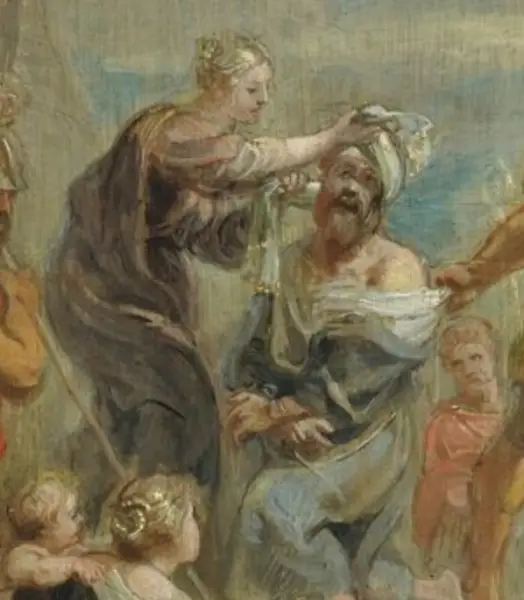
The scene that fixed Plautilla's name in Christian memory takes place on the road outside Rome, at the Ostian Gate, where the Apostle Paul was being led to execution. The earliest detailed telling appears in the late antique apocryphon known as the Martyrium Pauli, circulated under the name of Linus, which tells how Paul covered his eyes with the veil Plautilla had given before he knelt to meet the sword. The story grew richer in the hands of medieval retellers. Jacobus de Voragine's Golden Legend relates that when the condemned Apostle came near, Plautilla, a Christian woman of the city, wept over him and begged a share in his prayers. He turned to her with gentle authority and asked to borrow the veil that covered her head, so that he might bind his own eyes for the blow, and told her she would take it back again. She gave it. Bystanders jeered at the folly of surrendering so precious a cloth to a condemned man they called an enchanter. But the Apostle's promise held: after the beheading, the veil was returned to her, delivered by a miracle that confounded the mockers and confirmed in her hands the truth of what she had witnessed. In that exchange of a simple cloth lies one of the most tender episodes in the literature of the martyrs.
§ Sources and legend
A Veil That Became a Sign
In Christian imagination, Plautilla's veil came to signify far more than its cloth. It was a woman's small possession, offered in an hour of grief, and it came back bearing heaven's endorsement. The miracle vindicated the Apostle at the very moment of his humiliation and vindicated the woman who had dared to be seen weeping for him. Scoffers who dismissed Paul as a deceiver were answered not by argument but by the impossible return of the borrowed veil. Medieval preachers and compilers treasured the story precisely because it joined the great drama of apostolic martyrdom to an ordinary act of female kindness, making a Roman matron a participant in the founding testimony of the Church. It also gave the faithful a concrete relic of memory: wherever the story was told, artists and writers could conjure the road to the Ostian Gate, the kneeling Apostle, the covering cloth, and the woman waiting for its return. The episode belongs to the class of traditions that grew around the deaths of the apostles, historical in outline in Paul's execution by the sword as a Roman citizen, legendary in its embellishments, and enduringly eloquent about what Christians believed happened when their witnesses died.
§ Sources and legend
Commemoration East and West
Plautilla's veneration belongs to the earliest stratum of the Church's remembrance of its saints, before any formal process of canonization existed. She is honored as a martyr in both the Roman Catholic Church and the Eastern Orthodox Church. In the Byzantine tradition she is commemorated on 20 May under the name Plautilla the Roman, an entry preserved in the great modern compilation of the Greek synaxarion that carries forward the ancient calendars. The West received her principally through the liturgical and narrative currents that flowed from the Golden Legend, which kept her episode before the faithful wherever the feasts of the Apostles were celebrated. No dates for her canonization exist because none were needed: the antiquity of her cult, her association with the apostolic age, and her traditional martyrdom around the year 67 sufficed for her continuous remembrance. Her case illustrates how the oldest saints of the Roman Church came to be numbered among the canonized, not by decree but by the sustained devotion of the communities that told her story, painted her veil, and kept her name on the calendar of heaven for nearly two millennia.
§ Liturgical commemoration
The Veil in Art and Memory
The miracle of Plautilla's veil became one of the recognizable motifs of Western religious art, attached to countless depictions of Paul's beheading and its aftermath. Museum collections preserve the theme across centuries and media. The Princeton University Art Museum holds a panel traditionally titled The Beheading of Saint Paul that scholars have read in light of the veil miracle; the J. Paul Getty Museum preserves an Italian trecento initial showing the beheading together with the return of the veil; and the Museum of Fine Arts in Boston owns a Flemish tapestry of Saint Paul requesting the veil, whose catalogue explicitly names the Golden Legend as its narrative source. Rubens and his circle also treated the scene, showing the woman lending her veil to the condemned Apostle. Art historians have studied the iconography in detail, tracing how painters balanced the violence of the execution with the quiet miracle of the returned cloth. Through these images Plautilla's memory has traveled far beyond the liturgical calendar, reaching viewers who know nothing of the synaxaria. She remains one of those figures in whom the legend and the artwork sustain one another: the story gave the painters their subject, and the painters, in turn, have kept the story alive.
§ In art and reception
In Their Own Words
Plautilla, my dear daughter, lend me the veil with which thy head is covered. I shall cover my eyes therewith, and then thou shalt take it back.
The Record
- Symbols
- the veil·the returned, bloodstained cloth
- Canonization
- Pre-congregation; venerated from antiquity in the Roman Catholic and Eastern Orthodox Churches
Prayer
Bibliography
Show 7 sources
- "Ἡ Ἁγία Πλατίλλα ἡ Ρωμαία (20 Μαΐου)". Μέγας Συναξαριστής (in Greek). Retrieved September 13, 2025.
- "Ps.-Linus, Martyrium Pauli apostoli (trans. Andrew Eastbourne)". Tertullian.org. Roger Pearse.
- "Jacobus de Voragine, Golden Legend: Life of St. Paul (Caxton trans.)". Fordham Medieval Sourcebook.
- Bauman, Guy Caesar (1977). "The Miracle of Plautilla's Veil in Princeton's "Beheading of Saint Paul"". Record of the Art Museum, Princeton University. 36 (1): 3–11. doi:10.2307/3774443.
- "The Beheading of Saint Paul". Princeton University Art Museum.
- "Initial S: The Beheading of Saint Paul and the Miracle of Plautilla's Veil". J. Paul Getty Museum.
- "Tapestry: Saint Paul Requesting Plautilla's Veil". Museum of Fine Arts, Boston.
Profile text adapted from the Wikipedia article, licensed CC BY-SA 4.0.
Pray with this saint every day
Save St. Plautilla to your favorites, read the full profile, and get feast-day reminders in the Saints app.
Get the Saints AppFree on the App Store for iPhone and iPad