
died 730 (aged c. 100)·Feast July 15
St. Plechelm
Anglo-Saxon missionary bishop of Frisia
Overview
Plechelm was an Anglo-Saxon monk and bishop who became one of the great missionaries of the early medieval Netherlands. Born around 630 in the British Isles — Alban Butler places his birth in southern Scotland, while other authorities place him in northern England — he was ordained a priest and set out with the monks Wiro and Otger on pilgrimage to Rome, where he received episcopal consecration, perhaps from Pope Sergius I, and collected holy relics for the mission field. Returning north, the three companions traveled to Gaul, where Pepin of Herstal received them favorably and granted them St. Peter's Mount at Sint Odiliënberg in Frisia. There they founded a monastery that became a springhead of Christianity in the Low Countries, dispatching missionary bands into the lands between the Rhine and the Meuse. Plechelm is said to have taken part in the Synod of Utrecht in 697. He died at Sint Odiliënberg in 730, reputedly at the age of one hundred. Honored at Sint Odiliënberg and Ruramonde, he was canonized by Pope Agapetus II around 950. After Norman raids forced the removal of the relics of Wiro, Plechelm, and Otger to Utrecht, Bishop Balderic of Utrecht translated Plechelm's remains in 954 to the basilica he had built at Oldenzaal, which still bears the saint's name. He is honored as a patron saint of the Netherlands.
The Complete Life
A Saxon from the Northern Marches
The sources disagree about where Plechelm first saw the light of day, a familiar difficulty with the saints of the seventh-century British Isles. Alban Butler records that he was an English Saxon born in southern Scotland; Richard Stanton's menology places him in the north of England; and other traditions reach toward Ireland. What the accounts share is the essential picture: a Saxon Christian raised in the mission-saturated world of the Anglo-Celtic north, where monasteries like Lindisfarne, Iona, and their daughter houses sent evangelists across seas that had once carried raiders. In that world a gifted young man of religious disposition would be formed in monastic discipline and, if he proved worthy, ordained to the priesthood. Plechelm was ordained, and from the start his horizons were continental rather than insular. He attached himself to kindred spirits in the missionary movement, chief among them the monk Wiro and the deacon Otger, with whom he would share the rest of his life. The partnership of the three was to prove decisive for the Christianization of the Netherlands, though at the beginning it consisted simply of three monks with pilgrims' staffs, resolved to go to Rome and then wherever God might send them.
§ Life
Pilgrimage to Rome and Consecration
Plechelm's path to the mission field ran through Rome, as it did for so many Anglo-Saxon missionaries of his age. In the company of Wiro and Otger he made the long pilgrimage to the tombs of the Apostles, a journey of several months that brought the northern monks into direct contact with the center of Western Christendom. There Plechelm received consecration as a bishop, perhaps at the hands of Pope Sergius I, though the exact circumstances of his ordination belong to legend as much as to record. The Roman sojourn served the mission in a practical way as well: he returned from the city carrying holy relics, the spiritual armament that early missionaries valued for the founding of churches and shrines among newly converted peoples. With a bishop's orders, relics from the apostolic city, and two faithful companions, Plechelm possessed everything the missionary enterprise of his day required. The three left Rome not for home but for new fields, turning north through Gaul. There their undertaking met its providential instrument: Pepin of Herstal, the powerful mayor of the palace whose Frankish dominions bordered the still-pagan Frisian lands, welcomed the missionaries and put territory at their disposal.
§ Life
St. Peter's Mount and the Conversion of the Netherlands
Pepin of Herstal granted the missionaries St. Peter's Mount, the height at Sint Odiliënberg in the Kingdom of Frisia, and there Wiro, Plechelm, and Otger built a monastery that became one of the key bases of the Christianization of the Netherlands. The site's position gave the foundation its strategic value: from Sint Odiliënberg the monks could reach the provinces lying between the Rhine and the Meuse, the river corridors through which Christianity would ultimately penetrate the Dutch lowlands. Missions were repeatedly dispatched from the monastery into those territories, carrying the Gospel to settlements where the old Germanic religions still held sway. Plechelm served the work as a bishop, providing sacramental leadership, ordaining clergy, and consecrating the churches that the mission planted. His presence is also recorded, if the testimony preserved by John O'Hanlon is accepted, at the Synod of Utrecht in 697, an assembly that belongs to the formative period of the Church among the Frisians. Together with Wiro he labored at Sint Odiliënberg for the remainder of his long life, and the place became so identified with the three missionaries that their memory was honored there for centuries. The monastery stood as proof that the northern mission begun by wandering monks had taken root in Frisian soil.
§ Life
A Hundred Years of Service
Plechelm's life stretched to extraordinary length by any measure, medieval or modern. He died at Sint Odiliënberg in the year 730, and the tradition preserved by his hagiographers holds that he had reached the age of one hundred. If the figure is taken at face value, his century of life spanned the entire arc of the northern mission: from his Saxon boyhood in the British Isles, through ordination, the Roman pilgrimage, and consecration as a bishop, to five decades or more of labor among the Frisians beside the Rhine and the Meuse. He died not in his native Britain but in Frisia, among the people he had served, in the monastery on St. Peter's Mount where he and Wiro and Otger had first raised the cross. His companions predeceased him or were buried beside him, for the three were honored together at Sint Odiliënberg and at Ruramonde, where their cult flourished in the generations after their deaths. By the time he died, the mission he had carried into the Netherlands was no longer a fragile outpost but an established institution with a monastery, dependent churches, and a memory that would survive war and invasion. His burial place became a shrine, and the holiness of his last resting place drew the faithful long after the memory of his face had faded.
§ Life
Canonization and the Translation of 954
Plechelm's veneration was ancient, but the Church gave it formal recognition in the tenth century. About the year 950, Pope Agapetus II canonized the missionary bishop, confirming a cult that had grown up around the tombs at Sint Odiliënberg and Ruramonde. The timing of the canonization belongs to a broader movement in which the bishops of the tenth century gathered the scattered cults of the early mission field into the official sanctuaries of the reformed Church. Political circumstance soon shaped the saint's resting place. In the middle of the ninth century Norman invaders had swept through the region, and the relics of the three missionaries — Wiro's, Plechelm's, and Otger's — were carried to Utrecht for protection. In 954 Bishop Balderic of Utrecht completed the saint's new story: he had built the Basilica of St. Plechelm at Oldenzaal in Overijssel expressly to enshrine the remains, and in that year he transferred the relics to their new home. The basilica became the center of Plechelm's cult in the Netherlands, the goal of pilgrimage and the bearer of his name down to the present. Through canonization and translation alike, the tenth century transformed the memory of a Frisian missionary into an institutional cult whose monuments still stand.
§ Veneration
Patron of the Netherlands
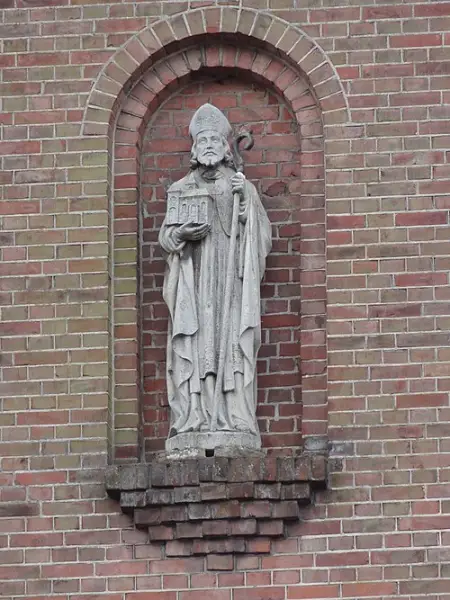
The Christianization of the Netherlands, in which Plechelm's monastery played so important a part, eventually made the country one of the historic heartlands of European Catholicism, and the Church honored the missionaries who accomplished it with enduring titles. Plechelm is honored in the Catholic Church and the Old Catholic Church alike as a patron saint of the Netherlands, and his memory is also kept in the Eastern Orthodox Church, a threefold veneration that testifies to how widely his cult traveled. His feast falls on July 15. The Basilica of St. Plechelm at Oldenzaal remains the principal shrine of his memory in Overijssel, and the statue of the saint crowns the tower of the church at De Lutte, keeping watch over the countryside his mission once evangelized. The places of his life and death — Sint Odiliënberg, whose very name preserves the memory of the companions, and Ruramonde, where the three were first honored — remain landmarks of the early Dutch Church. For the Dutch faithful, Plechelm stands with the other Anglo-Saxon and Irish missionaries who crossed the North Sea to plant the faith among their ancestors, a reminder that the Christianity of the Low Countries was born of the courage of monks who left everything for the Gospel.
§ Veneration
Timeline
- 697
Reportedly present, together with Wiro, at the Synod of Utrecht.
§ Life
- 730
Died at Sint Odiliënberg in the Kingdom of Frisia, said to have reached the age of one hundred.
§ Life
- 950
Canonized by Pope Agapetus II, about this year.
§ Veneration
- 954
Bishop Balderic of Utrecht transferred the relics to the new Basilica of St. Plechelm at Oldenzaal.
§ Veneration
The Record
- Major works
- Monastery of St. Peter's Mount at Sint Odiliënberg, center of missionary work between the Rhine and the Meuse
- Patron of
- patron saint of the Netherlands
- Canonization
- Pre-congregation cult; canonized by Pope Agapetus II about 950
Prayer
Bibliography
Show 5 sources
- Bateson, Mary (1896). "Plechelm". In Lee, Sidney (ed.). Dictionary of National Biography. Vol. 45. London: Smith, Elder & Co.
- Butler, Alban. "St. Plechelm, Bishop and Confessor", The Lives of the Saints. Volume VII: July. 1866.
- A Menology of England and Wales: Or, Brief Memorials of the Ancient British and English Saints Arranged According to the Calendar, Together with the Martyrs of the 16th and 17th Centuries. Burns & Oates. 2 March 1887.
- Farmer, David. The Oxford Dictionary of Saints (5 rev) OUP, 2011. ISBN 9780199596607.
- O'Hanlon, John. Lives of the Irish saints, Vol. 7, 1873, p. 239.
Profile text adapted from the Wikipedia article, licensed CC BY-SA 4.0.
Pray with this saint every day
Save St. Plechelm to your favorites, read the full profile, and get feast-day reminders in the Saints app.
Get the Saints AppFree on the App Store for iPhone and iPad