
c. 340 – c. 450·Feast August 27 (Julian; September 9 Gregorian)
St. Poemen the Great
Desert Father and shepherd of the Egyptian monks
Overview
Poemen the Great, whose name means shepherd, was a Christian monk of the Egyptian desert and the most frequently quoted teacher in the Apophthegmata Patrum, the Sayings of the Desert Fathers. Born around 340, he belonged to a monastery at Scetis, among the very earliest nurseries of Christian monastic life. In 407 raiders overran Scetis and scattered its monks; Poemen fled with his brother Anoub and a handful of companions to Terenuthis on the Nile, where the exiles first settled in an abandoned pagan temple. The disaster proved providential for posterity: the dispersed monks preserved their collective memory of Scetis, and Poemen's circle created the bulk of the sayings collection that has transmitted desert spirituality to every later generation. Poemen was sought out less for spectacular asceticism than for his gift as a spiritual guide. His teaching was marked by gentleness, mercy toward the fallen, and relentless suspicion of judgment. He counseled compassion for the weak, softened the penances of sinners, and taught that authority should be exercised by example rather than command. Nearly a quarter of the sayings in the collection are by or about him, and modern scholars such as Wilhelm Bousset and William Harmless treat him as a genuine historical figure. He died around 450 at Wadi El Natrun, remembered as a saint across the Christian East and West.
The Complete Life
A Son of the Desert of Scetis
Poemen was born around the year 340 in the Province of Egypt, at the moment when the movement of flight into the desert for the sake of the Gospel was transforming Egyptian Christianity. The name given him, Poemen, means shepherd, and it proved prophetic of his life's work. He settled at a monastery in Scetis, the wadi in the desert northwest of the Nile delta that had become, alongside Nitria and Kellia, one of the first great centers of Christian monasticism. There the desert Fathers lived in cells scattered across the solitude, gathering on Sundays for the Eucharist and seeking out the elder monks for a word of salvation. Poemen grew into that world, receiving its traditions and embodying its disciplines, though his temperament inclined less toward spectacular austerity than toward discernment. He lived there with his brother Anoub, and the two would remain companions through the upheavals that followed. For decades the monastic life of Scetis was the whole of his formation: the memorized sayings of the elders, the rhythms of psalmody and work, the small habits of charity among brothers. When the history of desert monasticism was later written, it was largely through the remembered words of men like Poemen that it could be written at all.
§ Biography
Exile from Scetis
In 407 the monastic peace of Scetis was shattered. Raiders overran the monastery, and the monks scattered into exile. Poemen and Anoub fled with a handful of brothers to Terenuthis, a town on the Nile, and the little band, thrown upon the world, first made its home in an abandoned pagan temple. The raid was not an isolated blow; repeated attacks on Scetis marked a turning point in the history of desert monasticism, ending its concentrated settlement and dispersing its elders across Egypt. Yet the diaspora accomplished something the raids never intended. Cut off from the place that had formed them, Poemen and his companions carried Scetis in their memories, and the stories and sayings they preserved became the bulk of the Apophthegmata Patrum, the collection through which desert spirituality has reached the whole Church. Poemen's own gift of memory was decisive. Many of the stories in the collection are his recollections of the elders with whom he had lived in Scetis, recalled and retold in exile for monks who had never seen the desert settlement. Zacharias of Sakha, a Coptic author of later times, credited Poemen himself with writing, which has led some to wonder whether he helped compose the collection. Exile thus made him, perhaps more than any other single figure, the voice of Scetis.
§ Biography
The Shepherd's Mercy
Poemen's personality, as the tradition preserves it, was that of a wise shepherd rather than a fierce ascetic, and what monks quoted most was his gift for guiding souls. Tolerance of others' weaknesses marked him above all. When older monks consulted him about brothers who fell asleep during prayer, and were inclined to wake them, he answered that when he saw a brother dozing, he laid the man's head on his knees and let him rest. Harsh penance found no welcome with him: when a monk confessed a great sin, Poemen reduced the prescribed penance from three years to three days. His refusal to judge took even stranger forms. To a brother whose irregular household had produced a child, he sent a bottle of wine in celebration, and the brother, stricken in conscience by the gesture, later dismissed the woman. His counsel on authority was characteristically indirect: asked by a visiting monk whether he should take charge of the brothers he lived with, Poemen answered no, and told him to be their example rather than their legislator. He taught more by example than by lecture. Behind the gentleness lay a rigorous doctrine of the interior life: a man may seem silent, he warned, but if his heart condemns others, he is babbling without cease. For Poemen, the true work was the purification of the heart, not the multiplication of severity.
§ Biography
Elder of the Exiles
Poemen lived to extraordinary old age, dying around the year 450 at Wadi El Natrun, the district that contained ancient Scetis, having lived through more than a century of the desert's history. In his last decades he stood as the elder of the Scetian diaspora, the Abba to whom monks still came from near and far for a word of guidance. His fame in the collections is measured by the sheer weight of his presence: nearly a quarter of the sayings in the Apophthegmata Patrum are by or about him, so many that some scholars suspected the name Abba Shepherd had become a generic label under which sayings of different elders were gathered. Others hold that Poemen's circle itself gathered the sayings. Scholarship today has largely confirmed his standing as a historical person; both Bousset and Harmless treat him as a real man, not a literary convenience. He is also featured prominently in the Ethiopic Collectio Monastica, another witness to the sayings of the Fathers. Among the teachings of his final years stand his triads of the spiritual life, among them his threefold counsel for the labor of the soul: to prostrate oneself before God, to refuse all reckoning of one's progress, and to abandon every self-willed choice.
§ Biography
The Most Quoted of the Fathers
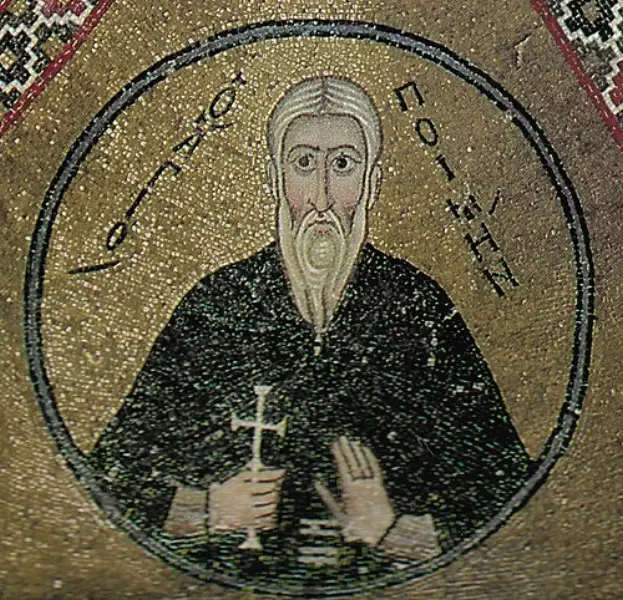
No voice of the desert reaches the modern reader more often than Poemen's. As the most quoted Abba in the Apophthegmata Patrum, he became the representative of desert wisdom for Byzantine monasticism, for the Western tradition that descended from John Cassian and Benedict, and for the renewed interest in the Desert Fathers that has marked Christianity from the nineteenth century to the present. Art preserved his memory alongside his words: an eleventh-century mosaic of Saint Poimen shines in the nave of Hosios Loukas in Greece, and a fresco of 1547 at the Dionysiou Monastery on Mount Athos portrays him among the ascetic saints. He is venerated as a saint in the Eastern Orthodox Church, the Oriental Orthodox Churches, and the Roman Catholic Church, and in the Coptic tradition he stands among the great monastic Fathers of Egypt. His feast is kept on 27 August in the Julian calendar, corresponding to 9 September in the Gregorian. The scholars who study early monasticism find in him the clearest expression of the desert's second great discovery: that discernment, memory, and mercy are as essential to the spiritual life as fasting and vigil. His sayings continue to be translated, memorized, and practiced wherever Christians seek a word of salvation in the tradition of the Fathers.
§ Selected sayings of Poemen
Timeline
- 340
Born around this year in the Province of Egypt of the Roman Empire.
§ Saint Poemen the Great
- 407
Raiders overran the monastery at Scetis; Poemen fled with Anoub and other monks to Terenuthis on the Nile.
§ Biography
- 450
Died around this year at Wadi El Natrun in Egypt, near the end of an exceptionally long life.
§ Saint Poemen the Great
In Their Own Words
For my part, when I have seen a brother who is dozing, I put his head on my knees and let him rest.
No, be their example, not their legislator.
A man may seem to be silent, but if his heart is condemning others, he is babbling incessantly.
We have not been taught to kill our bodies, but to kill our passions.
Many of our Fathers have become very courageous in asceticism, but in fineness of perception there are very few.
The Record
- Major works
- Sayings preserved in the Apophthegmata Patrum (Sayings of the Desert Fathers)·Sayings featured in the Ethiopic Collectio Monastica
- Symbols
- hermit·ascetic
- Canonization
- Pre-congregation; venerated as a saint in the Eastern Orthodox, Oriental Orthodox, and Roman Catholic Churches
Prayer
Bibliography
Show 6 sources
- Harmless, William (September 1, 2000). "Remembering Poemen Remembering: The Desert Fathers and the Spirituality of Memory". Church History. 15. American Society of Church History.
- Harmless, William (17 June 2004). "Abba Poemen". Desert Christians: An Introduction to the Literature of Early Monasticism. Oxford University Press. pp. 206–211. ISBN 978-0-19-516222-6.
- "Abba Poemen: Brief Life and Sayings", Orthodox Metropolitanate of Hong Kong and South East Asia.
- Guy, Jean-Claude (ed.). Apophtegmes des Pères. Les Éditions du Cerf. p. 442. ISBN 2204048089.
- "Venerable Pimen the Great", Orthodox Church in America.
- Palladius of Galatia (1907). "Of A Certain Brother Who Was A Neighbour Of Abba Poemen". The paradise, or garden of the holy fathers. Translated by Ernest Alfred Wallis Budge. Chatto & Windus.
Profile text adapted from the Wikipedia article, licensed CC BY-SA 4.0.
Pray with this saint every day
Save St. Poemen the Great to your favorites, read the full profile, and get feast-day reminders in the Saints app.
Get the Saints AppFree on the App Store for iPhone and iPad