
69 – 155·Feast February 23
St. Polycarp of Smyrna
Bishop of Smyrna and apostolic father
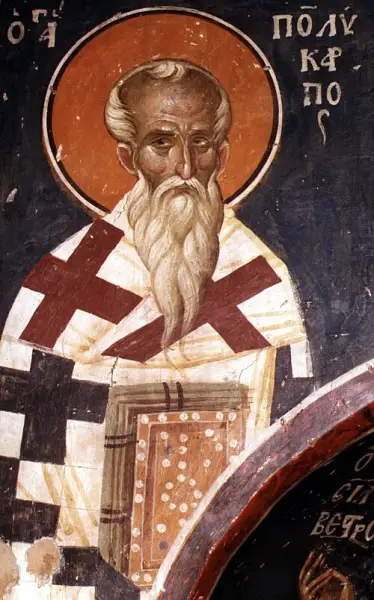
Overview
Polycarp was a Christian bishop of Smyrna in the second century and one of the principal figures bridging the age of the apostles and the settled church that followed. Irenaeus and Tertullian both describe him as a disciple of John the Apostle, and Jerome records that John ordained him to lead the church of Smyrna. He stands with Clement of Rome and Ignatius of Antioch among the three chief Apostolic Fathers. One writing of his survives, a letter to the Philippians, which weaves together echoes of the Septuagint and the early Christian texts. His death is recorded in the Martyrdom of Polycarp, among the earliest genuine accounts of a Christian martyr's passion: because he would not offer incense before the emperor's image, he was bound and set upon a pyre, and when the flames could not destroy him, an executioner ran him through. That same account preserves the oldest evidence of Christians gathering a martyr's bones for annual commemoration. Polycarp's steady witness, his link to the apostolic generation, and his defense of inherited teaching made him, in the memory of the early church, a living bond with the time of Christ's own disciples.
The Complete Life
A Hearer of John
The tradition surrounding Polycarp's beginnings rests on the testimony of writers who stood close to him or to his students. Irenaeus and Tertullian both state that he had been a disciple of John the Apostle, and Jerome, writing in his catalogue of illustrious men, says that this same John ordained him bishop of Smyrna. Irenaeus adds that Polycarp was a companion of Papias, another who had heard John, and that he corresponded with Ignatius of Antioch. The account of Ignatius' martyrdom describes his arrival at Smyrna, where he hastened to meet the bishop of the city, his former fellow disciple under John. Ignatius addressed a letter to Polycarp and mentioned him elsewhere in his correspondence with the Ephesians and the Magnesians. Irenaeus, who knew the aged bishop in his own youth, treasured the memory of him and recorded what Polycarp would recount of his past: how he had spoken with John and with others who had actually seen Christ, and what words he had heard from their mouths. Irenaeus reports that Polycarp was brought to the faith by apostles and consecrated a presbyter, and that his own recollection of the man's gravity, deportment, and teaching remained vivid decades later.
§ Link to the Apostles and Jesus
Bishop and Teacher at Smyrna
Everything known of Polycarp's ministry comes through a handful of early documents: the narrative of his martyrdom, the works of Irenaeus, the letter to Florinus, the correspondence of Ignatius, and the epistle he himself addressed to the Philippians. He led the church of Smyrna as its bishop and stands among the three chief Apostolic Fathers alongside Clement of Rome and Ignatius of Antioch. The one writing that survives under his name, the letter to the Philippians, is built from a rich weave of references to the Septuagint and gives insight into how the earliest Christians used their scriptures. Irenaeus mentions, in a letter now lost but preserved in extracts by Eusebius, that Polycarp composed other epistles to neighboring churches and to individuals, none of which endure. Charles E. Hill has argued that the teaching Irenaeus ascribes to an unnamed apostolic presbyter represents the lost instruction of Polycarp himself. A minority of scholars, including Hans von Campenhausen, have even proposed his hand behind the pastoral epistles of the New Testament, a theory that would place those books among pseudepigrapha. In 1999 the Harris Fragments, Coptic texts from the third to sixth centuries that mention him, were published, extending the evidence for his early fame.
§ Life
Rome, Anicetus, and the Paschal Question
According to Irenaeus, Polycarp traveled to Rome while his fellow Syrian Anicetus occupied the bishop's chair there, to discuss differences in practice between the churches of Anatolia and those of the imperial capital. On certain questions the two quickly reached agreement, but on the date of Easter they remained apart. Polycarp followed the Eastern custom of keeping the feast on the fourteenth of Nisan, the day of the Jewish Passover, whatever the weekday; Anicetus followed the Western practice of celebrating on the first Sunday after the spring equinox's full moon. Neither broke communion with the other: each adhered to his own custom in full fellowship, and Anicetus welcomed him to preside at the Eucharist in the bishop's own church, a mark of honor unusual in Roman eyes. The meeting became a model of divergent rites held together by shared faith. Irenaeus also credits the visit's witness with effect beyond liturgy, reporting that Polycarp's testimony turned many disciples of Marcion and Valentinus from their teachers. In the later Quartodeciman dispute, Polycrates of Ephesus would appeal to Polycarp's example, recorded through Eusebius, as authority for the Asian practice of keeping the paschal feast with John on the fourteenth of Nisan.
§ Visit to Anicetus
The Teaching of the Letter
Polycarp's theology must be reconstructed from a short letter and the report of his trial. Writing to the Philippians, he cites Ephesians to affirm that salvation rests on grace rather than works, yet exhorts his readers to do good, leaving uncertain whether he regarded works as the fruit of grace or as necessary to its preservation; interpreters divide over whether the passage makes him a monergist or a synergist. His confession of Christ is emphatic: Jesus is the Son of God and the eternal high priest, to whom all things in heaven and earth are subjected, whom every breath worships, and who comes to judge the living and the dead. He insists on the sinlessness of Jesus, on the Incarnation and the death of Christ upon the cross, and rejects docetism without compromise. He rejected the teaching of Marcion without reserve, naming him the firstborn of Satan, and appears to treat false doctrine as a graver danger than immorality, though he calls the immoral to repentance as well. His statements in the account of his trial show trinitarian contours. He affirms the resurrection of the dead and Christ's return as judge, and his circle's premillennialism suggests he shared that hope. His letter recognizes numerous New Testament books as scripture and quotes Tobit besides.
§ Theology
Trial and Martyrdom at Smyrna
The account of Polycarp's death describes him declaring on the day of his execution that he had served Christ for eighty-six years and had suffered no wrong from him, words that could mean either that he was then eighty-six or that his conversion lay that far back. Because he would not offer incense to the emperor, he was condemned, bound, and set upon the pyre; as the flames did not destroy him, an executioner finished the work with a sword. The date of his death is disputed. Eusebius places it in the reign of Marcus Aurelius, around 166 or 167, while a later addition to the martyrdom account sets it on Saturday, February 23, during the proconsulship of Lucius Statius Quadratus, around 155 or 156, the earlier chronology fitting better with his links to Ignatius and John. The narrative says he was arrested on a Sabbath and put to death on the Great Sabbath, a detail William Cave read as evidence that the Smyrnaeans assembled on Saturdays and J. B. Lightfoot explained through the festival of Purim, since the fourteenth of Nisan cannot fall as early as February under the standard Jewish calendar. Others reply that the Jewish calendar was not yet fixed, and that the season saw both a Jewish and a Christian Passover.
§ Martyrdom
Bones More Precious Than Gold
Polycarp belongs to the pre-congregation saints, honored across the churches without any formal process of canonization: the Eastern Orthodox, Catholic, Oriental Orthodox, and Church of the East all venerate him, as do Lutherans and Anglicans. The account of his martyrdom is among the earliest, and perhaps the earliest, records of Christians venerating a martyr's relics and keeping an annual commemoration on the date of death: the Smyrnaeans wrote that they collected his remains, treasuring them above jewels and precious metal, and deposited them where they would meet in gladness each year to keep the birthday of his martyrdom. Relics of Polycarp lie beneath the high altar of Sant'Ambrogio della Massima in Rome. For more than five centuries his right arm rested with the monks of the Dormition monastery at Ampelakiotissa near Nafpaktos in Greece, until it was stolen on March 14, 2013; a fragment removed on an earlier occasion was found and returned to the monastery on July 14, 2019. His feast is kept on February 23 by Catholics, Orthodox, Lutherans, and the Church of England, and on 29 Amshir, corresponding to March 8, by Coptic Orthodox Christians.
§ Veneration and commemoration
The Most Admirable Polycarp
Polycarp occupies a decisive place in the history of the early church. His own congregation styled him the most admirable Polycarp, a teacher both apostolic and prophetic who held the episcopal chair of the Catholic church at Smyrna; he ranks among the earliest Christians whose writings survived their generation. Jerome remembered him simply as a disciple of the apostle John, ordained by him presbyter of Smyrna. He led an important congregation in the age when the Christian church was taking shape, and his orthodoxy is acknowledged today by the ancient Eastern and Oriental Orthodox churches, by Catholics, and widely by mainstream Protestants, Church of God groups, and Sabbatarians alike. His greatest gift to the church after the apostles' deaths was authentication: in an age when many interpretations of the sayings of Jesus competed for hearers, the witness he could bear to the genuine tradition of apostolic doctrine carried singular weight, condemning the novelties of heretical teachers as inventions. Irenaeus, who heard him preach in his youth, judged him a far weightier and more steadfast witness to truth than Valentinus, Marcion, and the rest. When the Quartodeciman controversy divided East and West, Polycrates of Ephesus cited his practice as precedent, and his letter and passion entered the Apostolic Fathers, where they remain foundational documents of the early church.
§ Importance
Timeline
- 69
Born at Smyrna in the Roman Empire, according to the traditional dates of his life.
§ Polycarp
- 23 Feb 155
Martyred at Smyrna: bound to the pyre and burned, then run through with a sword when the flames failed to destroy him.
§ Martyrdom
- 1999
Publication of the Harris Fragments, third- to sixth-century Coptic texts that mention Polycarp.
§ Life
- 14 Mar 2013
His right arm, kept for over five centuries at a monastery in Ampelakiotissa, Greece, was stolen and never recovered.
§ Veneration and commemoration
- 14 Jul 2019
A fragment taken earlier from the stolen arm was discovered and returned to the Ampelakiotissa monastery.
§ Veneration and commemoration
In Their Own Words
Eighty and six years I have served Him, and He has done me no wrong.
How then can I blaspheme my King and Savior? You threaten me with a fire that burns for a season, and after a little while is quenched; but you are ignorant of the fire of everlasting punishment that is prepared for the wicked.
I bless you, Father, for judging me worthy of this hour, so that in the company of the martyrs I may share the cup of Christ.
The Record
- Major works
- Epistle of Polycarp to the Philippians
- Patron of
- earache sufferers
- Symbols
- wearing the pallium·holding a book representing his Epistle to the Philippians
- Canonization
- Pre-congregation; venerated as a saint and Church Father across the Eastern and Western churches
Prayer
Bibliography
Show 7 sources
- Hartog, Paul (2002). Polycarp and the New Testament. Mohr Siebeck. ISBN 978-3-16-147419-4.
- Hill, Charles E. (2006). From the Lost Teaching of Polycarp: Identifying Irenaeus' Apostolic Presbyter and the Author of Ad Diognetum. Tübingen: Mohr Siebeck. ISBN 3-16-148699-4.
- Andrews, Herbert Tom (1911). "Polycarp". In Chisholm, Hugh (ed.). Encyclopædia Britannica. Vol. 22 (11th ed.). Cambridge University Press. pp. 20–22.
- Bacchus, Francis Joseph (1911). "St. Polycarp". In Herbermann, Charles (ed.). Catholic Encyclopedia. Vol. 12. New York: Robert Appleton Company.
- Grant, Robert M. (1963). "Chapter 14: The Non-Pauline Epistles". A Historical Introduction to the New Testament. Harper and Row.
- "Medieval Sourcebook: The Martyrdom of Polycarp trans. J.B. Lightfoot". Fordham University.
- Schoedel, William R. (2020). The Apostolic Fathers, A New Translation and Commentary, Volume V: Polycarp, Martyrdom of Polycarp, Fragments of Papias. Wipf and Stock Publishers. ISBN 978-1-7252-8086-1.
Profile text adapted from the Wikipedia article, licensed CC BY-SA 4.0.
Pray with this saint every day
Save St. Polycarp of Smyrna to your favorites, read the full profile, and get feast-day reminders in the Saints app.
Get the Saints AppFree on the App Store for iPhone and iPad