
1563 – 1591·Feast December 10
St. Polydore Plasden
Seminary priest and Tyburn martyr
Overview
Polydore Plasden was an English Catholic priest, born in London in 1563 to a horner's family, who gave his life at Tyburn in 1591 as one of the Forty Martyrs of England and Wales. Educated at Rheims and at the English College in Rome, he was ordained priest in December 1586 and sent back to England in 1588, at the height of the penal era. For three years he served Catholic communities in Sussex and London under constant danger of capture. In November 1591 he was taken at a house on Gray's Inn Lane while Edmund Gennings celebrated Mass for a congregation of recusants, seized in the raid led by the priest hunter Richard Topcliffe. Tried and condemned under the statute against priests, he was hanged, drawn, and quartered at Tyburn on December 10, 1591, at about twenty-eight years of age. At the scaffold he professed loyalty to Queen Elizabeth while declaring that he would sooner lose a thousand lives than deny his religion. Walter Raleigh, moved by his courage, ordered that he be allowed to hang to death and be spared the crueler part of the sentence. He was beatified in 1929 and canonized in 1970 by Pope Paul VI.
The Complete Life
A London Boyhood and Roman Studies
Polydore Plasden was born in 1563 into the family of a London horner, a craftsman who worked horn into useful goods, in the reign of Elizabeth I, when the practice of the old faith had become costly and, for priests, perilous. He was sent for his education to the seminary at Rheims, the college founded across the Channel to train Englishmen for a mission their homeland forbade, and continued his formation at the English College in Rome. There, on December 7, 1586, he was ordained to the priesthood. He remained in Rome for more than a year afterward; during that time he signed a petition in favor of keeping the Jesuits as superiors of the English College, a preference later recalled in connection with his arrest, since in England blame was laid on their influence for what he endured. In the spring of 1588 he passed through Rheims once more, staying from April 8 until September 2, when he was deemed ready and sent out on the mission. He was then about twenty-five years old, returning to a country where the sentence for a returned priest was death.
§ Life
Ordination for a Forbidden Mission
Plasden's path to the priesthood followed the pattern of the seminary priests of his generation. Reconciliation with Rome had not been his inheritance alone; it was a commitment he crossed the sea to pursue, studying at the two colleges that sustained the English mission. The English College at Rome, where he was ordained in 1586, trained its students for almost certain martyrdom, and the fact that Plasden remained there more than a year before moving on suggests a formation deliberate and thorough. His months at Rheims in 1588 completed his preparation, and on September 2 of that year he was dispatched to England. The mission he undertook was illegal on its face: under the Jesuits, etc. Act 1584, any priest ordained abroad who remained in England beyond a set term was guilty of treason. For three years Plasden labored anyway, serving Catholics in Sussex and in London from 1588 to 1591. Sussex and the capital were regions where recusant households kept the faith alive at their own risk, sheltering priests, hearing Mass in secret, and sustaining the sacramental life of a church without churches. Plasden's ministry belonged wholly to that hidden network.
§ Life
Ministry in Sussex and London
From 1588 to 1591 Plasden served the Catholics of Sussex and London, moving among the recusant households that made such a ministry possible. The mission priest's life was one of movement and disguise, saying Mass where a family dared to host him, reconciling the doubtful, and sustaining communities that risked fines and imprisonment for their worship. In London his work intersected with a circle of hospitality centered on the house of Swithun Wells on Gray's Inn Lane, a known refuge for Catholics. There, on November 2, 1591, Edmund Gennings was celebrating Mass with a congregation gathered when Richard Topcliffe, the government's most relentless hunter of priests, came to the door with his men. As the officers tried to force their way in, some of the worshippers held the door shut until the Mass was concluded, and only then surrendered quietly. Plasden was taken in the raid. Wells himself was absent, but he and his wife, together with Sydney Hodgson and John Mason, were afterward condemned on account of the discovery, Mrs. Wells alone being reprieved; she died in prison in 1602. On December 6, Plasden, Gennings, and Eustace White with three laymen were tried before the King's Bench and condemned.
§ Life
Tyburn, December 10, 1591
The six condemned men died on the same day, December 10, 1591. Edmund Gennings and Swithun Wells suffered opposite Wells' house on Gray's Inn Lane; Plasden, White, Hodgson, and Mason were put to death at Tyburn. At the scaffold Plasden made his last public declaration: he acknowledged Elizabeth as his lawful queen, promised to defend her against all her enemies to the best of his power, and prayed for her and for the whole realm — yet declared that he would sooner lose a thousand lives than abandon his faith or bear arms against it. The distinction between loyalty to the crown and fidelity to the faith, which the law of the time refused to recognize, he maintained to the end. Sentenced to be hanged, drawn, and quartered, he received one unexpected mercy: Sir Walter Raleigh, present at the execution, ordered that Plasden be allowed to hang until he was dead, sparing him the mutilations that followed. He was twenty-seven or twenty-eight years old. His death at Tyburn, in company with priests and laymen bound by the same raid and the same statute, passed at once into the memory of English Catholics as martyrdom.
§ Life
From Tyburn to the Altar
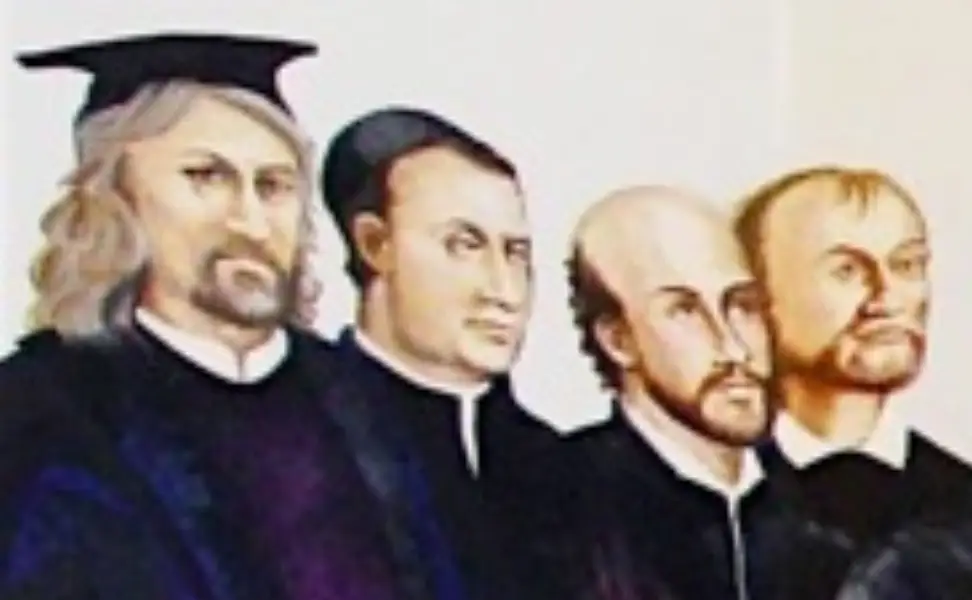
Recognition of Plasden's martyrdom matured over three centuries. The cause of the English martyrs was long in preparation; a decree of the Sacred Congregation of Rites concerning the causes of hundreds of servants of God put to death in England for the faith was already in view by the 1880s, and Plasden was beatified on December 15, 1929, by Pope Pius XI. Forty-one years later, on October 25, 1970, Pope Paul VI canonized him among the Forty Martyrs of England and Wales, the group canonized together as representatives of the priests and laypeople who died under the Elizabethan and Stuart penal laws. His feast is kept on December 10, the day of his execution, and, with his companion martyrs, on October 25. He is remembered in the church's calendar alongside Edmund Gennings, Eustace White, Swithun Wells, Sydney Hodgson, and John Mason, who died with him, and with the wider company of seminary priests who crossed the seas for an English mission under sentence of death. A mural in the English Martyrs Parish in Derby depicts him among the martyrs of December 1591, shown in the company in which he died.
§ Polydore Plasden
Witness of the Seminary Priests
Plasden's life and death belong to the larger story of the English mission, in which several hundred priests trained at Rheims, Rome, and Douai returned secretly to their homeland between 1574 and the reign of James I. Of those caught, many were executed under the 1584 act that made their very presence treason, and the episode at Gray's Inn Lane — a congregation holding the door while Mass was finished, then surrendering without violence — became one of the remembered images of that underground church. The deaths of December 10, 1591, drew particular notice: the intervention of Walter Raleigh to spare Plasden the extremity of the sentence shows that even among his enemies the young priest's bearing compelled respect. His declaration at the scaffold, professing civil loyalty while refusing religious conformity, articulated the position for which the seminary priests died, and it has kept his memory alive among English Catholics ever since. Canonization in 1970 placed him formally among the Forty Martyrs of England and Wales, whose feast the church keeps on October 25. The parish art at Derby, the annual feasts, and the records of the English College preserve the outline of a life spent, from ordination to Tyburn, almost entirely on a forbidden errand.
§ Polydore Plasden
Timeline
- 1563
Born in London, the son of a horner.
§ Polydore Plasden
- 7 Dec 1586
Ordained priest at the English College in Rome.
§ Life
- 2 Sep 1588
Sent from Rheims on the English mission after months of preparation.
§ Life
- 2 Nov 1591
Captured by the priest hunter Richard Topcliffe at Swithun Wells' house on Gray's Inn Lane during Mass.
§ Life
- 6 Dec 1591
Tried before the King's Bench with five companions and condemned under the Jesuits, etc. Act 1584.
§ Life
- 10 Dec 1591
Executed by hanging, drawing, and quartering at Tyburn with Eustace White, Sydney Hodgson, and John Mason.
§ Life
- 15 Dec 1929
Beatified by Pope Pius XI.
§ Polydore Plasden
- 25 Oct 1970
Canonized among the Forty Martyrs of England and Wales by Pope Paul VI.
§ Polydore Plasden
The Record
- Canonization
- Beatified 15 December 1929 by Pope Pius XI; canonized 25 October 1970 by Pope Paul VI as one of the Forty Martyrs of England and Wales
Prayer
Bibliography
Show 6 sources
- "Venerable English College". Archdiocese of Southwark. Archived from the original on 15 July 2019. Retrieved 4 February 2014.
- Wainewright, John (1912). "Ven. Swithin Wells". In Herbermann, Charles (ed.). Catholic Encyclopedia. Vol. 15. New York: Robert Appleton Company.
- Kelly, Christine J. (23 September 2004). "Gennings, Edmund [St Edmund Gennings]". Oxford Dictionary of National Biography (online ed.). Oxford University Press. doi:10.1093/ref:odnb/10516.
- "Grisly stories from the Inns". Counsel. March 2013. Archived from the original on 16 August 2024.
- Whitfield, Joseph Louis (1912). "Ven. Eustace White". In Herbermann, Charles (ed.). Catholic Encyclopedia. Vol. 15. New York: Robert Appleton Company.
- The One Hundred and Five Martyrs of Tyburn. London: Burns & Oates. 1917. p. 77.
Profile text adapted from the Wikipedia article, licensed CC BY-SA 4.0.
Pray with this saint every day
Save St. Polydore Plasden to your favorites, read the full profile, and get feast-day reminders in the Saints app.
Get the Saints AppFree on the App Store for iPhone and iPad