
died 259·Feast January 7
St. Polyeuctus
Soldier and martyr of Melitene
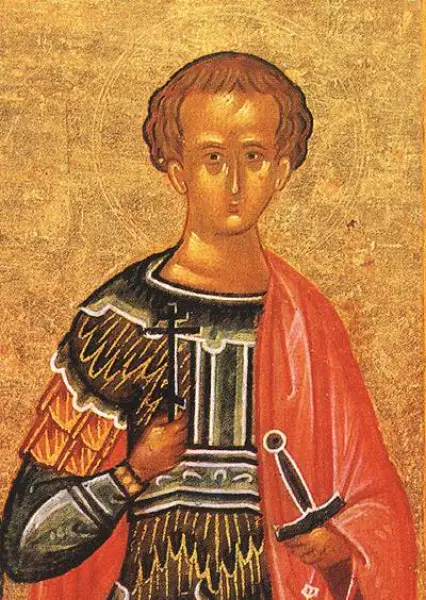
Overview
Polyeuctus of Melitene, who died on January 10, 259, is a martyr of the Roman era venerated across the Eastern and Western churches. Christian tradition remembers him as a wealthy army officer, a member of the Twelfth Legion Fulminata stationed at Melitene in Armenia, and the first Christian put to death in that city under the emperor Valerian. According to the account transmitted by Symeon Metaphrastes, the zeal of his friend Nearchus moved him to convert openly to Christianity. He then acted on his new faith with startling publicity, tearing up the imperial edict requiring idol worship in the city square and trampling a procession of idols underfoot. Arrested and tortured, he withstood the weeping of his wife Paulina, the entreaties of his children, and the appeals of her father, before being beheaded on January 10, 259. His relics were honored at Melitene, where a church rose over his grave, and Anicia Juliana dedicated a great basilica to him in Constantinople in the sixth century. In the West his cult reached Metz, where he became the patron of vows and treaty agreements, invoked as guarantor of a royal treaty around 568. Corneille's tragedy Polyeucte carried his story into French theater.
The Complete Life
An Officer of the Twelfth Legion
Polyeuctus belongs to the generation of Christians who suffered under the emperor Valerian, whose persecution of the mid-third century struck first at the church's leading members. Tradition presents him as a man of means and of rank: a wealthy Roman army officer serving in Melitene, the chief stronghold of Roman Armenia, where the Twelfth Legion Fulminata was garrisoned. There he formed a close friendship with Nearchus, a fellow soldier and a Christian, and the two served side by side in the same legion. The city of Melitene, on the frontier between empire and Armenia, was a military town, its life ordered by the rhythms of the army, and Polyeuctus' position within it made his eventual conversion a public matter rather than a private one. Historians caution that the written account of his passion shows signs of later composition: certain inaccuracies in it suggest the text was set down at least a century after the events it narrates. What the tradition preserves, whatever its literary distance, is the outline of a soldier's vocation reversed — a man whose loyalty to the empire's service was transformed into a loyalty that the empire's courts could only punish.
§ Life
Conversion at the Edge of the Legion
The turn in Polyeuctus' life came through friendship. Symeon Metaphrastes records that the zeal of his companion Nearchus fired him to embrace Christianity openly, at the very moment when profession of the faith had become a punishable offense. The account of his conversion was remembered for its dramatic publicity. Fired, as the hagiographer says, with zeal, Polyeuctus made his way into the city square, ripped up the imperial decree demanding worship of the gods, and, meeting a procession that bore twelve idols through the streets, hurled them down and trampled them. The gesture was unmistakable — an officer of the empire, in the empire's own forum, destroying the empire's sacred emblems — and it made any retreat impossible. His family understood at once what the act would cost him. Paulina his wife, the children he loved, and her father all pleaded with him to relent, and their pleading became part of the story the martyrology preserved: a convert who had to choose between the affection of his household and the faith he had just confessed. He chose the faith, and his trial followed quickly upon his defiance.
§ Life
The Public Act of Faith
Polyeuctus' witness took the form of an act rather than an argument. By overturning the imperial decree and the images of the gods in the open square of Melitene, he put himself in the place of the confessor: the law's demand was now aimed at him personally, and the whole city had seen it. The authorities responded with torture, seeking the recantation that his public defiance had made necessary to their dignity. The account of his passion lingers over the hardest suffering of all, that inflicted on him by those nearest to him — a wife in tears, children entreating, a father-in-law pressing him without pause — a domestic tribunal set up beside the public one. Neither the pains inflicted by the magistrates nor the grief of his household moved him to offer sacrifice to the gods. Tradition records the outcome plainly: he was condemned and beheaded, dying on January 10, 259, and is honored as the first Christian of Melitene to be martyred under Valerian. In the roll of the legion's soldiers he remains one of the earliest named witnesses, remembered not for speeches but for a single decisive act of contempt for the idols.
§ Life
Torture, Condemnation, and Beheading
The final scenes of Polyeuctus' life unite the elements that made his passio a model for later hagiography. Arrested for his destruction of the idols, he was subjected to torture by the authorities of Melitine, who sought to reverse in the prison what could not be undone in the square. His family's intervention formed the hardest trial: Paulina and the children he loved, together with her father, surrounded him with weeping and protest, and the account makes their sorrow real without making it victorious. He held to his confession and was sentenced to death. On January 10, 259, he was beheaded, and the Christians of the city received his body for burial at Melitene, where in time a church was raised over his grave and dedicated to his memory. The sanctuary became a place of pilgrimage in the region: tradition relates that the parents of Euthymius the Great prayed at the church of Saint Polyeuctus in Melitene for the son they longed for. The date of his passion, January 10, was fixed in the ancient Armenian calendars, and his cult spread from a garrison town of eastern Anatolia to Constantinople and, eventually, to Gaul.
§ Life
From Melitene to Constantinople and Metz
Polyeuctus' memory took architectural form in two capitals. At Melitene his grave church marked the martyrdom itself. At Constantinople, the imperial capital, Anicia Juliana dedicated a basilica in his honor between 524 and 527; excavations in the 1960s showed that at Justinian's accession it was the largest church in the city, appointed with extraordinary splendor, its wealth displayed in gilded reliefs of peacocks and abundant oriental ornament. Its relics were later translated to the neighboring Church of the Holy Apostles. In the West his cult appeared at Metz, probably introduced by Nicetius, bishop of Trier, and a church was built for him not far from the royal palace of the Merovingians. There he acquired a distinctive role: patron of vows and treaty agreements, invoked as the guarantor of the treaty by which Sigebert I divided the kingdom of his late brother Charibert I around 568. The historian Stefan Esders proposes that relics of Polyeuctus reached the West around the time Radegund acquired her fragment of the True Cross. His feast, kept on January 7 in the Catholic calendar and January 9 in the Orthodox, and his story, retold by Corneille, Gounod, and Donizetti, kept his name alive far beyond Armenia.
§ Veneration
Timeline
- 10 Jan 259
Beheaded at Melitene in Armenia after torture, the first martyr of the city under Valerian.
§ Life
- 524
Anicia Juliana begins construction of a basilica dedicated to Polyeuctus at Constantinople, completed by 527.
§ Veneration
- 568
Invoked as guarantor of the treaty by which Sigebert I divided the kingdom of his late brother Charibert I.
§ Veneration
- 1642
Pierre Corneille's tragedy Polyeucte, drawing on the account of his martyrdom, is first performed.
§ Cultural references
- 1679
Marc-Antoine Charpentier's ballet on the Polyeuctus story is composed.
§ Cultural references
- 1838
Donizetti's opera Poliuto, adapted from Corneille's play, is composed; it later appears in Italian as Les martyrs.
§ Cultural references
- 1878
Charles Gounod's operatic adaptation of Polyeucte, made with librettist Jules Barbier, is staged.
§ Cultural references
- Jan 1892
Paul Dukas's overture Polyeucte receives its premiere.
§ Cultural references
In Their Own Words
Enflamed with zeal, St Polyeuctus went to the city square, and tore up the edict of Decius which required everyone to worship idols. A few moments later, he met a procession carrying twelve idols through the streets of the city. He dashed the idols to the ground and trampled them underfoot.
The Record
- Patron of
- vows·treaty agreements
- Canonization
- Pre-congregation martyr, venerated in the Eastern Orthodox and Roman Catholic churches since antiquity
Prayer
Bibliography
Show 6 sources
- "Martyr Polyeuctus of Melitene, in Armenia". oca.org. Retrieved 2019-04-07.
- "Martyrdom of Polyeuctus", The Passion of Perpetua and Felicitas in Late Antiquity, Univ of California Press, 2021, p. 253. ISBN 9780520976498.
- Mason, Arthur James. The Historic Martyrs of the Primitive Church, Longmans, Green, & Company, 1905, p. 120.
- "Church of St. Polyeuctus", Turkish Archaeological News, October 12, 2021.
- Majeska, George P., Russian Travelers to Constantinople in the Fourteenth and Fifteenth Centuries, Dumbarton Oaks, 1984, p. 302. ISBN 9780884021018.
- Esders, Stefan. "'Avenger of all Perjury' in Constantinople, Ravenna and Metz", Western Perspectives on the Mediterranean: Cultural Transfer in Late Antiquity and the Early Middle Ages 400-800 AD, (Andreas Fischer, Ian Wood, eds.) A&C Black, 2014, p. 27 et seq. ISBN 9781472502124.
Profile text adapted from the Wikipedia article, licensed CC BY-SA 4.0.
Pray with this saint every day
Save St. Polyeuctus to your favorites, read the full profile, and get feast-day reminders in the Saints app.
Get the Saints AppFree on the App Store for iPhone and iPad