
c. 156 – 175·Feast January 19
St. Pontianus of Spoleto
Youthful martyr and protector of Spoleto
Overview
Pontianus, known in Italian as Ponziano, was a Christian martyr of the second century, put to death at Spoleto during the reign of Emperor Marcus Aurelius. According to the Passio preserved in the cathedral of Spoleto, he was a youth of about eighteen, born around 156 into a local noble family, who was accused of the forbidden faith before the Roman magistrates. Condemned to appear before the judge Flavian, he declared himself ready for any torment rather than betray his Lord, and was beheaded on January 14, 175. His body was buried in the cemetery outside the walls, where the Basilica of San Ponziano eventually rose over his grave and made him the patron of the city. His cult spread far beyond Umbria: in 966 Bishop Balderic of Utrecht carried one of his arms home to his cathedral, making Pontianus a co-patron of that Dutch diocese, and a Frisian village honors him as its own patron. In Spoleto he is invoked against earthquakes, on the strength of an ancient saying attributed to him before his death. A statue of Pontianus stands among the 140 saints crowning Bernini's colonnade in St. Peter's Square, and his skull is still carried in procession through Spoleto each year.
The Complete Life
A Noble Youth of Spoleto
The account of Pontianus' origins rests on a Passio preserved in the cathedral of Spoleto, the document from which nearly everything about him is drawn. It describes him as a young man of a local noble family, about eighteen years old, living in the city of his birth in the days when Christianity was a capital offense under Roman law. Spoleto in the second century was a Roman municipality in the Umbrian hills, and the young man's family belonged to its established order — a detail that makes his condemnation the more striking, since it set the children of the municipal aristocracy against the machinery of imperial justice. He was denounced as a Christian to the authorities, the usual first step in a prosecution under the empire, and the denunciation brought him before a judge named Flavian. The Passio records no hesitation in the accused: confronted with the choice between renouncing his faith and suffering the penalties of the law, the eighteen-year-old declared himself ready for torture and death. His youth, his rank, and his resolve together fixed the shape of the cult that would grow around him in the city of his family and far beyond it.
§ Life
Condemnation and Beheading
Brought before the judge Flavian, Pontianus faced the question put to every accused Christian of the age: sacrifice to the gods and live, or confess and die. According to the Passio, he declared himself ready to endure torment and to die rather than betray his Lord, and the court passed the sentence his confession required. He was beheaded on January 14, 175, in the reign of Emperor Marcus Aurelius, whose later years saw some of the severest local persecutions of the young church. The Christians of Spoleto recovered his body and laid it to rest in the cemetery known as di Sincleta beyond the walls, where the community could honor it. That grave became the seed of his cult: in time the Basilica of San Ponziano was built over the spot as a shrine to his memory, and the burial ground of a condemned criminal was transformed into the principal sanctuary of the city's patron. The date of his martyrdom, January 14, remained fixed in the local calendar, though the universal feast of the saint came to be kept on January 19. His youth at death — scarcely more than a boy of eighteen — has made him, in art and devotion, the perpetual image of Christian courage in its first flowering.
§ Life
The Ancient Cult of a Martyr
Pontianus belongs to the saints of the undivided church, canonized by the acclamation of the Christian people rather than by any papal decree. His veneration is attested from the earliest centuries at the grave outside the walls, where the Basilica of San Ponziano rose over the cemetery of di Sincleta. In time a monastery rose beside the basilica, its Benedictine monks charged with the shrine's care; across the generations they gave way to nuns of their order, until Napoleonic forces occupying Italy shut the house down in 1810. The complex remains a living sanctuary: today it is operated by Canonesses Regular of the Lateran, who keep the ancient monastery as a house of hospitality open to all. Each year the city honors its patron with a festival beginning on the eve of his feast, its services culminating in a procession through the streets in which the martyr's skull, preserved in the basilica, is carried for the veneration of the people. His memory is shared by three churches — the Roman Catholic, the Old Catholic, and the Eastern Orthodox — and his figure stands among the 140 statues of saints that crown Bernini's colonnade in St. Peter's Square.
§ Veneration
Utrecht, Marssum, and the Shaking City
Pontianus' patronage spread north and took on a particular character. In 966 Bishop Balderic of Utrecht, presenting an account of his administration in Rome, toured the churches and monasteries of Italy and gathered relics for the churches of his diocese; among his acquisitions was one of the martyr's arms, enshrined in his cathedral, an honor that made Pontianus a co-patron of the diocese of Utrecht. When the Reformation reached that city and Calvinist mobs attacked the Catholic cathedral, members of the Old Catholic Church rescued and preserved the relic. In 1994 the Old Catholic Primate brought it back in solemn ceremony to the abbess of the community that administers the Spoleto basilica, closing a circle of nine centuries. In the Frisian village of Marssum he is honored as patron. In Spoleto itself his protection assumed a specific form: invoked against earthquakes, from an ancient tradition that the dying martyr predicted the city would shake but would not collapse. In 1703, as his feast was being observed, ruinous earthquakes began to shake the region, continuing for nearly three weeks; thousands died across Italy, yet Spoleto itself recorded no deaths — a deliverance the city has never forgotten.
§ Patron saint of Utrecht
Timeline
- 156
Born at Spoleto, according to the traditional dating of his life, into a local noble family.
§ Life
- 14 Jan 175
Beheaded at Spoleto after choosing torture and death over renouncing his faith before the judge Flavian.
§ Life
- 966
Bishop Balderic of Utrecht obtains one of Pontianus' arms during a journey to Rome and enshrines it in his cathedral, making the martyr co-patron of the diocese.
§ Patron saint of Utrecht
- 1703
Ruinous earthquakes begin on his feast day and recur for nearly three weeks; thousands die across the region, but Spoleto records none.
§ Protection against earthquakes
- 1810
The monastery attached to the Basilica of San Ponziano is suppressed during the Napoleonic occupation of Italy.
§ Veneration
- 1994
The Primate of the Old Catholic Church solemnly returns the Utrecht relic of Pontianus' arm to the abbess who administers the Spoleto basilica.
§ Patron saint of Utrecht
In Their Own Words
Spoleto will shake but not will collapse
The Record
- Patron of
- Spoleto·Utrecht·Marssum·protection against earthquakes
- Symbols
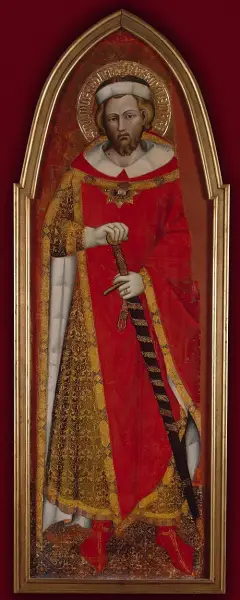
- young man holding a sword
- Canonization
- Pre-congregation; honored as a martyr by the Catholic, Old Catholic, and Eastern Orthodox churches
Prayer
Bibliography
Show 6 sources
- "Festa di S. Ponziano, patrono di Spoleto". Archidiocesi di Spoleto-Norcia (in Italian). 14 January 2013. Retrieved 13 August 2013.
- "Santi e Beati della Diocesi". Archidiocesi di Spoleto-Norcia (in Italian). Archived from the original on 2013-07-27. Retrieved 2013-08-13.
- "St. Pontianus". Catholic Online.
- "Chiesa e Monastero di San Ponziano - Secoli XII-XIII". Comune di Spoleto (in Italian).
- "Monache Canonichesse Regolari Lateranensi". Archidiocesi di Spoleto-Norcia (in Italian).
- "Saint Ponziano of Spoleto". Saints.SPQN.com.
Profile text adapted from the Wikipedia article, licensed CC BY-SA 4.0.
Pray with this saint every day
Save St. Pontianus of Spoleto to your favorites, read the full profile, and get feast-day reminders in the Saints app.
Get the Saints AppFree on the App Store for iPhone and iPad