
fl. c. 26–36·Feast October 27
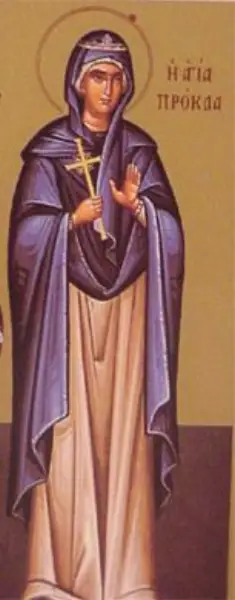
St. Procla, Wife of Pontius Pilate
Wife of Pilate who warned him against condemning Jesus
Overview
The wife of Pontius Pilate is a shadow at the edge of the Passion narrative. The Gospel of Matthew records her only once: as her husband sat in judgment over Jesus, she sent him a message urging him to have nothing to do with the righteous man, because she had suffered much that day in a dream because of him. Scripture leaves her nameless, but Christian memory did not. By the fifth century the Gospel of Nicodemus called her Procula, and that name, in its Greek form Procla, became stable in both East and West; Western tradition later widened it to Claudia Procula. The Eastern churches received her as a convert and intercessor and honor her as a saint, commemorating her on October 27 in the Byzantine tradition and, together with Pilate himself, on June 25 in the Ethiopian and Oriental traditions. Apocryphal writings of the early and medieval centuries enlarged her story: Paul baptizes her, she stands at the cross, she dies a martyr's death beside her husband, and in the Ethiopian Book of the Cock her healed daughters stand beside her in Pilate's court. The West was more divided, reading her dream sometimes as divine warning and sometimes as diabolical deception, yet her figure never left the Christian imagination, from medieval mystery plays to modern novels and film.
The Complete Life
A Nameless Woman in the Gospel
The wife of Pontius Pilate enters history in a single verse. Matthew's Gospel, written near the end of the first century, tells that as Pilate sat on the judgment seat she sent word to him: to spare the righteous man on trial, since a dream that day had left her tormented on his account. She is one of several biblical women identified only through their husbands, and Matthew gives her no name. Whether Pilate was married cannot be proven, though scholars judge it likely; a governor of Judaea between 26 and 37 could lawfully bring his wife to his post, since the old Republican prohibition had been repealed, probably under Tiberius. Many historians nonetheless regard the episode itself as legendary rather than documentary, a scene shaped like the stories in Josephus of noble pagan women drawn toward Judaism. Her name arrived later. The cognomen Procula, Greek Prokla, first surfaces in the fifth-century Gospel of Nicodemus and the sixth-century chronicle of John Malalas and proved remarkably stable in both eastern and western memory. Scholars have proposed origins for it: a consul's death recorded in the Roman fasti of 37, a transcription error that mistook the Latin word procul, meaning far off, for a name, or simply her true cognomen preserved by tradition. The fuller Claudia Procula of Western lore rests on the Pseudo-Dexter Chronicle, a forgery published in 1619, though graves of real women of that name have been found at Beirut, Cyrene, and Patara.
§ Historical and biblical origins
Conversion in the Apocrypha
The earliest testimony to her conversion to Christianity comes from the second-century apologist Origen, and the apocryphal literature took the seed and grew a forest. In the Acts of Paul, written around 160, Pilate's wife is baptized by the Apostle himself and quickly displays the marks of sanctity. The Gospel of Nicodemus, also called the Acts of Pilate, expands Matthew's single verse into a scene: she sends a messenger rather than coming herself, and Pilate, defending her to the accusers of Jesus, describes her as pious and a keeper of the Jewish religion; in some versions both she and Pilate stand at the crucifixion, too grief-stricken to eat or drink. The Paradosis Pilati of the fifth century raises her and her husband to the rank of martyrs, recounting how Tiberius condemned Pilate for the death of Jesus, how Procula already served the Christian God, and how she died of joy upon seeing an angel bear her beheaded husband to heaven. The Evangelium Gamalielis has Pilate crucified for his faith and rescued, the couple baptized by light from heaven, and Procla found dead on the same day as her beheaded husband. The Martyrium Pilati opens with the charitable works of the now-Christian Procula and ends with her, her husband, and their two children crucified twice over for the faith.
§ New Testament Apocrypha
The Dream and Its Meaning
At the heart of her cult stands the dream. The Eastern churches read it without difficulty as a heaven-sent warning, and Procla's intervention on behalf of the righteous man became the warrant for her veneration as a convert and confessor of Christ. The Western tradition was never of one mind. Augustine and Jerome allowed the dream a divine origin without according her the honors of a saint, while an older and harsher line, running through Rabanus Maurus, Bede, and Bernard of Clairvaux and echoed later by Martin Luther, held the dream to be the devil's work, an attempt to derail salvation itself. The early ninth-century Old Saxon Heliand gives that reading dramatic form: Satan fears that if Christ dies, hell will be emptied of sinners, and so plants the dream. In the York Mystery Plays she appears as Dame Precious Percula, her sleep invaded by a devil who first laments the souls he will lose, then whispers that Jesus is innocent. In the Ethiopian Book of the Cock, a text of quasi-canonical standing read during Holy Week, Procla enters Pilate's court with her deaf and mute daughters, whom Jesus heals, writes a letter declaring him the Son of God, and hears him transform it into a blessing upon her. Her whole legend turns on this moment of nocturnal knowledge: a woman awake to Christ while the men around her slept.
§ Later Christian tradition
Widow and Martyr
No historical record follows the wife of Pilate beyond the judgment seat, and even archaeology offers only a tantalizing possibility. In the 1920s a lead sarcophagus was uncovered at Beirut bearing two bracelets inscribed with the name Claudia Procula in Greek; the discoverer dated it to the third century and wondered whether the author of the Gospel of Nicodemus might have taken her name from this very woman, while a later student of the find moved the burial forward to the first century's middle and later decades, judging that an identification with Pilate's wife, remote as it was, could not be dismissed outright. Legend was less cautious. Western story, elaborating Pseudo-Dexter, made Claudia Procula an illegitimate daughter of Julia the Elder, born in exile and legitimized by Tiberius, a member of the imperial house itself. The Slavonic Josephus has Jesus heal her on her deathbed. The apocryphal martyrdoms give her a gallant ending: dying of joy at her husband's heavenly welcome, or found dead on the day of his beheading, or crucified beside him and their children, once by the Jewish authorities and once by Tiberius. The Byzantine iconographic tradition sums her up in two titles that outlast every theory: Governess of Judea, and Widow and Martyr.
§ New Testament Apocrypha
A Saint of the Christian East
Procla's veneration belongs to the East. The Eastern Orthodox Church celebrates her on October 27; the Eastern Catholic Churches keep the same feast, and the Oriental Orthodox and Ethiopian churches honor her together with her husband on June 25, recalling the tradition that Pilate himself repented and died a Christian. Her titles in the Byzantine sacramental memory, Governess of Judea and Widow and Martyr, preserve the two poles of her story: the Roman matron who ruled a household in occupied Jerusalem, and the woman who lost her husband to the consequences of the Passion. The West never canonized her. Western Christianity revered Pilate in some regions and despised him in others, and his wife shared his divided fate: honored in the East, suspect in the West, her dream alternately canonized as grace and condemned as temptation. Augustine, Jerome, and later Calvin defended the divine origin of the dream while withholding her the title of saint; the mainstream Western exegetical tradition, from Bede to Luther, preferred to see the devil in it. Thus her sanctity rests on pre-congregation popular veneration, rooted in the earliest centuries of the church, sustained above all by the Orthodox, Coptic, and Ethiopian communions that have never ceased to keep her feast.
§ Later Christian tradition
The Woman Who Warned Pilate
Art remembered her before theology settled her name. The earliest images of Procula are disembodied heads beside Pilate, mouths open in warning; the oldest surviving example, from Fulda, dates to about 970–980, and full figures standing behind the judge, sometimes whispering in his ear, appear from the eleventh century, especially in German-speaking lands. Medieval drama made her a speaking part, none larger than the York Tapiters' and Couchers' Play. The modern age multiplied her. Aemilia Lanyer in 1611 made her the chief speaker of a defense of womankind, arguing that Pilate's disobedience of his wife undid the curse laid on Eve. Klopstock, Charlotte Brontë, and Gertrud von Le Fort wrote her again, Le Fort's 1955 novel, in which she bears Pilate's guilt and dies a martyr, being perhaps the best known of all. Anne Catherine Emmerich's visions spread her Western name, Claudia Procles, among the devout and put linen for Christ's blood into her hands. Cinema and television have cast her endlessly, from DeMille's King of Kings to The Passion of the Christ and The Chosen, where she consoles the Virgin and pleads for Jesus. A woman given one sentence of scripture now has two thousand years of afterlife.
§ Christian art and plays
Timeline
- 26
Pontius Pilate begins his tenure as governor of Judaea; his wife plausibly accompanied him to his post after the Senate repealed the old ban on governors' wives
§ Historical and biblical origins
- 80
The Gospel of Matthew records the unnamed wife of Pilate sending her husband a warning dream-message on behalf of Jesus
§ Historical and biblical origins
- 160
The apocryphal Acts of Paul depicts Pilate's wife as baptized by the Apostle and quickly showing signs of sainthood
§ New Testament Apocrypha
- 450
The Gospel of Nicodemus first gives Pilate's wife the name Procula and expands her role in the Passion
§ Name
- 450
The Paradosis Pilati presents Pilate and Procula as martyrs: she dies of joy when an angel carries her beheaded husband to heaven
§ New Testament Apocrypha
- 550
The chronicle of John Malalas likewise knows Pilate's wife under the name Prokla
§ Name
- 820
The Old Saxon poem Heliand portrays the dream of Pilate's wife as sent by Satan, fearing the loss of his dominion over sinners
§ Later legends
- 975
The earliest surviving image of Procula, a disembodied head warning Pilate, is made at Fulda, dated about 970–980
§ Christian art and plays
- 1050
Full-body depictions of Procula standing behind or whispering to Pilate begin to appear in the eleventh century
§ Christian art and plays
- 1611
Aemilia Lanyer's Salve Deus Rex Judaeorum gives Pilate's wife the central voice, arguing Pilate's sin undid the curse on Eve
§ Modern reception
- 1619
The Pseudo-Dexter Chronicle, first published that year, preserves the first surviving witness to her name, Claudia Procula
§ Name
- 1955
Gertrud von Le Fort's novel Die Frau des Pilatus portrays Claudia Procula as taking on Pilate's guilt and dying a martyr, baptized in blood
§ Modern reception
In Their Own Words
Have thou nothing to do with that righteous man; for I have suffered many things this day in a dream because of him.
The Record
- Canonization
- Pre-congregation: venerated as a saint by the Eastern Orthodox, Oriental Orthodox, Eastern Catholic, Coptic, and Ethiopian churches; never canonized in the Western Church
Prayer
Bibliography
Show 6 sources
- Bond, Helen K. (1998). Pontius Pilate in History and Interpretation. Cambridge University Press. ISBN 0-521-63114-9.
- Boxall, Ian (2018). "From the Magi to Pilate's Wife: David Brown, Tradition and the Reception of Matthew's Text". In The Moving Text: Interdisciplinary Perspectives on David Brown and Bible. London: SCM Press. pp. 17–36. ISBN 9780334055266.
- Kany, Roland (1995). "Die Frau des Pilatus und ihr Name: Ein Kapitel aus der Geschichte neutestamentlicher Wissenschaft". Zeitschrift für neutestamentliche Wissenschaft und die Kunde des Urchristentums. 88 (2): 104–110.
- Hourihane, Colum (2008). "She Who Is Not Named: Pilate's Wife In Medieval Art". In Between Judaism and Christianity Art: Historical Essays in Honor of Elisheva (Elisabeth) Revel-Neher. Leiden: Brill. pp. 215–239. ISBN 9789004171060.
- Smith, Jill Carington (1984). "Pilate's Wife". Antichthon. 18: 102–107.
- Piovanelli, Pierluigi (2003). "Exploring the Ethiopic "Book of the Cock", An Apocryphal Passion Gospel from Late Antiquity". The Harvard Theological Review. 96 (4): 427–454.
Profile text adapted from the Wikipedia article, licensed CC BY-SA 4.0.
Pray with this saint every day
Save St. Procla, Wife of Pontius Pilate to your favorites, read the full profile, and get feast-day reminders in the Saints app.
Get the Saints AppFree on the App Store for iPhone and iPad