
died 3 December 979·Feast December 3
St. Abraham of Alexandria
Syrian merchant who became sixty-second Coptic Pope
Overview
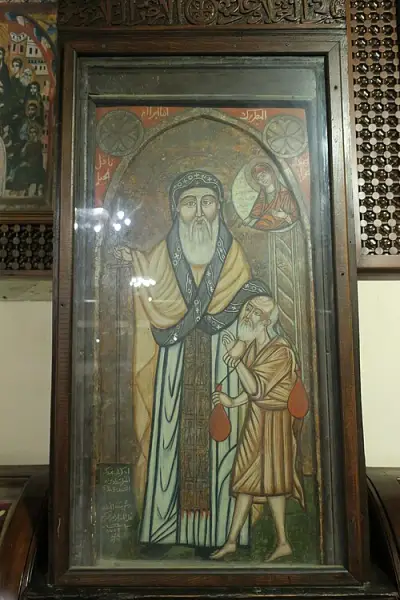
Abraham of Alexandria, known in the Coptic tradition also as Efrem or Ephrem and remembered as Abraham the Syrian, was the sixty-second Pope of Alexandria and Patriarch of the See of St. Mark. Born at Ebn-Zaraa in Syria, he was a wealthy merchant whose trade brought him to Egypt again and again until he settled there, taking up residence in Alexandria. He became known throughout the city for goodness, devoutness, and a singular love of the poor. When the throne of St. Mark had stood vacant for about two years under the Fatimid ruler al-Muizz, the bishops and leaders of the Coptic community gathered to choose a patriarch, and it was Abraham who walked into their midst; convinced that God had sent them their candidate, they elected him unanimously and carried the protesting merchant in iron fetters to Alexandria for consecration. As patriarch he attacked the sale of church offices, disciplined clergy who violated the sanctity of marriage, and gave away half of his considerable wealth to the needy while spending the rest on works of public charity, including pools built across Egypt for the Saint Mercurius Church in Coptic Cairo. He died on 3 December 979 and was buried in the Hanging Church, where his icon is still venerated.
The Complete Life
A Merchant from Syria
Abraham was Syriac by birth, a native of Ebn-Zaraa, and his first life was that of a man of commerce. Wealthy and enterprising, he traveled to Egypt on business repeatedly, and at last remained there, settling in Alexandria. The sources portray him not as an ecclesiastic in the making but as a layman whose distinction lay in character: he was known for goodness, for devoutness, and for a special love of the poor that marked him among the people of the city. Under the Fatimid caliph al-Muizz, the first Muslim ruler of Egypt after the conquest, the Coptic community endured a government ambivalent in its treatment of them, alternating sympathy with abuse and atrocity. It was in this unsettled world that the merchant from Syria lived out his quiet charity, giving to the needy while his business flourished. Only after his ordination did the shape of his generosity become fully visible: he divided his fortune in two, distributing half to the poor and devoting the remainder to building pools of water throughout Egypt, among them the pool of the Saint Mercurius Church in Coptic Cairo, a work of mercy in a land where water is life.
§ Early life
Elected in Iron Fetters
The calling of Abraham to the patriarchate came, in the telling of the Coptic historians, almost by force. The See of St. Mark had been vacant for roughly two years, and the bishops and community leaders of the Copts assembled in the Church of St. Sergius and Bacchus in Cairo to weigh possible candidates. While they were in session, Abraham the Syrian, whom the chronicles call a man given to religion and piety, came into the church. One of those present turned to a bishop and observed that if they were seeking a candidate for the patriarchate, God had just sent them one. The assembled company was struck by the suggestion, examined the man himself, and resolved unanimously to elect him. Abraham protested, but the church would not release him: he was bound in iron and carried off to Alexandria, there to be consecrated as the sixty-second occupant of the patriarchal throne. The story has become one of the treasured legends of the Coptic pulpit, a reminder that the throne of St. Mark has sometimes been filled not by ambition but by the unwilling obedience of a holy layman seized, quite literally bound, for the service of the altar.
§ Election
Reform of the Church of St. Mark
Abraham's patriarchate, though brief, was a season of discipline. His first act upon taking office was to suppress the practice of simony, the buying and selling of sacred office, which had grown into a significant affliction of the church over the course of the last several patriarchates. He then turned to the morals of the church archons, the lay notables who administered much of Coptic communal life, many of whom kept concubines alongside their lawful wives. The patriarch confronted them, and went so far as to threaten with excommunication anyone who continued to violate the sanctity of marriage. These measures made his tenure a moral restoration of a church living uneasily under Fatimid rule, whose government alternated between tolerance and brutality toward its Christian subjects. Alongside this rigor stood the charity that had distinguished him since his merchant days: his wealth, half given to the poor and half spent on pools and waterworks across Egypt, continued to serve the people he now shepherded. He resided at St. Mark's Church and governed the see until his death, having shown that a man conscripted to the altar against his will could rule it with both justice and tenderness.
§ Patriarchate
Death and Veneration
Pope Abraham the Syriac died on 3 December 979 and was buried in the Hanging Church in Old Cairo, one of the holiest sanctuaries of the Coptic world, where an icon of the saintly patriarch is kept and honored. The Coptic Orthodox Church numbers him among its saintly popes and keeps his feast on 3 December, which corresponds to the sixth day of Kiahk in the Coptic calendar, a season of the liturgical year rich in the praise of the Virgin and deeply beloved by Coptic faithful. He was succeeded on the throne of St. Mark by Pope Philotheos, having reigned over a church pressed by the unpredictable rule of al-Muizz and its aftermath. His memory has remained attached to two things above all: the legend of his election, in which a reluctant Syrian merchant was bound in iron and carried to Alexandria because the church believed God had chosen him, and the pooling of his fortune into waterworks for the poor of Egypt. In the long catalogue of the patriarchs of Alexandria, between Mina II and Philotheos, he stands as the sixty-second, and among the saints of the Coptic altar as its most famous convert from the caravan trade.
§ Death
Timeline
- 975
Chosen unanimously by the assembled bishops at the Church of St. Sergius and Bacchus in Cairo and taken to Alexandria, where he is consecrated the 62nd Patriarch
§ Election
- 975
Immediately upon taking office he suppresses the practice of simony that had spread through the previous patriarchates
§ Patriarchate
- 3 Dec 979
Pope Abraham the Syriac dies and is buried in the Hanging Church in Cairo
§ Death
The Record
- Major works
- Pools built throughout Egypt, including the pool of the Saint Mercurius Church in Coptic Cairo
- Canonization
- Pre-congregation: venerated as a saint by the Coptic Orthodox Church
Prayer
Bibliography
Show 4 sources
- Cerulli, Enrico. 1943. Il libro etiopico dei Miracoli di Maria e le sue fonti nelle letterature del medio evo latino. Rome: G. Bardi, page 3.
- "Pope Abraam". CopticChurch.net. Retrieved 2018-03-14.
- Atiya, Aziz S. The Coptic Encyclopedia. New York: Macmillan Publishing Co., 1991. ISBN 0-02-897025-X.
- "البابا أبرام إبن زرعة - البطريرك رقم 62". St-Takla.org. Retrieved 2026-03-30.
Profile text adapted from the Wikipedia article, licensed CC BY-SA 4.0.
Pray with this saint every day
Save St. Abraham of Alexandria to your favorites, read the full profile, and get feast-day reminders in the Saints app.
Get the Saints AppFree on the App Store for iPhone and iPad