
c. 570 – 618·Feast November 8
St. Adeodatus I
First pope to seal his letters with lead
Overview
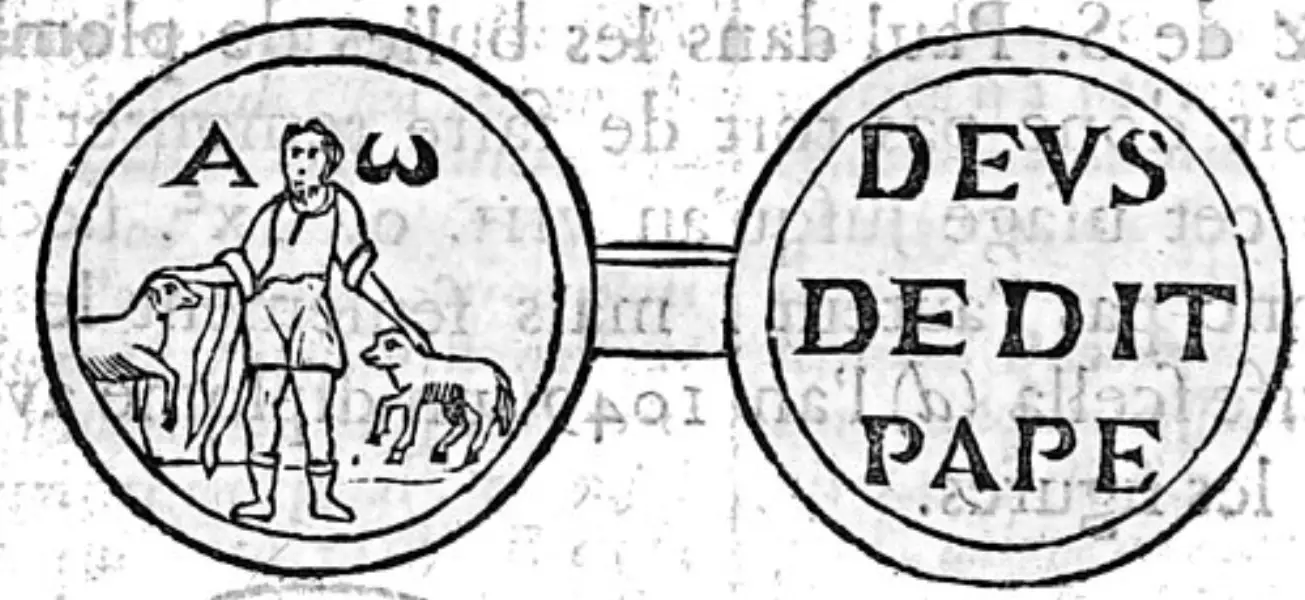
Adeodatus I, also called Deodatus or, in the form he himself used on his seal, Deusdedit, was bishop of Rome from 19 October 615 until his death on 8 November 618. Born at Rome around 570, the son of a subdeacon named Stephanus, he spent four decades as a priest of the Roman church before his election, and he was the first priest raised to the papal throne since John II in 533, an office that in the intervening decades had gone to deacons and monks. His short pontificate fell in the weary years that followed the death of Gregory the Great, and historians read it as a second wave of reaction against Gregory's reforms, after that of Sabinian. Adeodatus undid Boniface IV's policy of handing the papal administration to monks, brought the secular clergy back into those offices, and conferred Holy Orders on roughly fourteen priests, the first such ordinations in Rome since the time of Gregory. Tradition credits him with a quieter revolution: he was the first pope to affix lead seals, bullae, to papal documents, the practice from which the phrase papal bulls descends. One seal from his reign survives, bearing the Good Shepherd amid his sheep, the Alpha and Omega, and the inscription Deusdedit Papæ. He died in November 618, after an earthquake and an outbreak of scabies had struck Rome that summer, and was succeeded by Boniface V.
The Complete Life
A Roman of a Priestly House
Adeodatus was born at Rome around the year 570, into a family already bound to the service of the altar: his father, Stephanus, was a subdeacon. Rome into which he was born was a city of the Eastern Roman Empire, recovering in his childhood from the Gothic wars and the plague years that had emptied its streets. He became a priest of the Roman church, and the sources are emphatic about the length of that service: he labored as a priest for forty years before his election to the papacy. In 590, the very year Gregory the Great was raised from the same clergy to the throne of Peter, Adeodatus was created cardinal by Gregory on 15 October, joining the body of priests who served the great Roman basilicas. Nothing else is recorded of those four decades in the parishes and churches of the city, but their cumulative weight mattered: when the papal electors of 615 looked for a successor to Boniface IV, they passed over the monks who had dominated the previous generations and chose a man formed by long, ordinary priestly service in Rome itself, the first priest elected pope since John II in 533.
§ Biography
Election to the Throne of Peter
Adeodatus was consecrated bishop of Rome on 19 October 615, succeeding Boniface IV, the monk-pope who had converted the Pantheon into a church of the Blessed Virgin and all the martyrs. His election marked a turn in the papacy's internal politics. For over eighty years the see had been filled by men drawn chiefly from the ranks of deacons and monks, Gregory the Great himself being the most famous example; Adeodatus was the first simple priest elevated since John II had been chosen in 533. Modern historians interpret the choice as part of a second wave of opposition to Gregory the Great's papal reforms, the first having come under Sabinian. The Roman clergy, whose influence had waned under the monk-dominated administrations of Gregory, Boniface III, and Boniface IV, now found one of their own upon the throne. The new pope governed for three years, from October 615 to November 618, a span on which the surviving records are thin, but which the sources agree was spent restoring the clergy of the city to the standing they had held before the Gregorian reorganization of the papal household.
§ Pontificate
Restoring the Clergy and Sealing the Church
Almost nothing is known of Adeodatus's pontificate in detail, but the two facts that survive are telling. First, he put an end to Boniface IV's custom of giving the posts of the papal administration to monks: the clergy of the city were summoned back to them, and about fourteen priests received ordination at his hands, the first the Roman church had seen since Gregory the Great's pontificate closed in 604. In a city where the clergy had watched monastic outsiders receive the offices they considered their own, this was a genuine restoration, and the number of ordinations suggests a deliberate rebuilding of the presbyterate. Second, by tradition he introduced the lead seal, the bulla, into the paperwork of the Holy See, the habit from which papal decrees took the name they still carry, papal bulls. One such seal from his reign is still preserved: on one face the Good Shepherd stands amid his flock above the letters Alpha and Omega; the other face bears the inscription Deusdedit Papæ, God's gift, the pope, the name Adeodatus rendered in Latin. A man of whom almost nothing else is known thus fixed a mark on the church's paperwork that has never quite worn away.
§ Pontificate
Earthquake, Plague, and Death
The last year of Adeodatus's life was a dark one for Rome. In August 618 an earthquake struck the city, and in its aftermath came an outbreak of scabies, the itchy skin disease that spread through the weakened population. The pope himself did not long survive these blows: he died on 8 November 618, aged forty-seven or forty-eight, having reigned a little more than three years. He was succeeded by Boniface V, under whom the church of Rome continued the adjustments of the post-Gregorian decades. His feast is kept on 8 November, the day of his death, in the Roman calendar. Though he lived and died in a poorly documented age, the Eastern Orthodox Church numbers him among the pre-Schism Orthodox Popes of Rome, the unbroken line of bishops of the imperial city whom the undivided church of the first centuries honored as saints, and the Catholic Church has always reckoned him in its canon of papal saints. The lead seal he pressed into the wax of his letters outlasted the earthquake and the plague alike, and remains among the oldest surviving physical artifacts of any pope's hand.
§ Pontificate
Timeline
- 570
Born at Rome, the son of a subdeacon named Stephanus, in the Eastern Roman Empire
§ Biography
- 15 Oct 590
Created cardinal by Pope Gregory I while serving as a priest of the Roman church
§ Biography
- 19 Oct 615
Elected bishop of Rome, the first priest to be chosen pope since John II in 533
§ Pontificate
- Aug 618
An earthquake strikes Rome, followed by an outbreak of scabies in the city
§ Pontificate
- 8 Nov 618
Dies at Rome after a three-year pontificate and is succeeded by Boniface V
§ Pontificate
The Record
- Major works
- Introduction of lead seals (bullae) on papal documents
- Symbols
- Lead seal bearing the Good Shepherd, the Alpha and Omega, and the inscription Deusdedit Papæ
- Canonization
- Pre-congregation: venerated as a saint from antiquity in the Catholic Church and among the pre-Schism Orthodox Popes of Rome in Eastern Orthodoxy
Prayer
Bibliography
Show 6 sources
- The Catholic Encyclopedia: An International Work of Reference on the Constitution, Doctrine, Discipline, and History of the Catholic Church. (1913:760). United States: Encyclopedia Press.
- Attwater, Aubrey (1939). A Dictionary of Popes: From Peter to Pius XII. Oxford University Press. p. 66. ISBN 0199295816.
- Jeffrey Richards, The Popes and the Papacy in the Early Middle Ages (London: Routledge and Kegan Paul, 1979), p. 262.
- "Pope Saint Adeodatus I". New Catholic Dictionary. CatholicSaints.Info. 27 July 2012.
- Herbermann, Charles, ed. (1913). "Pope St. Deusdedit". Catholic Encyclopedia. New York: Robert Appleton Company.
- Philips, Fr Andrew. "The Holy Orthodox Popes of Rome". orthodoxengland.org.uk. Retrieved 2018-03-17.
Profile text adapted from the Wikipedia article, licensed CC BY-SA 4.0.
Pray with this saint every day
Save St. Adeodatus I to your favorites, read the full profile, and get feast-day reminders in the Saints app.
Get the Saints AppFree on the App Store for iPhone and iPad