
c. 621 – 676·Feast June 26 (disputed)
St. Adeodatus II
Benedictine monk-pope who resisted Constantinople's heresy
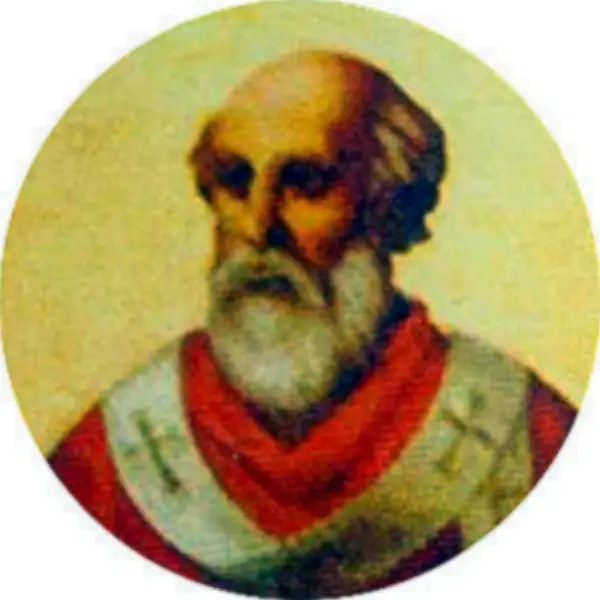
Overview
Adeodatus II, sometimes called Deodatus, was bishop of Rome from 11 April 672 until his death on 17 June 676. Rome was his birthplace about the year 621, his father a man named Jovinianus, and he entered monastic life at the Benedictine monastery of Sant'Erasmo al Celio on the Caelian Hill, and from that cloister he was raised to the throne of Peter in succession to Vitalian, his election being ratified by the Byzantine exarch of Ravenna within weeks, as the constitution of the Byzantine papacy required. His pontificate of four years is extremely obscure, yet it took its stand on two commitments. In the doctrine of the church, Adeodatus refused communion with the Monothelite establishment of Constantinople: he refused the synodical letters dispatched to him by Patriarch Constantine I, and for this his name was struck from the diptychs of the imperial capital, a public break at a time when the memory of the persecuted Pope Martin I and the Confessor Maximus still burned. In the government of the church he improved monastic discipline, restored churches in disrepair, protected the Abbey of Sts. Peter and Paul, exempted Marmoutier Abbey at Tours from the authority of the Holy See, granted Venice the right to choose its own doge, and rebuilt St. Peter's basilica on the Via Portuensis and the monastery of St. Erasmus. His death came on 17 June 676, and Donus took up the throne after him.
The Complete Life
From the Cloister of the Caelian Hill
Adeodatus was born at Rome around the year 621, the son of a Roman named Jovinianus, and grew up in the city as it passed through the last decades of Byzantine rule in Italy. Of his childhood and education the record preserves nothing beyond his parentage, but the turning of his life is known: he became a Benedictine monk at the monastery of Sant'Erasmo al Celio, the ancient foundation on the Caelian Hill dedicated to St. Erasmus. There he lived under the Rule of St. Benedict, in prayer, manual labor, and obedience, within a monastic tradition that Gregory the Great had made dear to the Roman church a lifetime before. He was already a man of about fifty when the papal throne fell vacant in 672, a senior monk of a Roman house rather than a career cleric of the Lateran. The electors of the Roman church chose him in succession to Vitalian, and his age at election suggests they were choosing an experienced figure of settled holiness, a son of the cloister whose whole formation had been Benedictine. It is as a monk-pope, one of the line begun by Gregory himself, that his pontificate should be read.
§ Rise
Election in the Byzantine Papacy
Adeodatus became pope on 11 April 672, at a moment when the bishop of Rome lived under the constitutional arrangements of the Byzantine Empire. No papal election took effect in those years without imperial approval, communicated in Italy through the exarch of Ravenna, the emperor's viceroy; accordingly the ratification of Adeodatus's election reached Rome within weeks of his choice, and only then did his pontificate properly begin. The world into which he was installed was agitated by the aftermath of the Monothelite controversy. Pope Martin I, who had defied the emperors' attempts to impose the doctrine that Christ had only one will, had died an exile and a martyr in the Crimea, and Maximus the Confessor, who had suffered mutilation for the same resistance, had recently ended his own tortured course. A surge of passionate interest in these two confessors ran through the church of the 670s, and any pope who succeeded to the throne of Peter had to decide whether Rome would remember or soften their witness. Adeodatus's answer was given in his first dealings with Constantinople, and it was the answer of the martyrs rather than of the court.
§ Rise
Standing Against Monothelitism
The doctrinal crisis of Adeodatus's pontificate arrived with the routine courtesies of ecclesiastical diplomacy. Patriarch Constantine I of Constantinople sent the new pope the synodical letters by which a newly enthroned patriarch announced his faith and sought communion; Adeodatus rejected them, refusing to acknowledge a patriarchal church whose emperors and bishops still sheltered Monothelitism, the teaching that in the incarnate Christ there is but one will. The rebuke was answered in kind: his name was excluded from the diptychs of Constantinople, the official lists of bishops in communion read at the liturgy, so that for the length of his pontificate the two sees stood publicly estranged. Whatever judgment later historians make of the obscurity of his reign, on this point the monk-pope did not flinch. At the same time he gave the church of his own city and province the quieter gifts of governance: he fostered the discipline of monks, restored churches falling into disrepair, protected the Abbey of Sts. Peter and Paul, later known as St. Augustine's Abbey, and exempted the abbey of Marmoutier at Tours from the authority of the Holy See, a liberty granted to the great community of St. Martin. To Venice, the rising city of the lagoon, his see conceded the right of the Venetians to choose their own doge.
§ Pontificate
Builder of Churches
Adeodatus devoted his reign, in the phrase of the sources, to the improvement of churches, and his final years carried on that work of restoration. Within Rome a basilica honoring St. Peter rose at the eighth milestone of the Via Portuensis, the highway running west toward Ostia's harbor, extending the apostle's patronage along one of the ancient highways; the monastery of St. Erasmus, the very house on the Caelian Hill where the pope had lived as a Benedictine, was reconstructed under his care. These projects belong to a pattern visible across his pontificate: the repair of a Christian city whose monuments were aging after two centuries of war, siege, and plague. Political events claimed little of his attention, and his papacy is judged to have made no outstanding contribution to civil society; its significance lay in the church's inner life, in monastic discipline, in the liberty of abbeys, and in the refusal of doctrinal compromise. He died at Rome on 17 June 676, at about fifty-five years of age, and the vacant throne was soon filled by Donus, another Roman, who carried forward the restoration of the Roman church.
§ Pontificate
A Disputed Sanctity
The memory of Adeodatus II has always stood at the edge of the calendar. Popular devotion styled him a saint and assigned his feast to 26 June, the day following his death; he even appears in the traditional catalogue of popes who are saints of the Catholic Church, a list that runs from Peter through the early medieval pontiffs. Yet the cult is disputed. The latest official edition of the Roman Martyrology, promulgated after the Second Vatican Council, appears not to include him, and the devotions that once kept his June feast have no firm attestation in the early sources. What is certain is the outline of his reign: a Benedictine of Sant'Erasmo who resisted the Monothelite patriarchate of Constantinople at the cost of liturgical rupture, disciplined and favored monks, freed an ancient abbey, granted Venice its doge, and rebuilt the churches of his city. He died in 676 and was succeeded by Donus, and with that the sources nearly close. The disputed sanctity suits the man the record reveals: a pope whose public act was to reject a lie told about Christ, and whose other works were all of the kind that leaves no legend, only roofs mended and monks corrected.
§ Pontificate
Timeline
- 621
Born at Rome in the Byzantine Empire, the son of Jovinianus
§ Rise
- 11 Apr 672
Elected pope in succession to Vitalian, having been a Benedictine monk of Sant'Erasmo al Celio in Rome
§ Rise
- 672
Weeks after his choice the exarch of Ravenna confirms the election, as the custom of the Byzantine papacy demanded
§ Rise
- 672
Rejects the synodical letters of Patriarch Constantine I of Constantinople, and his name is excluded from the diptychs of that see
§ Pontificate
- 17 Jun 676
Dies at Rome after a four-year pontificate and is succeeded by Donus
§ Pontificate
The Record
- Major works
- Reconstruction of St. Erasmus' monastery·Building of the Basilica of St. Peter at the eighth milestone of the Via Portuensis·Grant to Venice of the right to choose its doge
- Canonization
- Disputed: sometimes called a saint with a feast on 26 June, but he appears not to have been included in the latest official edition of the Roman Martyrology
Prayer
Bibliography
Show 6 sources
- "Pope Adeodatus II (Adeodatus) [Catholic-Hierarchy]". www.catholic-hierarchy.org. Retrieved 27 February 2021.
- Attwater, Aubrey (1939). A Dictionary of Popes: From Peter to Pius XII. p. 74.
- Kelly, J N D (2010). A Dictionary of Popes. Oxford University Press. p. 74. ISBN 978-0-19-929581-4.
- "Adeodatus II". Encyclopædia Britannica. Retrieved 3 August 2015.
- Martyrologium Romanum, ex decreto sacrosancti oecumenici Concilii Vaticani II instauratum auctoritate Ioannis Pauli Pp. II promulgatum, editio [typica] altera, Typis Vaticanis, A.D. MMIV (2004) ISBN 88-209-7210-7.
- Herbermann, Charles, ed. (1913). "Pope St. Adeodatus". Catholic Encyclopedia. New York: Robert Appleton Company.
Profile text adapted from the Wikipedia article, licensed CC BY-SA 4.0.
Pray with this saint every day
Save St. Adeodatus II to your favorites, read the full profile, and get feast-day reminders in the Saints app.
Get the Saints AppFree on the App Store for iPhone and iPad