
died 8 July 885·Feast July 8
St. Adrian III
Pope who died journeying to settle an empire's succession
Overview
Adrian III, also written Hadrian III, was bishop of Rome and ruler of the Papal States from 17 May 884 until his death on 8 July 885, a pontificate of little more than a year set in one of the darkest hours of the Italian people. Born at Rome, he succeeded Marinus I and labored hard to relieve a population prey to famine and continuous war. His brief reign also reached outward: he addressed a letter of rebuke to the Christians of Spain, subjects alike of Muslim and of Christian rulers, reproaching their intimacy with the Jews among whom they lived, and he dispatched Theodosius, bishop of Brindisi and Oria, to Constantinople carrying a synodal letter on faith and the filioque addressed to the patriarch Photius I, continuing Rome's doctrinal exchange with the East. In the summer of 885 the emperor Charles the Fat summoned him to an Imperial Diet at Worms in the Rhineland to settle the imperial succession and to confront the rising power of the Saracens. Adrian set out on the journey but died at San Cesario sul Panaro, near Modena, before he could reach the assembly. He was buried in the church of San Silvestro at Nonantola Abbey, where his tomb immediately became a place of popular pilgrimage, commemorated a century later in the sculpted reliefs of the abbey doorway, and where his relics rest near the high altar. Leo XIII confirmed his cult on 2 June 1891.
The Complete Life
A Roman of Uncertain Name
Adrian III was born at Rome, in the Papal States over which he would one day rule, in the middle decades of the ninth century. Even his baptismal name is a matter of learned dispute. The seventeenth-century Benedictine scholar Jean Mabillon recorded that the pope's birth name was Agapitus, but the modern historian Reginald L. Poole argued that Mabillon had mistaken Adrian III, Marinus I's successor, for Agapetus II, who took the throne a full hundred years after Marinus II; the doubt has never been wholly resolved. What is certain is his Roman origin and his rise through the Roman clergy to the papal throne at a moment when the see of Peter passed from pope to pope with dizzying speed. The papacy of his generation was an Italian institution entangled in the wreckage of the Carolingian order: the empire of Charlemagne's descendants was fracturing, Saracen raiders held bases in the south of Italy, and the city of Rome itself knew violence around contested elections. In May 884, on the death of Marinus I, the Romans chose Adrian to succeed him, and he was installed as bishop of Rome on 17 May of that year, beginning a reign that would last barely fourteen months.
§ Background
A Troubled Italy and a Letter East
Adrian's pontificate was defined by the misery of the Italian people, who suffered alike from famine and from continuous war. The sources record that he labored hard to alleviate their condition, spending his short term in the practical works of relief that a starving province demanded of its bishop. His government of the church also had a doctrinal and diplomatic reach. He is known to have written a letter concerning the Christians of Spain, addressing communities living under both Muslim rule and Christian rule and reproaching their friendliness toward the Jews of those regions, a document that survives as evidence of the hardening attitudes of the ninth-century Latin church. Toward the East he pursued the thread of negotiation with the patriarchate of Constantinople, sending Theodosius, the bishop of Brindisi and Oria, as his envoy to Photius I, carrying a synodal letter on faith and on the filioque, the doctrine of the double procession of the Holy Spirit that stood at the center of Roman-Byzantine disagreement. He thus took up, in the year of his short reign, both the pastoral care of a broken land and the great doctrinal conversations of his age.
§ Pontificate
The Journey to Worms
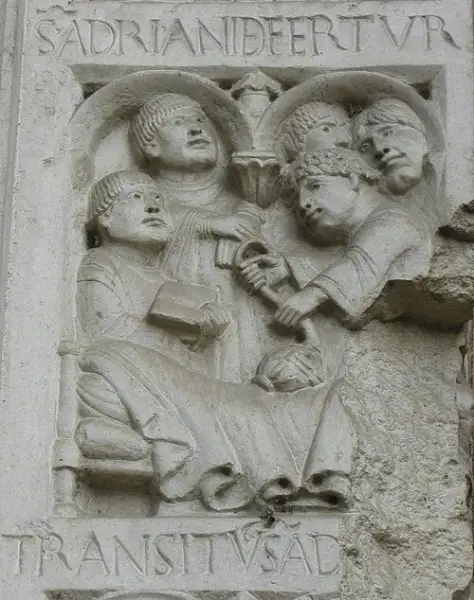
In the summer of 885 the emperor Charles the Fat, last of the grandsons of Charlemagne to rule the reunited empire, summoned Pope Adrian to the north. The purpose of the summons was an Imperial Diet to be held at Worms, in the Rhineland, where the emperor wished to settle the imperial succession, for Charles had no legitimate heir, and to take counsel on the rising power of the Saracens, whose raiding parties threatened Italy from their strongholds. Adrian set out from Rome on the long road across the Alps, an undertaking of many weeks for a pontiff governing a famine-stricken land. He never completed the journey. At San Cesario sul Panaro, near Modena on the road through Emilia, he died on 8 July 885, little more than a year after his election. The assembly at Worms went on without him, and the succession question he had been called to help resolve helped bring the Carolingian empire to its final partition. His body was carried to the neighboring Abbey of Nonantola and buried in its church of San Silvestro, where his death and burial were later commemorated in the sculpted reliefs, carved about 1122, that still frame the doorway of that church.
§ Pontificate
Tomb, Pilgrims, and Canonization
The death of Adrian far from Rome, in the generous soil of the abbey that received him, produced one of the quietest saint-making movements of the Middle Ages. Pilgrims began flocking almost immediately to his grave in San Silvestro's church at Nonantola Abbey by Modena, and his relics were placed beside the high altar. A century after his death, the craftsmen of the abbey carved the sculpted reliefs, dated about 1122, that frame the doorway of San Silvestro and depict the pope's death and burial, making his story part of the very stone through which pilgrims entered. The Eastern Orthodox churches also keep his memory, with feasts on 8 and 30 July. In the Catholic Church his ancient cult received formal confirmation when Pope Leo XIII canonized him at Rome on 2 June 1891, enrolling Adrian among the popes recognized as saints. His feast is celebrated on 8 July, the day of his death on the road to Worms. He stands in the long roll of early medieval pontiffs whose sanctity grew not from length of reign but from the manner of their service: a year of famine relief, a letter East, and a death in obedience to a summons.
§ Pontificate
Timeline
- 17 May 884
Chosen to succeed Marinus I as bishop of Rome and ruler of the Papal States
§ Pope Adrian III
- 885
Summoned by Emperor Charles the Fat to an Imperial Diet at Worms to resolve who should succeed to the empire and deliberate on the Saracen menace
§ Pontificate
- 8 Jul 885
Dies at San Cesario sul Panaro near Modena, not long after setting out for Worms
§ Pontificate
- 1122
Sculpted reliefs framing the doorway of San Silvestro at Nonantola Abbey commemorate his death and burial there
§ Pontificate
- 2 Jun 1891
Pope Leo XIII confirms his cult at Rome, enrolling the medieval pope among the saints
§ Pontificate
The Record
- Major works
- Letter on the Christians of Spain·Synodal letter on faith and the filioque sent to Patriarch Photius I
- Canonization
- Canonized by Pope Leo XIII on 2 June 1891 in Rome, confirming the ancient cult that arose at his tomb
Prayer
Bibliography
Show 7 sources
- Reginald L. Poole (1917), "The Names and Numbers of Medieval Popes", The English Historical Review, 32 (128), 465–78, at 467.
- Monks of Ramsgate. "Hadrian III". Book of Saints, 1921. CatholicSaints.Info. 1 September 2013.
- Bernard S. Bachrach (1977). Early Medieval Jewish Policy in Western Europe (reprint ed.). University of Minnesota Press. p. 190. ISBN 9780816608140.
- Dvornik, Francis (1948). The Photian Schism. CUP Archive. pp. 228–230. Retrieved 20 January 2024.
- Richard P. McBrien, Lives of the Popes: The Pontiffs from St. Peter to John Paul II, (HarperCollins, 2000), 143.
- François Bougard (2002), "Hadrian III", in Philippe Levillain, ed., The Papacy: An Encyclopedia, vol. 2 (New York and London: Routledge), 682.
- "АДРИАН III РИМСКИЙ - Древо". drevo-info.ru (in Russian). Retrieved 2023-05-13.
Profile text adapted from the Wikipedia article, licensed CC BY-SA 4.0.
Pray with this saint every day
Save St. Adrian III to your favorites, read the full profile, and get feast-day reminders in the Saints app.
Get the Saints AppFree on the App Store for iPhone and iPad